7 Active AI Voice Cloning Tools Compared in 2026
Summary: Still struggling to find the best voice cloning AI tools? Overwhelmed by the countless options? Read this article to explore 9 best AI voice cloners based on my real tests, each tool's strengths and weaknesses to help you find the perfect voice cloning solution.
A cloned voice can sound convincing in a short demo and still lose consistency across a chapter, podcast, or video. The best voice cloning AI depends on the finished asset, not a single realism score.
I compared nine AI voice cloning tools and status entries across audiobook production, podcast editing, video narration, developer access, and voice cloning for singing. The reviews below separate active candidates from a discontinued service and a historical option whose current availability is uncertain.
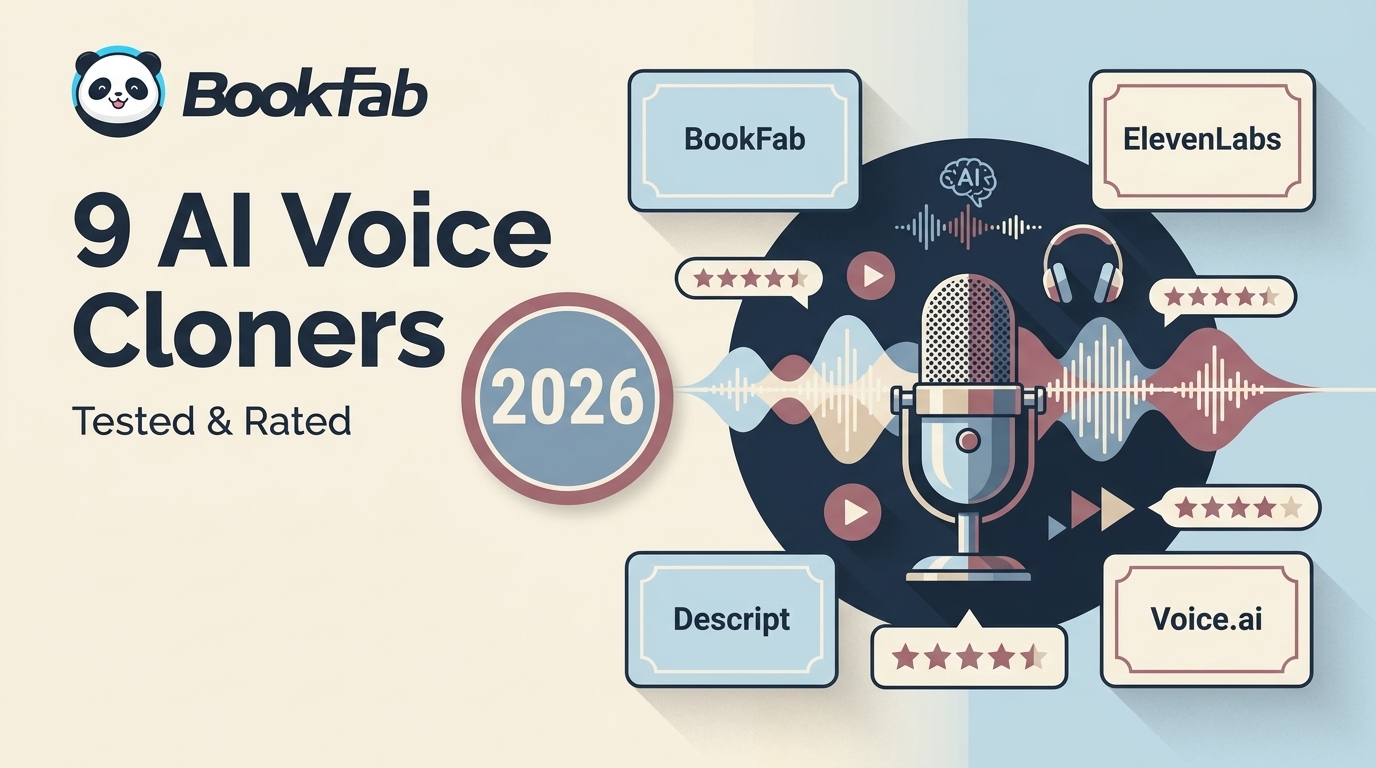
How We Tested These Voice Cloning Tools
The useful test is not whether a clone speaks one clean sentence. It is whether the voice stays recognizable, follows the script, handles pauses and pronunciation, and produces an export that fits the intended project.
The main comparison prioritizes active tools across different production needs.The six-tool comparison table is limited to active candidates with comparable setup, language, control, and usage-limit details.
- Voice match: Does the result preserve recognizable tone and pacing without sounding strained?
- Sample consistency: Does the service explain how recording noise, changing distance, or uneven delivery affects the clone?
- Production control: Can the user adjust pauses, speed, volume, pronunciation, emotion, or role assignment where the task needs it?
- Usable output: Can a free or paid account export enough audio for the stated audiobook, podcast, or video job?
- Consent and privacy: Does the service present clear speaker authorization, retention, deletion, or disclosure controls?
This produces a more useful best AI voice cloning comparison than a bare score. A best voice cloner for a short social clip may be the wrong choice for a multi-chapter audiobook.
Testing Workflow
The testing workflow held the script and listening criteria steady while recording each tool's setup, sample requirements, export behavior, and notable limitations.
- Set up the account: Record the requested information, consent step, and available trial access.
- Prepare the sample: Use clear speech at a steady distance, without music or changing room noise.
- Create the clone: Follow the service's recommended sample path and note any quality warnings.
- Generate the same script: Listen for similarity, naturalness, text accuracy, pronunciation, pauses, and audio clarity.
- Check the export: Confirm what can be downloaded, edited, reused commercially, or assigned to a larger project.
I registered an account on each service and followed the available setup flow. I entered the same test script, compared the same audible traits, and used those observations to form the scenario-based rankings.
Best AI Voice Cloning Tools Compared
These reviews show why the best voice cloning software changes with the job. Book-length narration rewards stable profiles and chapter-ready output, while video and podcast work benefits from editing tools around the cloned voice.
BookFab AudioBook Cloud Enhancer
BookFab AudioBook Cloud Enhancer is designed around voice cloning for audiobooks, with desktop voice-profile creation and switching inside AudioBook Creator. It suits creators who need several narrators or character voices in one book, rather than a mobile-only or fully local engine.

I recorded a 3–5 minute sample directly in the app. The 4.8/5 similarity and naturalness scores reflect that result.
The longer sample asks more of the speaker than instant cloning tools, but the resulting profile can be reused and switched inside an audiobook project. When I assess narration, I listen beyond the first sentence: chapter pacing, pronunciation, and a clear change between character profiles matter more over a full book.
Use voice samples and source text that you are authorized to access. Local audiobook outputs should remain within the permissions attached to the source material, the relevant platform terms, and applicable law.
How to Create and Use a BookFab Voice Profile
Step 1. Add a clear voice sample
Open BookFab, enter the My Voice area, and upload a recording or record directly in the app. A steady 3–5 minute sample gives the system enough consistent speech to build the profile.

Step 2. Review the profile
Open the finished task, choose an avatar, and add descriptive tags that make the voice easy to find when several profiles are stored.
Step 3. Assign the voice to an audio project
Use the profile in Text to Audio or assign it inside AudioBook Creator. For a multi-character title, switch profiles where the speaker changes and listen to the transition before exporting the full chapter.

ElevenLabs
ElevenLabs is strongest when natural delivery and multilingual narration matter. Instant Voice Cloning supports quick samples, while longer-form projects may need more careful pronunciation work and closer attention to credit use.

I tested IVC. After I uploaded the sample, the system quickly generated a usable cloned voice.
The output kept a natural cadence, but the clone was sensitive to background noise, changing microphone distance, and uneven speaking speed. Rare words may require spelling changes or another generation, so a long script can consume credits through pronunciation corrections. It works well for polished narration, but not for a project that needs extensive regeneration on a tight allowance.
Vocloner
Vocloner keeps the cloning task focused, with short sample options and separate standard and higher-control speech modes. It is a useful best voice clone AI candidate when style controls matter more than an attached video editor.

In my tests, the result was close enough to my recorded voice that someone could mistake it for me. I did not notice background noise.
The standard mode has less expressive pitch and shorter pauses. Higher tiers add tone and emotion controls, which makes Vocloner more useful for dialogue or advertising reads than the basic mode. The fit is weaker when the project also needs timeline editing, avatar creation, or a local desktop engine.
Descript
Descript connects voice cloning with transcript-based podcast and video editing. Its advantage is not the closest voice match in this test; it is the ability to revise spoken content in the same editor used for the finished episode.

Uploading my sample script was smooth. Descript's cloned voice does not closely resemble my natural tone and rhythm.
The audio remained clear and expressive, with fewer awkward pauses than several higher-similarity results. That trade-off makes sense for correction lines and podcast edits, but less so when an audiobook narrator's identity must remain recognizable across many chapters.
Mango AI
Mango AI places voice cloning inside an avatar and short-video toolset. It is better suited to compact visual content than long narration, especially when a creator wants a talking image or avatar without moving audio into another editor.

In my testing, processing time from submission to downloadable result was typically under five minutes. For example, the first time I generated audio for 89 characters, it resulted in over a minute of length, with long silences in the middle and choppy sound; the second time it was normal.
Short phrases matched pitch and tempo more reliably than longer or emotionally complex lines. The variation between generations makes it a weaker choice for chapter-length narration, where pauses and timing must remain consistent from one section to the next.
Play.ht Status and Alternatives
Play.ht should not be treated as a current voice cloning service. Reports place its permanent shutdown on December 31, 2025, so old plans, prices, and interface instructions no longer support a 2026 buying decision.

For natural multilingual narration, ElevenLabs covers the closest active use case in this list. Descript is more relevant when the cloned voice must stay inside a podcast or video edit, while BookFab addresses desktop audiobook narration and repeatable voice-profile assignment.
Uberduck
Uberduck's current availability and pricing are uncertain. Earlier versions of Uberduck AI focused on short creative voice and music experiments, but they are not dependable evidence of a current production service.

The historical output showed recognizable similarity but also background noise, uneven volume, short pauses, and occasional overlap between phrases. That profile is more relevant to experimentation than scheduled narration, client work, or a book project that needs stable service access.
VEED.io
VEED.io makes sense when the finished asset is a video rather than a standalone audio file. Voice cloning sits beside timeline editing, captions, clips, and export settings, which reduces handoffs between separate tools.

The cloned speech was clear, but its similarity to my sample was limited and the pacing needed more natural pauses. I would use it for a video correction or avatar narration where the edit matters as much as the voice, not for a long-form project built around a distinctive narrator.
Voice AI
Voice AI combines cloning with role assignment, text-to-speech, and real-time voice features. It has a Windows desktop option, while free web access has tighter export limits, so the usable format matters before a project is started.

The overall tone and voice closely resemble my own, and I can hear the AI mimicking the subtle human breath before speaking.
The same test also produced a fast speaking rate, very short pauses, and a static-like sound before the voice began. Multi-role controls are useful for character work, but the free web tier's download restriction limits it as a free AI voice cloner for finished projects.
Scoreboard and Final Rankings
The six active candidates below have enough comparable information for a compact decision table. Sample and setup sit beside the intended use so the reader can see both the production goal and the effort required.
| Tool | Best for + sample/setup | Languages | Delivery controls | Free/paid use |
| BookFab AudioBook Cloud Enhancer | Audiobooks; 3–5 min desktop sample | Japanese and English | Reusable profiles; multi-character switching | 3,000-word/account trial; paid desktop use |
| Elevenlabs | Natural narration; 10–30 sec IVC sample | Multilingual | Natural prosody; pronunciation may need regeneration | Free: 10,000 credits/month; cloning on paid tier |
| Vocloner | Style control; 10–90 sec sample, 25 sec preferred | English clone tested | Speed, volume, tones on higher tiers | Free: 1,000 chars/day; paid from $5/month annually |
| Descript | Podcasts/video; guided script recording | English clone tested | Transcript and timeline editing | Free: custom clone plus 5 min transcription |
| Mango AI | Avatar/video; 10 sec sample | 7 output languages | Basic delivery; variable long-text stability | Free: 5 uses/month, 200 words/output |
| Veed.io | Video voiceovers; short recorded prompt | English clone tested | Speed, volume, timeline editing | Free: 1 cloning attempt; paid tiers unlock cloning |
Figures in this table are stated as of August 2026. In a close result, I would give more weight to stable exports and a clear usage limit than to a tenth of a point in a listening score.
Choose a Tool by Use Case
The best AI voice generator is the one that produces the asset you actually need. Starting with the destination prevents an audiobook project from being forced through a short-video tool, or a podcast edit through a clone-only interface.
Audiobooks, Podcasts, and Video
- Audiobooks: BookFab supports reusable voice profiles and switching inside AudioBook Creator. ElevenLabs is the stronger online option when multilingual naturalness outweighs desktop book integration.
- Podcasts: Descript is useful for correction lines and transcript-based edits because the clone and episode timeline share one editor.
- Video and avatars: VEED.io connects the cloned voice to a conventional video timeline. Mango AI is more focused on talking images, avatars, and short visual content.
- Mobile-first use: Browser tools are easier to reach from more devices, but a best voice cloning app still needs a workable export path. BookFab's current fit is Windows desktop rather than mobile-only creation.
API, Business, and Singing
Developer access, business controls, and voice cloning for singing are separate requirements. A service can perform well for narration without exposing the integration or musical controls needed for those jobs.
- Developer API: ElevenLabs is the clearest candidate in this group when generated speech must be connected to an application, but usage costs should be modeled around repeated generations, not just the first successful line.
- Business production: Descript or VEED.io reduces file movement when the final deliverable is an edited podcast or video. Confirm account-level commercial rights, speaker consent, and deletion controls before involving client voices.
- Singing and character experiments: Treat musical voice tools as a distinct category. The narration scores here do not establish pitch tracking, melody control, or current service reliability for a singing project.
Voice Samples and Delivery Controls
Sample cleanliness and delivery control affect voice cloning quality more than a universal minimum duration. A steady recording with consistent distance gives the model a clearer target than a longer clip with music, echoes, or changing performance.
Sample Length and Setup Time
Short-sample tools reduce setup, while longer recordings can capture more of a speaker's pacing. The sample should match the intended delivery: conversational speech for podcasts, sustained narration for audiobooks, and compact lines for avatar clips.
- Record in one room with a fixed microphone distance.
- Keep speed and vocal energy consistent across the sample.
- Exclude music, another speaker, long silences, and sharp volume changes.
- Read enough connected text to expose pauses and sentence endings, not just isolated words.
Emotion, Prosody, and Pronunciation
Prosody means the rhythm, stress, and pitch that shape how a sentence is delivered. It becomes important when a clone must carry dialogue, emphasis, or long passages without flattening the meaning.
ElevenLabs produced natural phrasing but sometimes needed another generation for rare words. Vocloner adds more tone and emotion control on higher tiers, while Descript's editing context can be more valuable than exact similarity. After a model update, regenerate a short reference passage before committing a long script.
Languages, Safety, and Privacy
Multilingual voice cloning is useful only when the accent, pronunciation, consent process, and export rights remain workable in the target language. Language count alone does not show how a service handles names, code-switching, or regional delivery.
Language and Accent Coverage
The table distinguishes verified language information from an English-only test observation. For multilingual projects, create the sample in the language and accent the final script will use, then check names, numbers, sentence endings, and any switch between languages before producing a full recording.
Open-Source and Local Options
Open source voice cloning is a separate branch from these cloud services. Local execution can keep samples on the user's machine, but setup, model selection, storage, and hardware requirements shift more responsibility to the operator.
A local engine suits someone who can maintain the software and values direct control over files. A cloud service is easier to start and may include editing or API features, but voice samples are processed under the provider's retention and account policies. Neither branch is a universal winner.
Consent, Watermarks, and Data Retention
A safe voice cloning check should happen before the sample is uploaded. Read the service's speaker-authorization step, retention period, deletion method, and synthetic-audio disclosure or watermark policy as separate items.
- Confirm that the speaker has approved the specific project and intended audience.
- Check whether samples and trained profiles can be deleted from the account.
- Review whether generated audio carries a watermark, identifier, or disclosure requirement.
- Separate account access from project permission; a login does not grant rights to another person's voice.
Pricing and Free-Tier Limits
A free tier is useful only when it lets the user complete a meaningful export. Compare characters or minutes, clone count, regeneration cost, download access, and commercial rights together instead of treating a free signup as free production.
What You Can Actually Export
Vocloner's current paid tiers are Basic at $5, Pro at $19, and Advanced at $39 per month when billed annually.
For a long script, estimate at least one correction pass for names and difficult phrases. Voice AI's free web access, for example, may generate speech without allowing a finished download, while a video editor's free tier may limit the number of cloning attempts rather than the text length. There is no dependable voice cloning AI free unlimited option in this group.
Legal and Ethical Notes
AI voice cloning can be lawful in the United States, but the answer depends on consent, impersonation, publicity rights, privacy, the intended use, and applicable state law. Use voices and content that you are authorized to access and reproduce.
Privacy and Responsibility
A voice sample can function as biometric data, so account security and deletion controls deserve the same attention as audio quality. Public or client-facing synthetic speech should be disclosed when listeners could reasonably mistake it for an authentic recording.
When You Need Permission
Written permission is important when cloning another person's voice for advertising, monetized media, customer communication, or a public performance. Permission should identify the project, channels, duration, and whether the voice model may be reused.
State publicity and impersonation rules differ, and a familiar public voice does not become free to copy because recordings are easy to find. For a disputed commercial use or a voice connected to a public figure, legal advice should come from a qualified attorney familiar with the relevant state.
FAQs
These answers add quick boundaries that are easy to miss when comparing demos and plan pages.
Is it legal to clone a voice in the United States?
It can be, particularly for your own voice or a speaker who gave informed permission. Risk rises when the output imitates another person in advertising, fraud, political messaging, or other public uses. Document the permission and match it to the exact project rather than relying on a general verbal approval.
Do any voice-cloning tools offer unlimited free use?
Not among the dependable options compared here. Free access commonly limits characters, minutes, clone attempts, downloads, or commercial rights. For a book or recurring show, calculate the allowance after likely pronunciation corrections; the first clean demo can understate the amount of generation the project will consume.
Can I run voice cloning locally or with open-source software?
Yes, but local use shifts the trade-off from account limits to setup and hardware. It may suit a technically comfortable user who wants samples to stay on one machine. A modest laptop may struggle with larger models, and local software may not include the editing, hosting, or consent screens built into a cloud service.
What makes a voice sample produce a more stable clone?
Consistent distance, room sound, pace, and vocal energy matter more than chasing one universal sample length. Include full sentences with natural pauses, then compare a short reference script before adding more audio. If the clone drifts, replace the noisy or inconsistent sample rather than repeatedly regenerating the same text.
Final Thoughts
The strongest choice follows the finished asset. BookFab is built around desktop audiobook voice profiles, ElevenLabs emphasizes natural multilingual narration, Descript supports podcast edits, and VEED.io or Mango AI keeps the voice close to a video project.
Before committing a long script, create one representative passage and listen for pronunciation, pacing, pauses, and export behavior. For an audiobook, I would also switch between two voice profiles and check the chapter transition; a convincing single sentence does not prove that a whole book will remain comfortable to hear.
 21 Audiobook Websites Compared: Free Online Listening, No Download RequiredBy Amber Collins - Oct 20, 2026
 2 Ways to Download audiobook.jp on PC: MP3 and Unlimited Titles.By Amber Collins - Aug 26, 2026
 4 Easy Ways to Remove Audible DRM in 2026: Tool Reviews and TutorialBy Amber Collins - Aug 26, 2026
 EPUB to Audiobook: 5 Tools for MP3, M4B, and Read-AloudBy Amber Collins - Aug 26, 2026