
Can You Read Apple Books on Kindle? 4 Transfer Paths

Summary: Apple Books and Kindle use separate ecosystems and incompatible DRM. To read Apple Books or iBooks on Kindle, you need to remove Apple's FairPlay DRM first, convert the books to EPUB or AZW format, and then transfer the iBooks to your Kindle via the Send to Kindle service or USB. This article will provide a detailed, step-by-step tutorial on how to read Apple Books on your Kindle.
Apple Books on Kindle is possible when you have an exportable, DRM-free EPUB or PDF file. Send to Kindle can accept those files, but an Apple Store purchase is not directly exportable through that service.
To transfer Apple Books to Kindle, first identify whether you have an exportable personal EPUB or PDF. Eligible files can usually go directly through Send to Kindle; conversion is needed only when the file is unsupported, malformed, or being prepared for a direct USB transfer. The four delivery paths are Share to Kindle on iPhone or iPad, web or desktop upload, email, and USB.
Q: Is it possible to transfer a book I bought in the Apple Books to my kindle??
Choose a Path for Your Apple Books
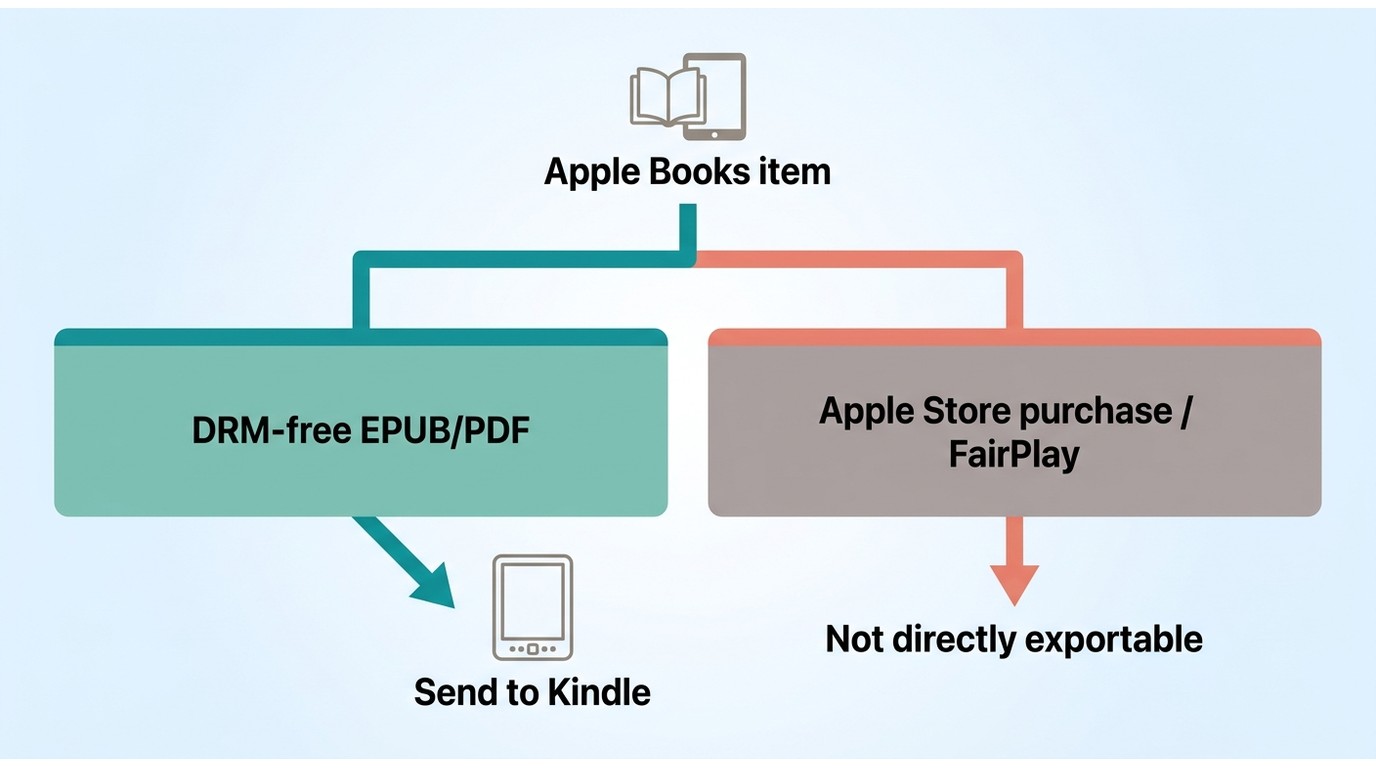
Start with the file’s origin. An EPUB or PDF that you added to Apple Books and can access without restrictions may follow an official Send to Kindle route. A purchased Apple Store title may remain tied to Apple’s account and protection system, so it requires a separate rights and compatibility assessment. For content you’re authorized to access, where permitted by platform terms and applicable law, the Apple Books DRM removal reference explains the separate access question.
ViWizard iBook Copy Status
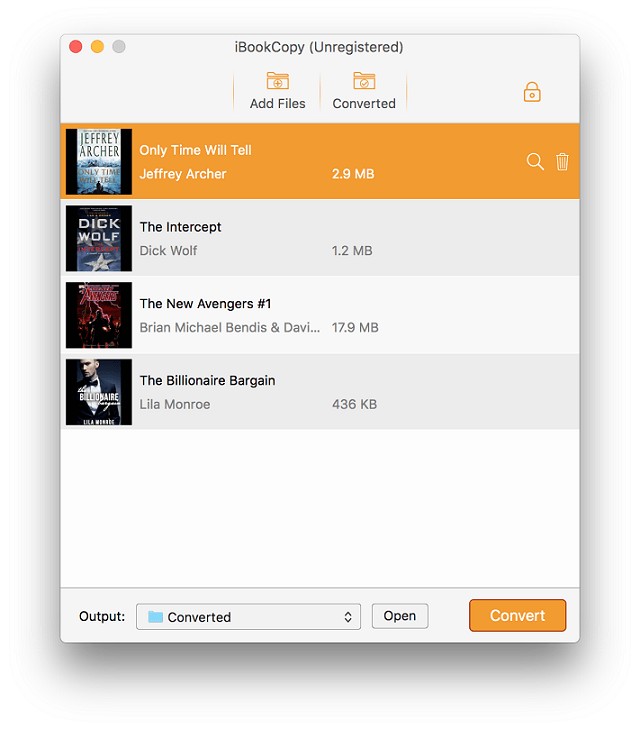
ViWizard iBook Copy is a legacy product rather than a current general-purpose route. Its official product page lists support only through macOS 10.12 or earlier, and the current ViWizard download center no longer lists iBook Copy.
Compatibility should be checked before relying on any legacy Apple Books utility.
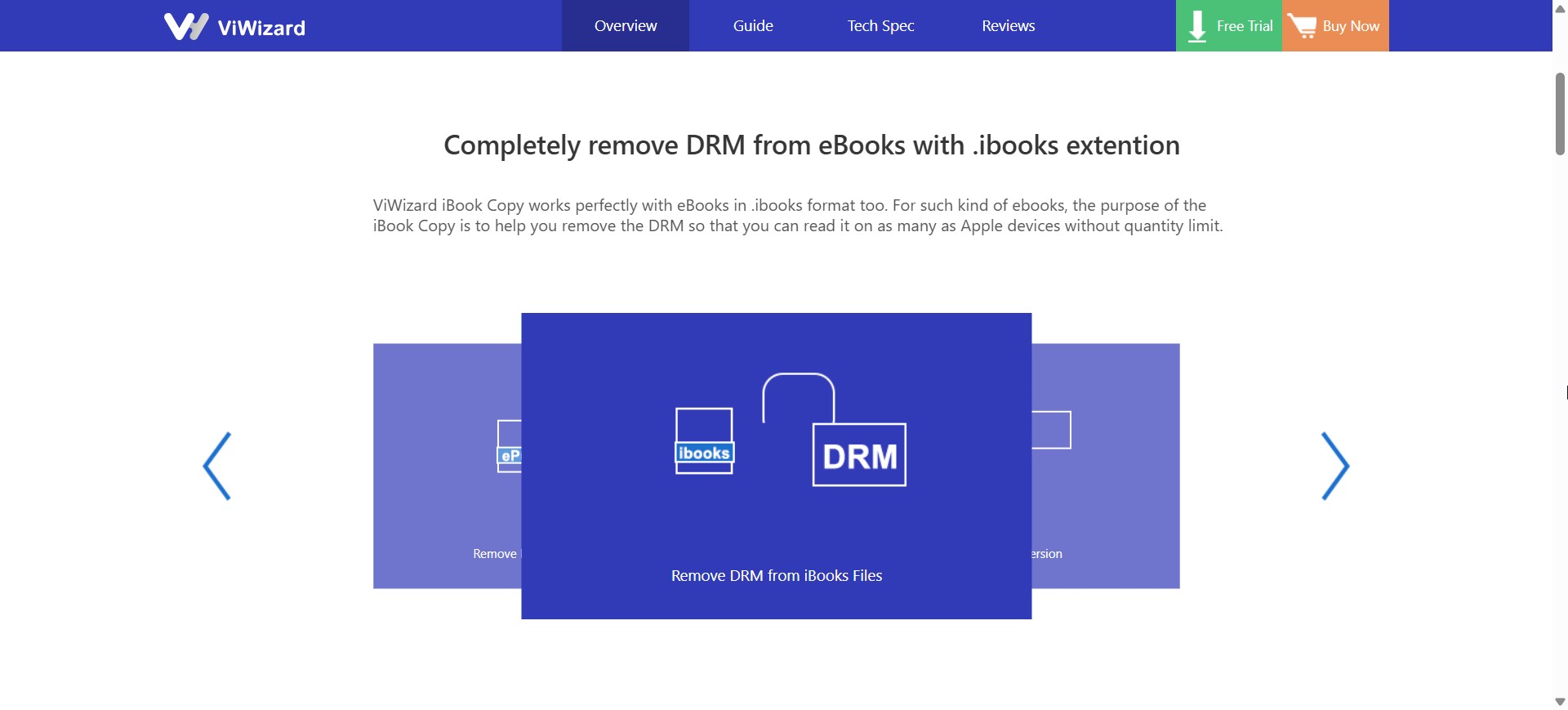
The product page’s older support range means its installation and file behavior should not be assumed on a current Mac.
RemoveBooksDRM: Advanced Mac Option
RemoveBooksDRM is an active open-source project for technically advanced Mac users. It changes system security settings, so it is not beginner-friendly and should not be treated as a routine transfer step. For content you’re authorized to access, where permitted by platform terms and applicable law, the official Send to Kindle path is preferable whenever the source file is already an eligible EPUB or PDF; no command sequence or conversion is needed in that case.
Convert Only When the File Needs It
An eligible EPUB does not need conversion before Send to Kindle. Conversion becomes relevant when an accessible file is malformed, uses a format that the chosen route does not accept, or is being prepared for a direct USB transfer. Calibre can convert and organize common eBook formats, but it is not a universal answer for Apple Store purchases. If your immediate goal is an iBook to PDF file for a fixed-page reading or printing need, use PDF only when that layout is useful on the target device.
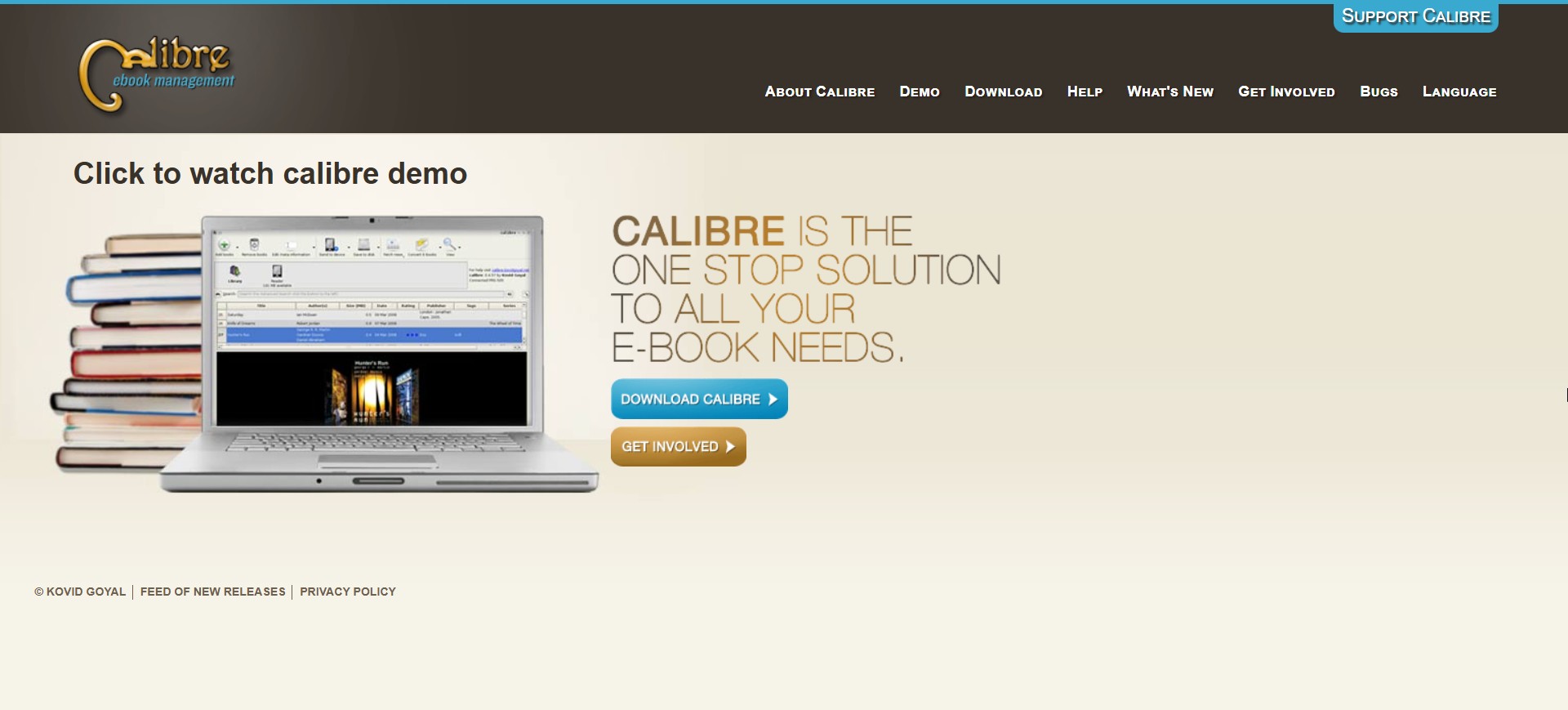
Using Calibre for an eligible file
Calibre is useful when you need to adjust an accessible eBook before sending it or when you are preparing a local file for USB transfer. It is less suitable when the source is only an Apple Books library item with no exportable file.
Step 1. Download Calibre on your Mac, Windows, or Linux Device
- Download and install the Calibre software on your device, ensuring it matches your specific system requirements. Then, run the software.
Step 2. Add .epub iBooks to Calibre
- To load iBooks EPUB e-books in the software, just press the Add Books button. Or, you can simply drag and drop the books into the main interface.
- After adding a new book, it will be positioned at the top of the book list.
- After the iBook files have been successfully loaded into the software, you can choose the e-books menu list and press the Convert books button.
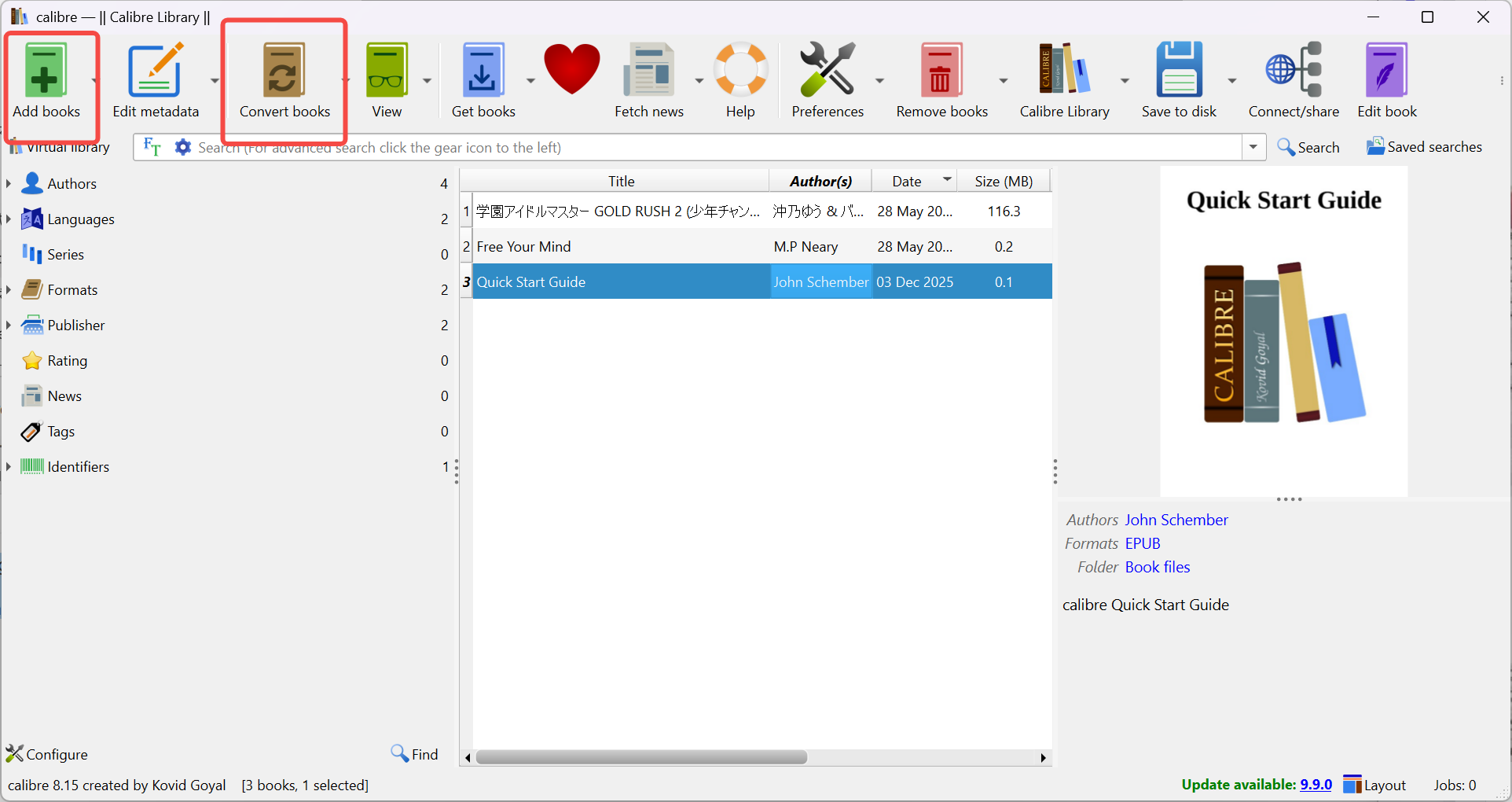
Step 3. Specify the Output Settings and Start Converting
- A window for eBook conversion will appear, prompting you to select the output format for the resulting eBooks. Be sure to choose a Kindle-compatible format. Send to Kindle accepts eligible EPUB files, so they do not need to be converted to MOBI for email delivery. For USB, select a compatible local format based on the Kindle device you plan to use.
- Once you have configured the settings, click the OK button at the bottom of the interface to initiate the conversion of the iBooks files to Kindle format.
Send Eligible Files to Kindle
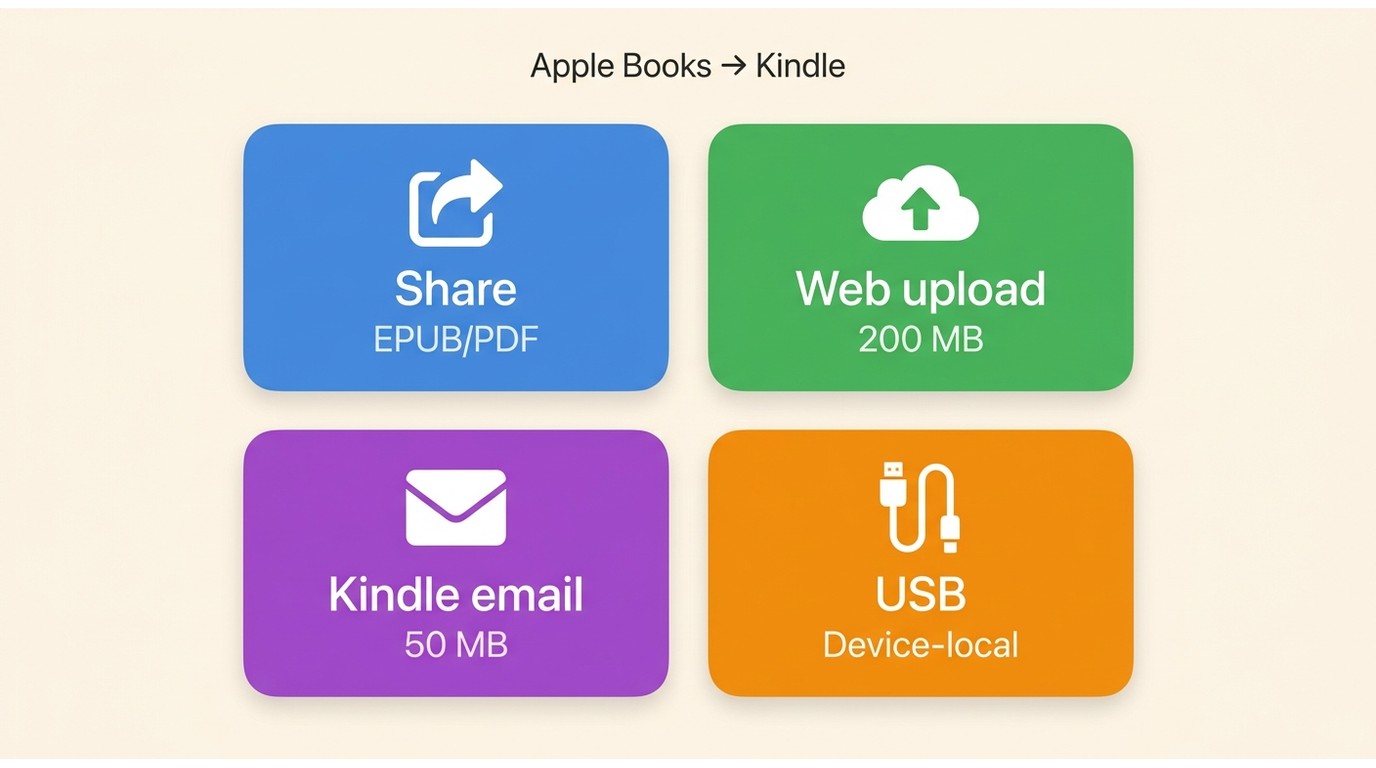
Once you have an eligible EPUB or PDF file, you can send it to Kindle through an official delivery route or copy a compatible local file over USB. The right route depends on whether you want Kindle library synchronization, a mobile share action, or a device-local copy.
| Route | Eligible file | Where | Size limit | Useful for |
|---|---|---|---|---|
| iPhone or iPad Share | EPUB or PDF | Kindle app | App-dependent | Files already on iOS |
| Web or desktop upload | EPUB or PDF | Send to Kindle | Up to 200 MB | Larger eligible files |
| Kindle email | EPUB or PDF | Approved sender | 50 MB total | Smaller files |
| USB | Compatible local file | Kindle storage | Device storage | Device-local copies |
Send to Kindle formats and limits are listed as of August 2026.
iPhone and iPad Share to Kindle
On iPhone or iPad, select or export an eligible EPUB or PDF, tap Share, choose Kindle, and then sync the Kindle library. A book visible in Apple Books may not exist as an exportable file in Files. For user-added DRM-free files, this is the simplest transfer route; it does not make a protected Apple Store purchase exportable.
Send to Kindle Formats and Limits
Send to Kindle accepts eligible EPUB and PDF files. Web uploads can be up to 200 MB, while email attachments may total up to 50 MB.
Send by Kindle Email
In your Amazon account settings, find the Kindle email address for your device and add your sending address to the Approved Personal Document Email List.

- Email an eligible EPUB or PDF to the Kindle email address from an approved personal email address.
- Total attachments may be up to 50 MB per email. This route works well for smaller files and established approved email addresses, but it is less suitable for large documents.
- Connect your Kindle to Wi-Fi and sync the library after sending.
Method 2. Transfer iBooks to Kindle using a USB connection
- Connect the Kindle to a computer with a USB cable and open the device storage.
- Copy a compatible local file to the device’s document folder. USB creates a device-local copy; it does not provide the same Kindle library synchronization as Send to Kindle. This route suits readers who already have a compatible file and want direct device transfer.
Use Send to Kindle on Desktop
- Open Send to Kindle on the web or use the supported desktop route on your computer.
- Sign in when prompted and upload or drag an eligible EPUB or PDF into the sending interface.
- Select the destination Kindle device or library option and send the file. Web upload is preferable for larger eligible files, while desktop use suits readers already organizing files on a computer.

Why You Can't Read Apple Books on Kindle Directly
A Kindle does not directly open an Apple Books library item because the item may be tied to Apple’s account system, stored in a non-exportable form, or presented in a format that needs processing. The file’s origin matters more than the Apple Books app label.
DRM Protection on iBooks
Purchased Apple Books may use FairPlay, Apple’s digital rights management system, which can tie the title to the purchasing account and Apple reading environment. By contrast, an EPUB or PDF that you added yourself may be DRM-free and available for Send to Kindle.
When a purchased title remains protected and tied to Apple’s reading system, Send to Kindle cannot treat it as an ordinary personal document. Paying for access does not automatically create an exportable file, and Apple does not provide a standard Send to Kindle export for those purchases.
EPUB Support and Format Limits
File format still matters, but EPUB is not automatically excluded. Send to Kindle accepts eligible EPUB and PDF files and processes them for the Kindle library. A Kindle e-reader does not simply open an Apple Books library item in place, and an EPUB extension alone does not prove that the file is valid, exportable, or free of access restrictions.
Fix Common Transfer Problems
When a transfer fails, check file visibility, validity, and eligibility before changing the delivery method. If the book is visible only inside Apple Books, it may not be exportable through Files. If Send to Kindle rejects an EPUB, confirm that it is a complete, readable file rather than a renamed container. If the file still has access restrictions, its EPUB extension does not change its eligibility. If the cover or metadata changes, review the source title, author, cover, and chapter information before resending. A USB copy can also be used for a compatible local file when cloud delivery is not the goal.
FAQs
Q
Will my Apple Books highlights and notes sync to Kindle?
Sending a compatible file to Kindle does not migrate Apple Books reading progress, highlights, or notes into Kindle sync. The transfer creates a Kindle copy, not a shared annotation history between the two ecosystems.
A
Q
Why can’t I find an Apple Books file in the Files app?
An item visible in Apple Books is not necessarily an exportable file in Files. Purchased titles and user-added EPUB or PDF files follow different access rules, so the Files app may show only the files you originally saved or imported.
A
Q
Can I send the same EPUB to a Kindle app and a Kindle Paperwhite?
An eligible EPUB sent through Send to Kindle can appear in the Kindle library after processing and synchronization, including on supported Kindle apps and e-readers. A direct USB copy is device-local and does not provide the same cross-device library behavior.
A
Q
Why did my cover or metadata change after transfer?
Send to Kindle or an intermediate conversion can change how cover art, title, author, and other metadata are handled. Check the source file’s metadata before sending it again, especially if the cover or chapter information is important to your library.
A
Conclusion
Whether an Apple Books item can move to Kindle depends on its origin, access restrictions, file format, and delivery route. Start with an EPUB or PDF that you are authorized to access, and use Send to Kindle when the file is eligible. Convert only when the source file or chosen USB route requires it. Purchased Apple Store titles are a separate rights-and-compatibility case, and no route should be treated as a promise that every book will work on every Kindle.

 How to Download Kindle Books in 2026: 5 Current OptionsBy Amber Collins - Aug 26, 2026
![How to Convert Kindle Books to EPUB Easily [2026 Verified]](https://r5.dvdfab.cn/upload/bookfab/en/convert-kindle-to-epub-RDlf.jpg) How to Convert Kindle Books to EPUB Easily [2026 Verified]By Amber Collins - Aug 26, 2026
How to Convert Kindle Books to EPUB Easily [2026 Verified]By Amber Collins - Aug 26, 2026 Kindle DRM Compatibility in 2026: What Still WorksBy Amber Collins - Aug 25, 2026
![[Quick Solution] How to Remove Kindle DRM on Mac](https://images.dvdfab.cn/media/未命名的设计__87__crpyru.png/public) [Quick Solution] How to Remove Kindle DRM on MacBy Amber Collins - Aug 24, 2026
[Quick Solution] How to Remove Kindle DRM on MacBy Amber Collins - Aug 24, 2026