BookFab Kindle Converter Review: EPUB/PDF Support in 2026

Summary: Unlock and convert your DRM-protected Kindle eBooks securely, even after Amazon’s latest 2026 DRM updates. Discover BookFab’s Auto Scan workflow for privacy, compatibility, and account safety—plus practical steps to keep your Kindle library future-proof.
Table of Contents
BookFab Kindle Converter at a Glance
Here's the short answer: BookFab Kindle Converter is a Windows app that reads Kindle books you've already downloaded through the official Kindle app and outputs them as EPUB or PDF for personal offline reading, provided your acquisition route is one it currently supports. Whether it will work for your specific title depends on your Kindle app version, the file type, and the current BookFab build.
If you searched for a BookFab Kindle review, you probably want to know three things before spending time or money: does it still work with the books I bought this year, what does the output actually look like, and are there limits on the free trial? This article walks through each of those, plus where the tool fits alongside Calibre and Epubor, and where it doesn't.
My editorial view up front: BookFab is worth trying when you already have a working local download route through the Kindle app; it's not the right pick if you can't get the book onto your PC in the first place, since no converter fixes that.
- You can still convert Kindle eBooks legally and safely - but outdated tools no longer work.
- Prioritizing account safety and reading freedom is essential in 2025.
- BookFab adapts to the latest Kindle DRM ecosystem.
If you're worried about losing your eBook library or your Kindle account, you're definitely not alone - and we're here to help you do it right.
What Changed for Kindle Conversion in 2026
From AZW Downloads to KFX Workflows
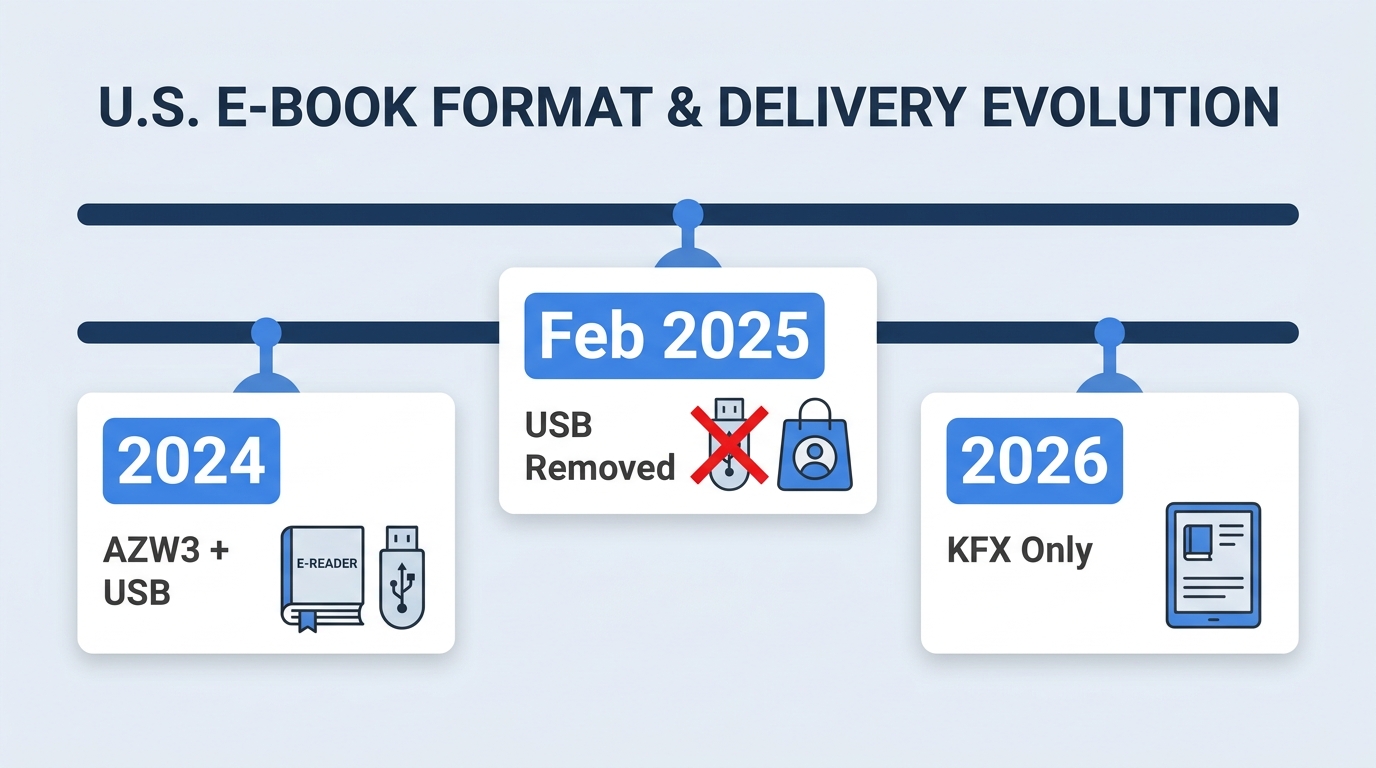
As of August 2026, the biggest shift readers have to plan around is the end of Amazon's "Download & Transfer via USB" option, which shut down for new purchases in February 2025[1]. That option used to hand you an AZW3 file you could open in Calibre or a compatible tool. It's gone.
What remains: books are still delivered through the Kindle apps on Windows, Mac, iOS, Android, and to registered Kindle devices over Wi-Fi, generally as KFX. That means a converter now has to work from files a supported Kindle app has already placed on your computer, rather than from a fresh USB export. Whether any given book is readable by a converter depends on your Kindle app version, the device or app route it was delivered to, and the specific KFX variant on that title.
Because current KFX variants behave differently across app versions, practical KFX DRM removal methods should be evaluated against the file route and title you actually have.
DRM Timeline (2024–2026)
| Date | Key Event |
| Early 2024 | Kindle for PC 2.x enforces full KFX encryption |
| Feb 2025 | USB book transfer permanently closed by Amazon |
| Apr–Jul 2025 | Widespread report: Calibre/DeDRM & Epubor break on new KFX files |
Why Older Methods Fail by Route
Calibre with the community DeDRM plugin and Epubor Ultimate are both still actively maintained, and both still work for a lot of readers — but the practical success rate now varies by Kindle app version, firmware on your Kindle device, the title, and the KFX variant. When conversion fails, you'll typically see errors like "KFX Input: unable to open" or "Title cannot be copied to library." That is often less about the converter and more about the file the Kindle app placed on your machine: a book that arrived via an older Kindle app build may open cleanly, while the exact same title downloaded through a newer build won't.
In other words, "does tool X still work?" is the wrong question in 2026. The right question is: which combination of Kindle app version, device, and title is currently supported by the tool I'm choosing?
Common Challenges Readers Run Into
- Newly purchased titles that a third-party tool cannot open
- "Login required" or "unable to open KFX" prompts mid-conversion
- Uncertainty about what the current Kindle app version actually allows
- Confusion about where personal-use backup ends and platform terms begin
- The closure of USB download and KFX-only delivery represents a watershed for eBook ownership.
- Relying on old workflows is now a recipe for frustration and security risk.
- Users must rethink not just the tools but also the process of safe eBook conversion.
If you feel like Amazon changed the rules just when you'd mastered the old ones, trust us - so does most of the reading world!
BookFab Workflows and Output Options
Built-in Browser Download
BookFab historically offered a built-in browser so you could sign in to your Amazon account inside the app and pull books straight into the conversion queue. That path is still available, but it has become less reliable over time: Amazon's login flow now includes multi-factor prompts and anti-automation checks that any embedded browser has to keep pace with, and each Kindle update can change what the built-in browser sees.
Practically, this route works best when you want a one-window experience and are comfortable retrying occasionally; it's not the route I'd pick if you already have a working local Kindle library.
Auto Scan and Local File Detection
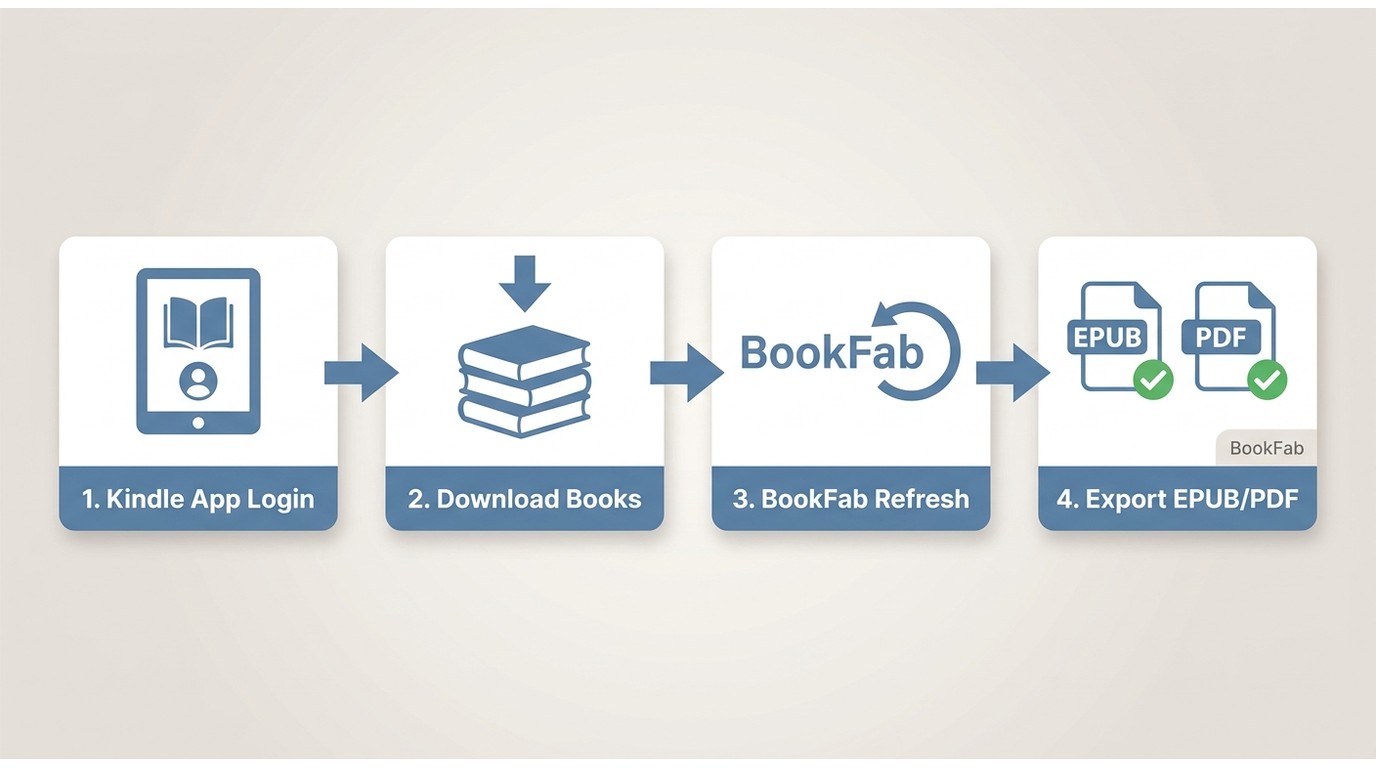
Auto Scan is the mode I'd steer most readers to, with one prerequisite: the book has to already be on your PC through the official Kindle app. There's no folder-picking; BookFab looks at the Kindle app's local library, and a refresh click brings your titles into the queue. Because you sign in to Amazon in the Kindle app rather than in BookFab, your Amazon credentials are not entered into BookFab at all.
Process at a glance:
- Install and sign in to the Kindle app on Windows
- Download the titles you want, locally, through that app
- Click refresh in BookFab to scan the local Kindle library
- Choose EPUB or PDF and run the conversion
If a title never finishes downloading in the Kindle app, Auto Scan has nothing to work with. That's the honest Edge case — a converter is not a fix for Kindle not downloading books in the first place.
EPUB, PDF, Metadata, and File Quality
BookFab outputs EPUB and PDF and aims to preserve the cover, title, author, and chapter structure so the file is usable in a regular reader app rather than a bag of loose pages. Text-heavy novels generally reflow well as EPUB; illustrated books, manga, and titles with heavy fixed layouts tend to be more faithful as PDF, at the cost of larger file size. Exact fidelity varies by title and source file, so if layout matters to you, test one book with the free trial before buying. For the specific KFX to EPUB and PDF workflow, the dedicated walkthrough goes deeper than this review.
- "Auto Scan" is now the safest and most future-proof method for Kindle eBook conversion.
- BookFab's workflow keeps your login credentials out of reach from all third parties.
- Relying on cloud-based or integrated browser syncing exposes users to security risks and sudden failure due to Amazon DRM updates.
Browser Download vs Auto Scan: How to Choose
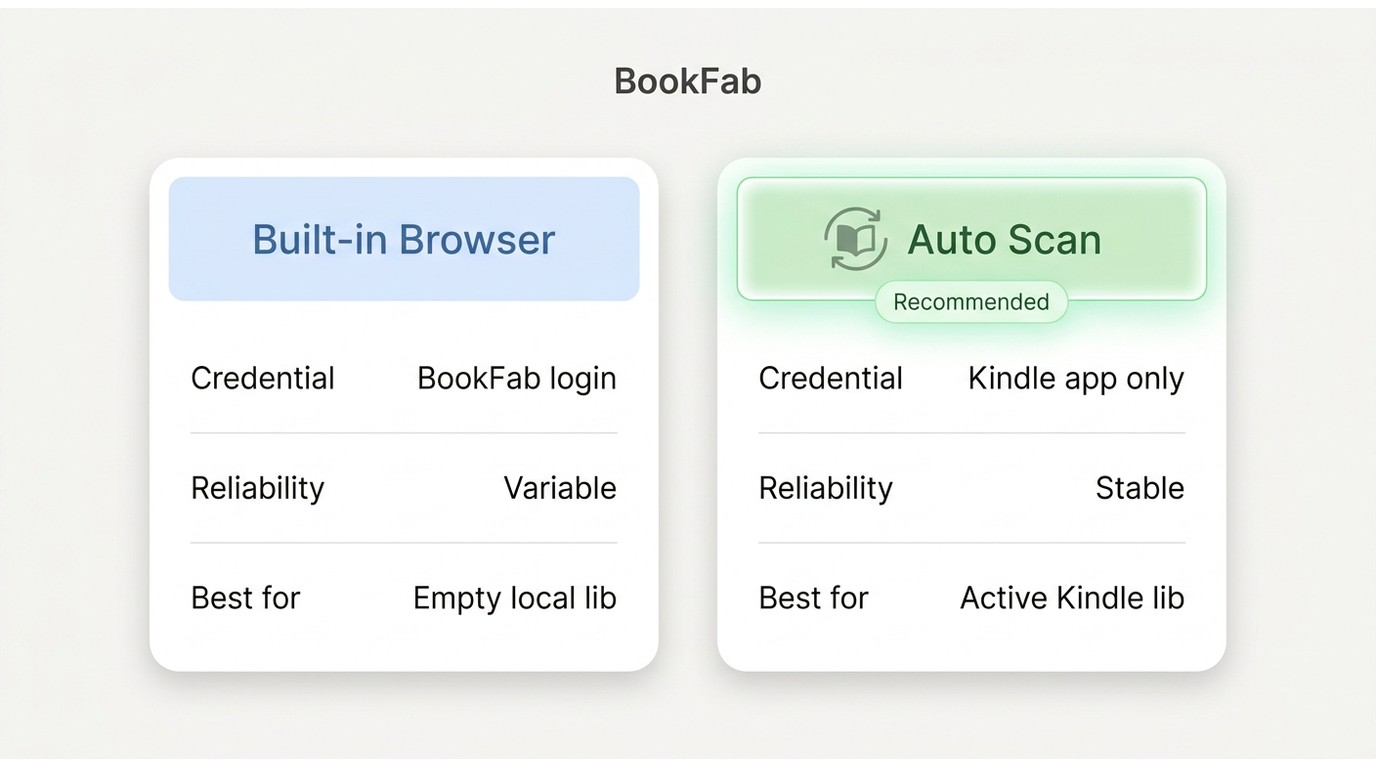
Workflow Comparison
The two modes solve different problems. Built-in Browser tries to keep everything in one window: you sign in, pick a book, and the tool handles the rest. Auto Scan splits the job — the Kindle app handles authentication and download, BookFab handles the local file. In my testing that split is what keeps Auto Scan predictable across Kindle updates: when Amazon changes the sign-in flow, the Kindle app absorbs the change and Auto Scan keeps reading local files the same way.
Privacy and Process Separation
Splitting acquisition from conversion has two concrete effects. First, your Amazon password is entered into the Kindle app, not into BookFab, so BookFab doesn't need to store or transmit those credentials. Second, when Amazon updates its sign-in flow, only the Kindle app has to adapt; the local-file step in BookFab is unaffected. It does not, however, remove all account or platform risk — how a converter is used still sits under Amazon's terms and your local law.
Who Each Workflow Suits
Auto Scan fits readers who already keep a working Kindle app library on Windows and mainly want a cleaner file for offline reading. Built-in Browser is more relevant when your local Kindle library is empty or partial and you'd rather stay in one window; expect to retry more often when Amazon's login changes. If you can't get the title to download through the Kindle app at all, neither mode helps until that step is resolved.
Browser Download vs Auto Scan
| Feature | Browser Download | Auto Scan (BookFab) |
| Reliability | Unstable, often blocked | Highly stable |
| Account security | At risk of ban | Account never touched |
| Conversion success | Fails on new KFX | Handles latest KFX |
| Privacy | Credentials exposed | Credentials local only |
| Legal compliance | Dubious | Follows official flow |
- "Easy" browser tools often become unusable overnight as Amazon deploys new blocks.
- BookFab's Auto Scan workflow prioritizes both user freedom and account protection.
- Making the extra manual step now prevents much bigger pains down the road.
Account Safety and Legal Boundaries
The reasonable question to ask is what a local-file workflow actually changes about risk. In Auto Scan mode, BookFab reads files the Kindle app has already saved to your PC and processes them locally; it does not sign in to your Amazon account or transmit your credentials. That reduces one specific exposure — credential sharing with a third-party app — but it does not eliminate every account, platform, or legal risk. How the resulting file is used still falls under Amazon's terms and applicable law.
The compliance line I'd draw for readers: this is a tool for content you're authorized to access, used to create a personal offline copy, where permitted by platform terms and applicable law. It is not a tool for sharing or redistributing files, and no converter changes that.
- Account bans and library wipes are a proven, real-world risk with server-based converters.
- BookFab's 100% local workflow ensures your privacy, and your books, remain yours.
- Security is about more than encryption - it's about controlling what information you expose, and to whom.
Current Compatibility and Alternatives
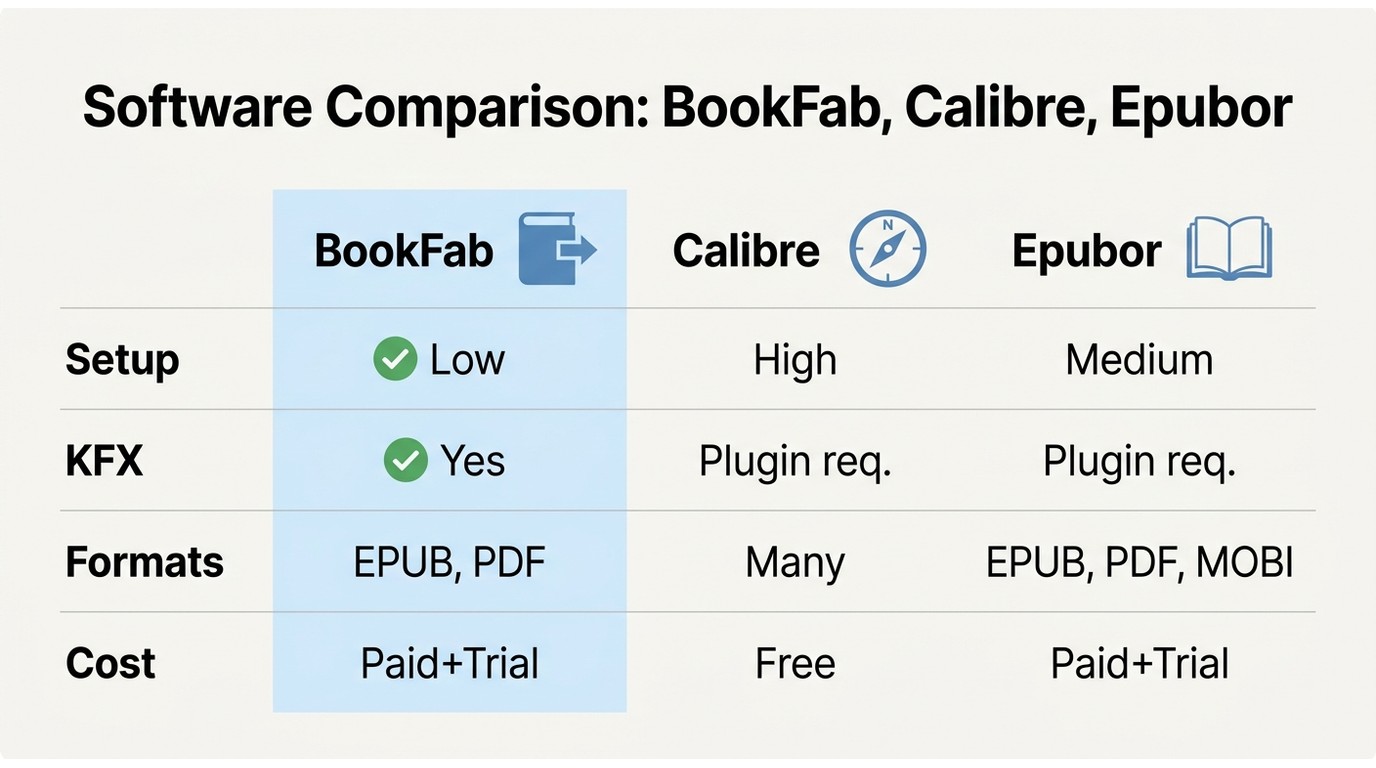
Tested Routes and Known Limits
Rather than claim universal support, it's more useful to describe what BookFab reliably handles today: Kindle books downloaded locally through a supported Kindle app version on Windows, output to EPUB or PDF, with cover, title, author, and chapter data preserved. Where results get variable: brand-new releases the day they land, heavily illustrated titles, books that only partially downloaded, and files coming from very recent Kindle app builds that any converter — BookFab included — may need an update to read. If a specific title matters, the trial exists precisely so you can confirm before committing.
BookFab, Calibre, and Epubor
For sibling context, if you're comparing broader approaches to handling Kindle files for personal use, the practical choice usually comes down to setup tolerance and which acquisition route you already have working.
| BookFab vs. Others (as of July 2025) | ||||
| Converter | KFX v10+ Support | USB Path Needed | Amazon Login Needed | Status |
| BookFab | Yes | No | No | Actively maintained, reliable |
| Epubor Ultimate | No (as of 2025) | Sometimes | Yes | Fails on newest books |
| Calibre w/DeDRM | Partial/No | Yes (legacy) | No | Fails or unstable |
Troubleshooting by Acquisition Route
When something goes wrong, it helps to separate the stage where it broke:
- The title won't download. That's an acquisition problem, not a converter problem. Check that you're signed in to the right regional Amazon account, that the Kindle app is up to date, and that the title actually finished syncing before you open BookFab. The Kindle book download guide covers this stage in more detail.
- BookFab doesn't detect a local file. Click refresh after the Kindle app finishes; if the file is partial or paused, Auto Scan will skip it.
- Conversion fails on a specific title. Try a different title first to isolate whether the issue is title-specific (often a new release or a heavy fixed-layout book) or environmental.
- The output looks off. For illustrated or fixed-layout titles, try PDF instead of EPUB; expect file size to grow accordingly.
- Compatibility and updates are crucial: BookFab leads with robust support for the latest KFX.
- Competing converters struggle with post-2025 changes, especially USB removal and enhanced encryption.
- Choosing a security-focused tool also means choosing one that reliably keeps up with Amazon's evolving
🛡️ Savvy readers know: the best tools are the ones still working after the next big update!
Safe Conversion Practices
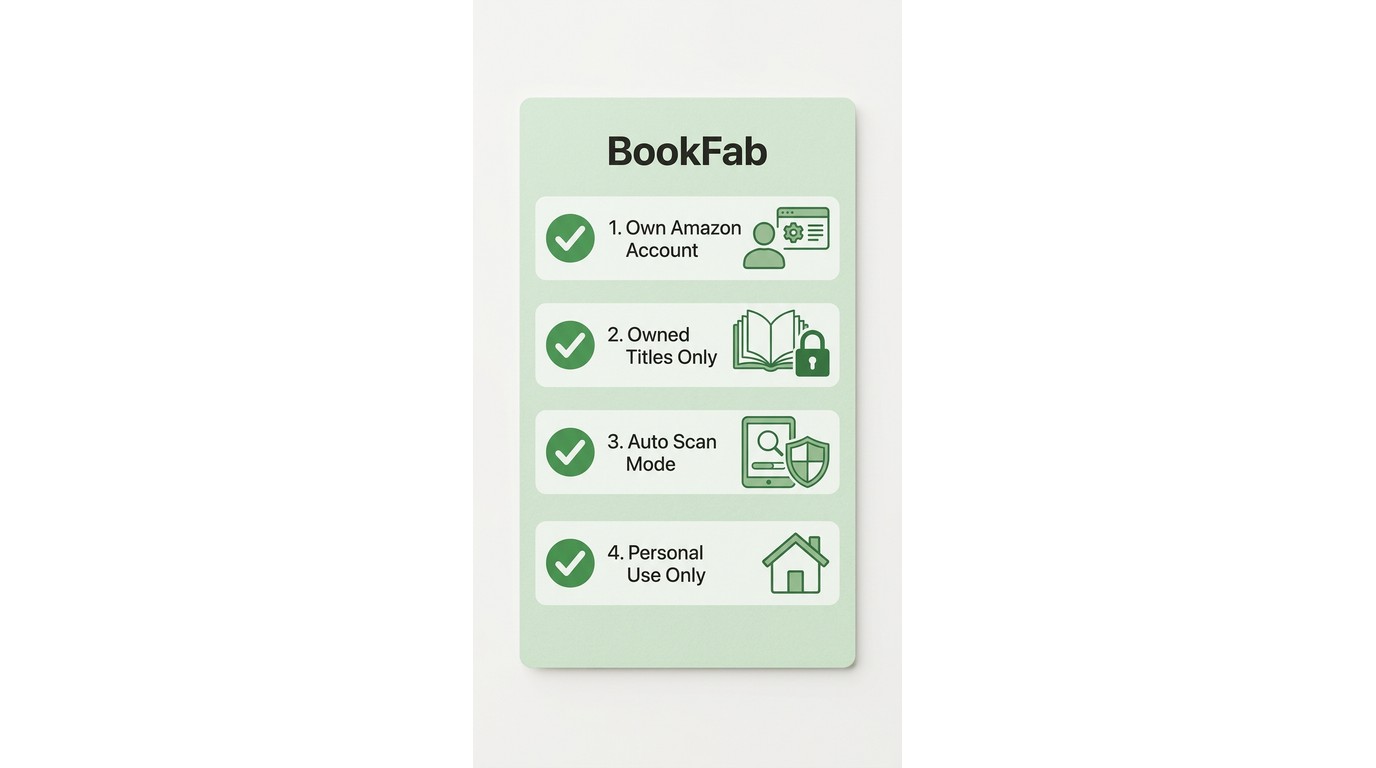
The safe lane is narrower than "generally allowed." A converter fits best when you're working with content you're authorized to access, keeping the resulting file for personal offline reading, and doing so where platform terms and your local law permit it. Anything involving sharing or redistribution sits outside that lane, regardless of which tool made the file.
A short working checklist:
- Sign in to the Kindle app with your own account and let it finish syncing.
- Download only titles you already own or have subscription rights to.
- Use Auto Scan in BookFab so your Amazon credentials stay in the Kindle app.
- Keep the output file for your own reading; don't upload, share, or sell it.
BookFab Pricing and Trial Limits
BookFab Kindle Converter offers a limited free trial rather than a permanently free product: you can convert a small number of books to check whether your titles, Kindle app version, and desired output all work end-to-end before paying. Current US pricing, license length, and any bundle options should be read from the official BookFab Kindle Converter page at the moment you buy — prices and promotions vary by region and time. The refund policy on the official site allows a full refund if you've converted less than 2,000 words with the license.
My honest fit call on price: if you convert a book or two a year, the trial and a manual workflow may be enough. If you convert regularly, or you specifically need EPUB/PDF output with metadata preserved without piecing together plugins, paying for a converter that maintains updates against Kindle app changes is the more time-honest choice.
BookFab Kindle Converter FAQ
Q
Does BookFab Kindle Converter work with newly purchased books?
It depends on the acquisition route. If a newly purchased title downloads cleanly through a supported version of the Kindle app on Windows, Auto Scan can usually pick it up and output EPUB or PDF. For same-day releases or files delivered by a very new Kindle app build, a BookFab update may be needed before that specific title is supported. Confirming with the free trial on one title is the honest way to check.
A
Q
What can I try if BookFab does not detect a Kindle book?
Separate the stages. First, confirm the title finished downloading in the Kindle app itself — a partial or paused download won't be scanned. Then click refresh in BookFab so it re-reads the local Kindle library. If detection works but conversion fails, try a second title to see whether the issue is title-specific (new release, heavy fixed layout) or environmental.
A
Q
Can BookFab work with Calibre after conversion?
Yes. Once BookFab produces an EPUB or PDF from your authorized local files, Calibre is a solid companion for library organization, metadata editing, and further format conversion between common ebook formats. Calibre itself doesn't handle Kindle protection natively, which is why a separate tool sits in front of it for the Kindle step.
A
Q
Is BookFab free, or does the trial have limits?
The trial is limited, not permanent. It lets you convert a small number of books so you can test compatibility and output quality before buying; it's not a full free product. For current pricing and license terms in the US, check the official product page at the time of purchase.
A
Is BookFab the Right Fit?
Where BookFab isn't the right pick: readers who can't get their Kindle books to download locally in the first place, and readers who convert a book a year and are fine piecing together a free workflow. No converter fixes an acquisition problem, and a paid tool is overkill for occasional use.
Where it earns its place: readers who already have a working Kindle app library on Windows, want clean EPUB or PDF output with metadata preserved, and would rather pay for a maintained tool than chase plugin updates. If that's you, run one title through the free trial first — that single test tells you more than any review, mine included. The Kindle to EPUB walkthrough is the next stop if you want a step-by-step tutorial.

 How to Download Kindle Books in 2026: 5 Current OptionsBy Amber Collins - Aug 26, 2026
![How to Convert Kindle Books to EPUB Easily [2026 Verified]](https://r5.dvdfab.cn/upload/bookfab/en/convert-kindle-to-epub-RDlf.jpg) How to Convert Kindle Books to EPUB Easily [2026 Verified]By Amber Collins - Aug 26, 2026
How to Convert Kindle Books to EPUB Easily [2026 Verified]By Amber Collins - Aug 26, 2026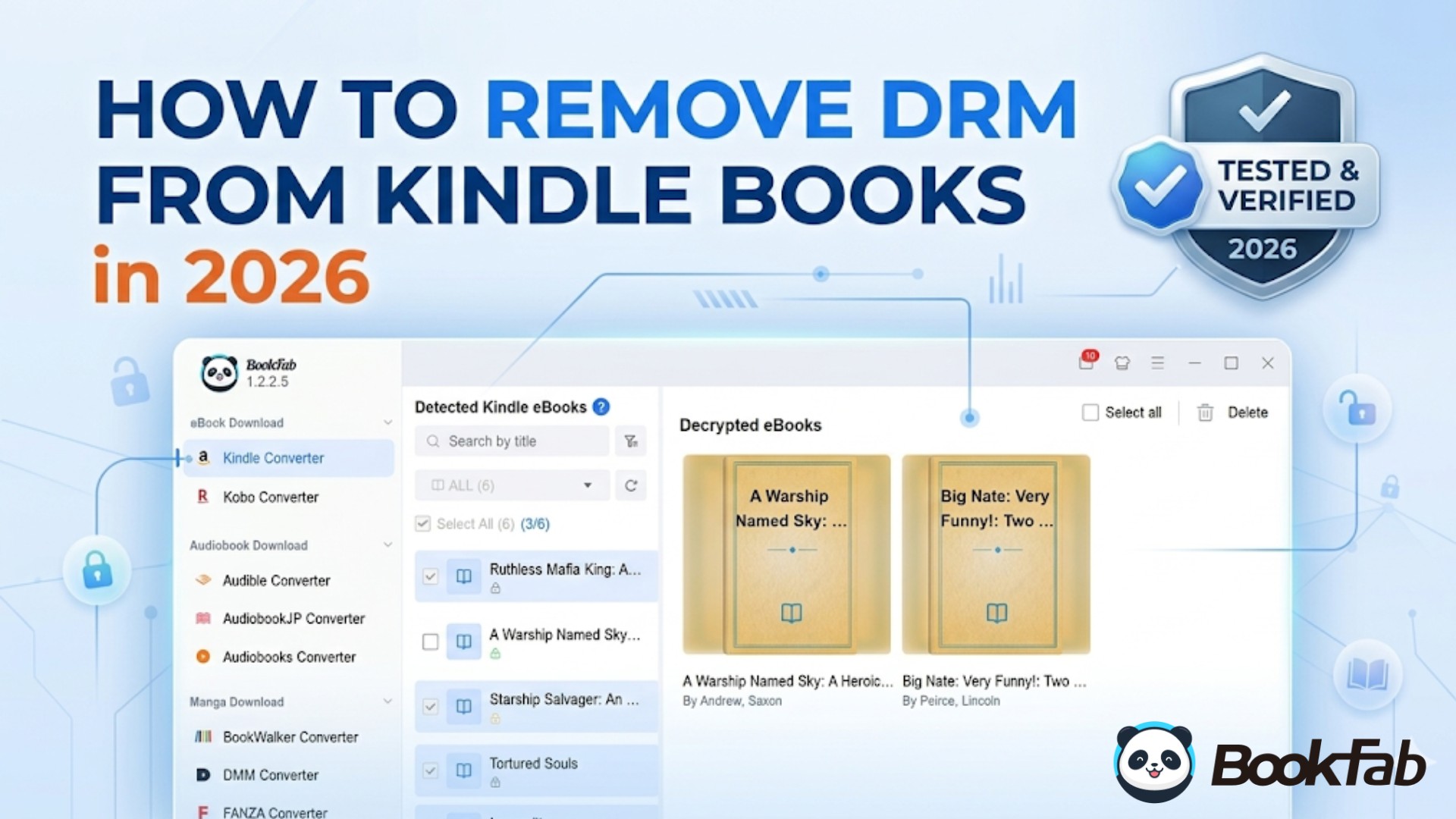 Kindle DRM Compatibility in 2026: What Still WorksBy Amber Collins - Aug 25, 2026
![[Quick Solution] How to Remove Kindle DRM on Mac](https://images.dvdfab.cn/media/未命名的设计__87__crpyru.png/public) [Quick Solution] How to Remove Kindle DRM on MacBy Amber Collins - Aug 24, 2026
[Quick Solution] How to Remove Kindle DRM on MacBy Amber Collins - Aug 24, 2026