
Prime Reading vs Kindle Unlimited: Which One Should You Choose in 2026?

Summary: Prime Reading is best for casual Prime members, while Kindle Unlimited suits frequent readers who want a larger catalog. This guide compares Prime Reading vs Kindle Unlimited by price, selection, borrowing limits, audiobooks, and ideal users to help you choose the better option.
Table of Contents
Here's the short answer: Prime Reading is a small rotating library included with Amazon Prime, and Kindle Unlimited is a separate $11.99/month subscription with a much larger catalog. Most readers ask which one has more books, but that's the last question I'd start with. As an editor who spends a lot of time looking at how Kindle titles behave across devices and reading apps, I've learned the useful question is narrower: does the service actually carry the books on your list, and does it fit how often you read? This Prime Reading vs Kindle Unlimited comparison walks through price, catalog fit, borrowing limits, audiobooks, and how to check whether a title is included before you subscribe.
If you plan to open purchased titles in another reading app, the EPUB vs MOBI format choice matters because EPUB is generally more widely supported outside older Kindle workflows.
What Is Prime Reading?
Prime Reading is a reading benefit included with an Amazon Prime membership. It gives Prime members access to a rotating library of Kindle ebooks, magazines, comics, children’s books, and selected titles with Audible narration.
The key word is rotating. A book you see in Prime Reading today may not stay there forever, so I treat it more like a small digital library shelf than a permanent bookstore. When I find something interesting in Prime Reading, I usually borrow it sooner rather than assuming it will always be available.
You do not need a Kindle device to use Prime Reading. You can read through the Kindle app on a phone, tablet, computer, or web browser. Kindle e-readers also support Prime Reading, which makes the service easy to use if you already live in the Amazon reading ecosystem.
Prime Reading: Key Points
| Feature | Prime Reading |
|---|---|
| Subscription type | Included with Amazon Prime |
| Extra monthly cost | No extra cost beyond Prime |
| Typical catalog style | Smaller, rotating, curated selection |
| Content types | Ebooks, magazines, comics, children's books, selected audiobooks |
| Best for | Existing Prime members and casual readers |
| Device support | Kindle devices, Kindle app, Fire tablets, phones, tablets, computers, and web browser |
| Main limitation | Smaller selection and rotating availability |
Prime Reading is not something I would usually buy Amazon Prime for by itself. But if you already use Prime for shipping, Prime Video, deals, or other benefits, Prime Reading can make the membership feel more valuable.
What Is Kindle Unlimited?
Kindle Unlimited is Amazon's standalone reading subscription. Unlike Prime Reading, it is not included with Amazon Prime. You can subscribe to Kindle Unlimited even if you are not a Prime member.
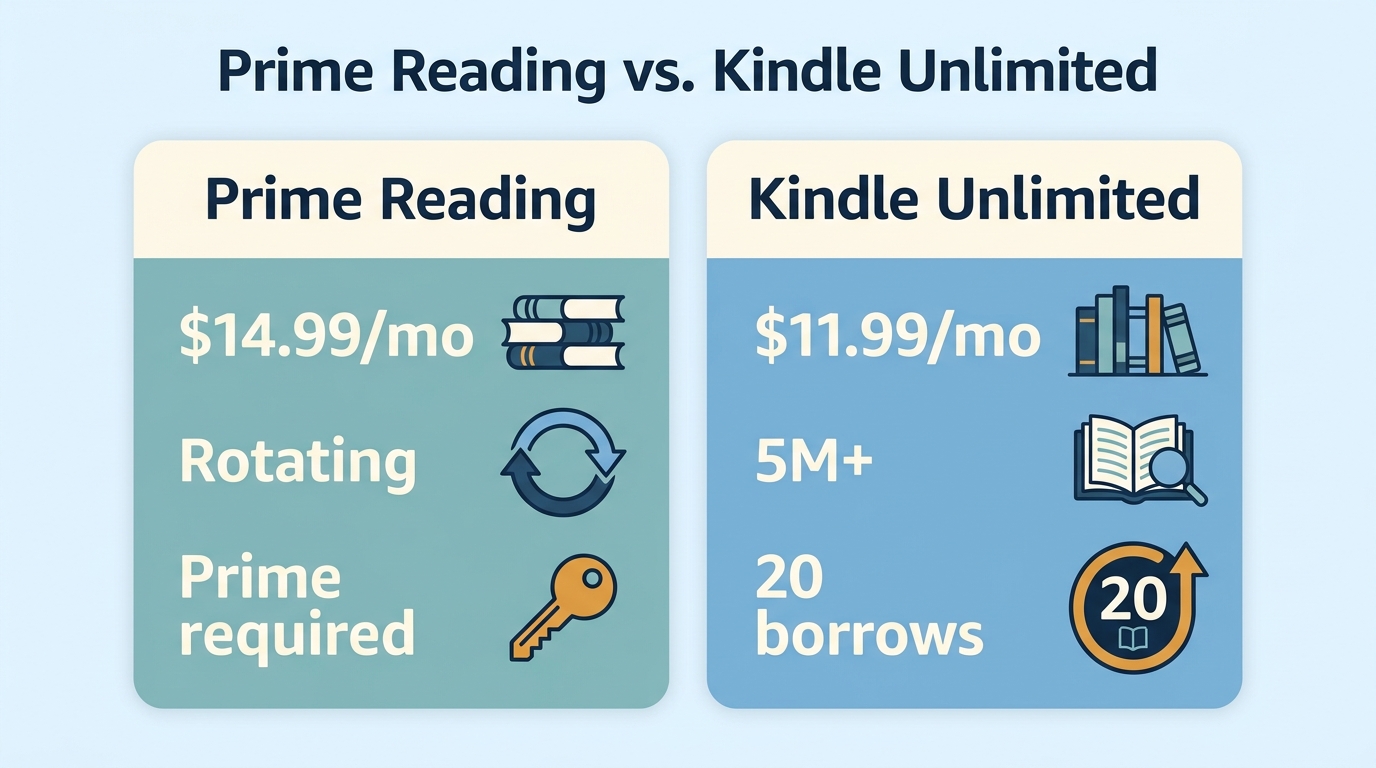
Amazon currently describes Kindle Unlimited as offering more than 5 million digital titles across ebooks, audiobooks, comics, manga, and magazines. You can borrow up to 20 eligible titles at a time, and there are no traditional due dates as long as your subscription stays active. That headline number sounds decisive, but in practice it only matters when the included genres and authors line up with your actual reading list — a point I'll come back to.
In my view, Kindle Unlimited works best when you read often and do not need every book to be a newly released bestseller from a major publisher. The catalog is especially strong for genre fiction, indie authors, long book series, romance, fantasy, mystery, thrillers, self-help, manga, and some nonfiction niches.
Kindle Unlimited: Key Points
| Feature | Kindle Unlimited |
|---|---|
| Subscription type | Separate monthly subscription |
| Prime required? | No |
| U.S. price | $11.99/month plus taxes (as of August 2026) |
| Catalog size | More than 5 million digital titles per Amazon's current description |
| Borrowing limit | Up to 20 titles at a time |
| Content types | Ebooks, audiobooks, comics, manga, magazines |
| Best for | Frequent readers, genre readers, indie book fans, series readers |
| Main limitation | Not every Kindle book is included, and many major bestsellers still require separate purchase |
Kindle Unlimited sounds like "everything on Kindle," but it is not. It is a large subscription catalog, not a pass to every ebook sold on Amazon.
Prime Reading vs Kindle Unlimited: Main Differences
The biggest difference between Prime Reading and Kindle Unlimited is not just library size. It is the purpose of each service.
Prime Reading is a Prime benefit. Kindle Unlimited is a paid reading plan.
That distinction explains almost everything else: the price, catalog depth, borrowing limits, and the type of reader each one serves.
| Comparison Point | Prime Reading | Kindle Unlimited |
|---|---|---|
| Membership requirement | Included with Amazon Prime | Standalone subscription; Prime not required |
| U.S. price | Included with Prime ($14.99/month or $139/year) | $11.99/month plus taxes |
| Catalog scope | Smaller rotating selection curated by Amazon | More than 5 million digital titles per Amazon's description |
| Borrowing limit | Smaller allowance; Amazon does not display a fixed public number in all regions | Up to 20 titles at a time |
| Included audio | Selected titles with Audible narration | Thousands of audiobooks included, but not every KU ebook has audio |
| Title discovery | Prime Reading storefront and "Read for Free" badge on eligible titles | Kindle Unlimited storefront and "Read for $0.00" or KU logo on eligible titles |
| Access after cancellation | Borrowed Prime Reading titles become unavailable when Prime access ends | Borrowed KU titles become unavailable when the KU subscription ends |
| Best fit | Casual readers who already have Prime | Frequent readers of genre fiction, indie authors, or long series |
| Not ideal for | Deep readers or long reading lists | Readers focused only on a few major new bestsellers |
| Prices as of August 2026. | ||
Price: Which One Costs Less?
Prime Reading is cheaper only if you already pay for Amazon Prime. In that case, the reading benefit does not add another monthly bill.
But if you are considering Prime only for reading, the math changes. In the U.S., Amazon Prime costs $14.99 per month or $139 per year. Kindle Unlimited costs $11.99 per month plus taxes. So if reading is your only reason to subscribe, Kindle Unlimited is usually the more direct and cheaper reading-focused option.
Here is my practical rule:
- If you already use Prime for shopping, streaming, and deals, Prime Reading is a free bonus.
- If you only care about books, Kindle Unlimited is the more logical subscription to evaluate.
Catalog Size and Book Selection
Kindle Unlimited is clearly larger. Amazon lists it as more than 5 million digital titles across ebooks, audiobooks, comics, manga, and magazines, while Prime Reading stays deliberately small and curated. That gap is real, but catalog size on its own is a poor way to pick between the two.
What matters is catalog fit. When I check whether a subscription suits a particular reader, I look at the specific books they want to read next, not the headline number. Kindle Unlimited is strong for genre fiction, indie authors, romance, fantasy, mystery, thrillers, manga, and long series where finishing one book leads to the next. It's noticeably weaker for celebrity memoirs, current major-publisher hardcovers, and the latest BookTok hits, many of which still need to be bought separately.
Prime Reading is a smaller shelf that changes over time. That size makes it easier to browse casually — a magazine on a flight, a short read during a commute, a children's picture book to try with a child at bedtime — but it isn't built to satisfy a long, specific wish list.
Borrowing Limits and Reading Flexibility
Kindle Unlimited lets you borrow up to 20 eligible titles at the same time. That is useful if you like to keep several books open at once, such as one novel, one nonfiction book, a manga volume, and an audiobook.
Prime Reading has historically had a smaller borrowing allowance, and availability details may vary by region and Amazon interface. The more important point for most readers is what happens to those borrowed titles later. Borrowed Prime Reading books stay available only while an Amazon Prime membership is active; borrowed Kindle Unlimited books stay available only while the Kindle Unlimited subscription is active. In both cases, the titles become unavailable after the relevant membership ends.
Purchased Kindle books are a separate category. When I check a book I actually paid for, the file stays tied to my Amazon account regardless of whether Prime or Kindle Unlimited is still active — and for those owned titles, some readers later convert Kindle books to EPUB so the same file opens in a non-Kindle reading app.
For readers who want local access beyond Amazon’s apps, downloading purchased Kindle books to a PC makes desktop reading and personal file management more practical.
Audiobooks: Does Either Service Replace Audible?
Neither Prime Reading nor Kindle Unlimited fully replaces Audible.
Some users may wonder, "Is Audible free with Prime Reading?" No. Prime Reading includes selected books with Audible narration, but the selection is limited. Kindle Unlimited includes thousands of audiobooks, but not every KU ebook has an audiobook version.
If you mainly listen to audiobooks and want specific new releases or popular narrated titles, Audible may still be a better fit. If you mostly read ebooks and treat audio as a bonus, Kindle Unlimited gives you more audio value than Prime Reading.
Bestsellers and Popular Authors
Neither service is a shortcut to famous new releases. Kindle Unlimited's catalog is large, but current major-publisher hardcovers, celebrity memoirs, and highly anticipated releases from well-known authors usually stay outside the subscription and still need to be bought separately. Prime Reading has the same limitation at a smaller scale — it may include a few recognizable names at any given moment, but it is not designed to be a bestseller library.
That does not make either service weak. It changes what the subscription is for. If your reading list is anchored to a fixed set of famous titles, both services will disappoint you and buying the specific book is usually simpler. If you are more flexible — willing to follow an indie author, start a new fantasy or romance series, or work through a genre's backlist — Kindle Unlimited begins to feel generous. A practical test I use: pick 10 books you actually want to read next and check each one before subscribing. If four or five are included, the subscription earns its place; if only one or two are, the numbers don't add up.
The Everyday Reading Experience
The two services also feel different to use, and that friction shows up before you finish a single book. Prime Reading is a small shelf inside a membership you already own — easy to browse, low commitment, and pleasant when a title catches your eye. It's not where I would send someone with a long reading list, but it works well for casual grazing.
Kindle Unlimited behaves more like a subscription library, and the discovery part takes some learning. Search results on Amazon mix KU titles with regular paid Kindle books, so the first week often feels crowded until you get used to filtering by the Kindle Unlimited badge or browsing the KU storefront directly. Recommendations also improve as you borrow — start a mystery series and the store begins surfacing more of that shelf, which is where the subscription starts to feel useful rather than overwhelming.
Finding Included Books on Amazon
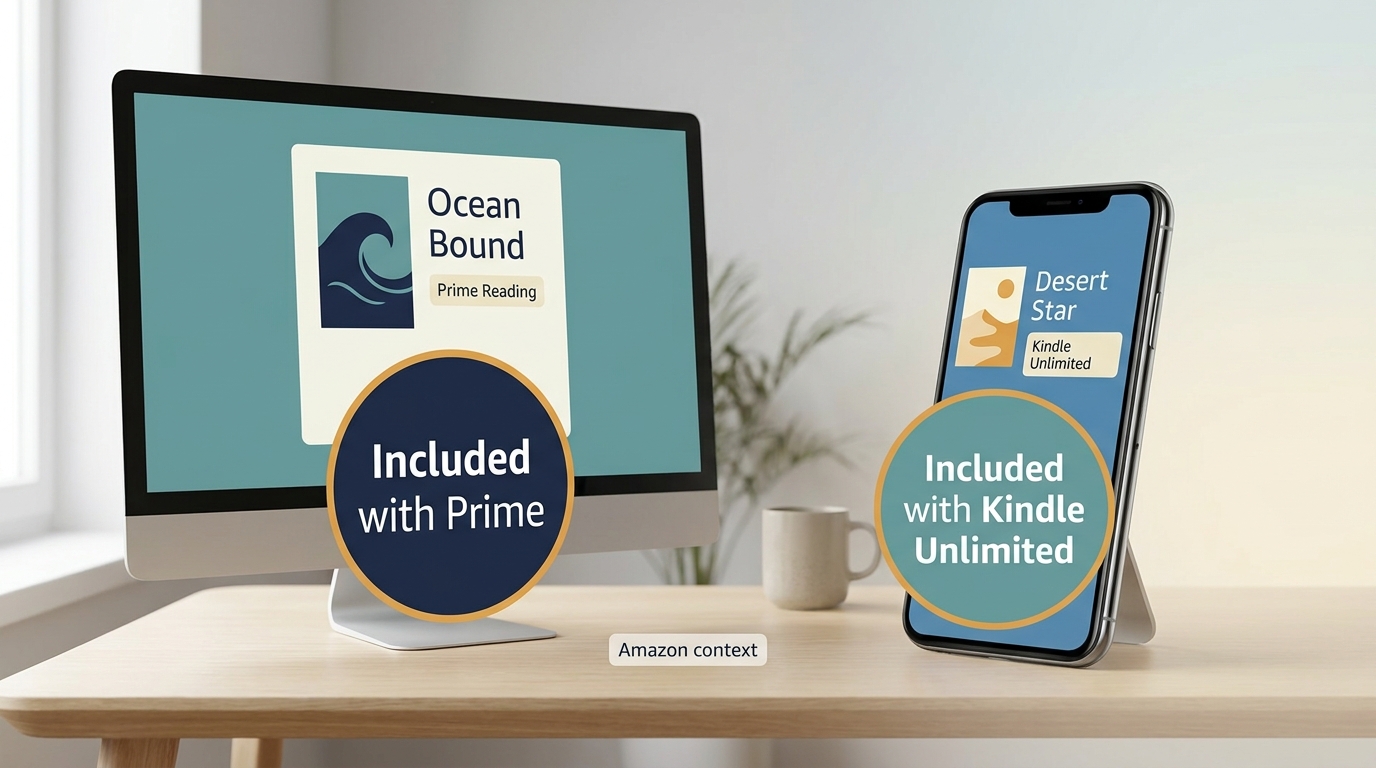
Amazon Prime Reading and Kindle Unlimited are separate catalogs, so a regular Kindle listing is not automatically included in either one. Finding the right badge before borrowing is part of the value of both subscriptions, not a minor storefront detail.
Prime Reading Access
- Open the Prime Reading catalog from Amazon while signed in to the Prime account you use for Kindle.
- Browse the available Prime Reading books, magazines, comics, and narrated titles, or look for the Prime Reading label on an eligible Kindle listing.
- Before borrowing, confirm that the title still shows the Prime Reading inclusion badge. The catalog rotates, so an earlier listing may no longer be available through Prime Reading.
Kindle Unlimited Labels and Filters
- Open the Kindle Unlimited storefront or filter Amazon Kindle results for Kindle Unlimited titles.
- Look for the Kindle Unlimited logo or the "Read for $0.00" label on the book's product page.
- Check that label again immediately before borrowing, especially when search results also show standard paid Kindle editions of the same title.
This short check is more useful than comparing headline catalog totals alone: it shows whether the book you want is included in the subscription you are considering.
Which Subscription Fits Your Reading?
The right choice depends on five conditions working together, not any one of them alone: whether you already pay for Amazon Prime, how many of your wish-list titles are actually included, which genres you read, how many books you finish a month, and whether you have access to a US public library through Libby.
Prime Reading is the better fit when:
- You already pay for Amazon Prime for shopping, video, or other benefits.
- You read occasionally rather than working through a long list.
- You enjoy magazines, comics, or short reads for travel and commutes.
- You don't want another monthly bill and are happy with a small rotating shelf.
My verdict: Prime Reading is a useful side benefit inside Prime, not a reason to subscribe to Prime on its own. It's not ideal if you finish several books a month or want a specific reading list covered.
Kindle Unlimited is the better fit when:
- You finish three or more books a month and want ongoing supply.
- You read romance, fantasy, mystery, thrillers, manga, indie authors, or long series.
- Enough titles from your actual wish list carry the Kindle Unlimited badge to justify $11.99/month.
- You want audiobook narration bundled with ebooks rather than paid separately.
My verdict: Kindle Unlimited earns its monthly fee when your reading habits are broad and the badge check comes back positive. It's not ideal if the books you actually want are current major-publisher hardcovers — those usually stay outside KU and are cheaper to buy individually.
Libby is worth checking before you subscribe to either. If your US public library card gives you access to Libby, many mainstream titles — including bestsellers KU doesn't carry — can be borrowed at no cost, though popular new releases may have wait times. A common pattern I see is Libby for major releases, Kindle Unlimited for genre reading and series, and Prime Reading as a bonus if Prime is already paid for.
- Casual readers
- Existing Prime members
- Budget-conscious readers
- Magazine and comic readers
- Travelers and commuters
- Voracious readers
- Genre fans
- Self-published/Indie book lovers
- Audiobook listeners
- Readers seeking a Netflix-style book library
FAQs
Q
Do I need Kindle Unlimited if I already have Amazon Prime?
Not automatically. Prime Reading already gives you a small rotating catalog at no extra cost, so paying another
1.99 a month for Kindle Unlimited only makes sense when KU's much larger catalog actually covers the books, genres, and series you want to read. Check a handful of titles from your real wish list against the Kindle Unlimited badge before subscribing.
A
Q
What happens to borrowed books after I cancel?
Borrowed titles remain available through the active paid membership period. After Prime or Kindle Unlimited access ends, titles borrowed through that service become unavailable. Kindle books you paid for are separate and remain in your Amazon library regardless of subscription status.
A
Q
Is Kindle Unlimited worth it if I use Libby?
Libby gives free access to ebooks and audiobooks through participating US public libraries, and it often carries mainstream titles Kindle Unlimited doesn't. The trade-off is wait times for popular releases, which KU avoids. If your library holds most of what you read and you can tolerate holds, Libby may cover you on its own. If you read heavily in genres like romance, fantasy, or indie fiction where library waits pile up, Kindle Unlimited still adds value alongside Libby.
A
Final Wrap Up
The honest way to decide between Prime Reading and Kindle Unlimited isn't to compare catalog sizes — it's to test whether either service carries the books you actually want to read next. Pick 8 to 10 titles from your real wish list, open each one on Amazon, and see which badge shows up: Prime Reading, Kindle Unlimited, or neither. That single check does more than any feature table. Weigh the result against whether you already pay for Prime, how many books you finish a month, and whether your US library card already covers you through Libby, and the right subscription usually becomes obvious.

 How to Download Kindle Books in 2026: 5 Current OptionsBy Amber Collins - Aug 26, 2026
![How to Convert Kindle Books to EPUB Easily [2026 Verified]](https://r5.dvdfab.cn/upload/bookfab/en/convert-kindle-to-epub-RDlf.jpg) How to Convert Kindle Books to EPUB Easily [2026 Verified]By Amber Collins - Aug 26, 2026
How to Convert Kindle Books to EPUB Easily [2026 Verified]By Amber Collins - Aug 26, 2026 Kindle DRM Compatibility in 2026: What Still WorksBy Amber Collins - Aug 25, 2026
![[Quick Solution] How to Remove Kindle DRM on Mac](https://images.dvdfab.cn/media/未命名的设计__87__crpyru.png/public) [Quick Solution] How to Remove Kindle DRM on MacBy Amber Collins - Aug 24, 2026
[Quick Solution] How to Remove Kindle DRM on MacBy Amber Collins - Aug 24, 2026