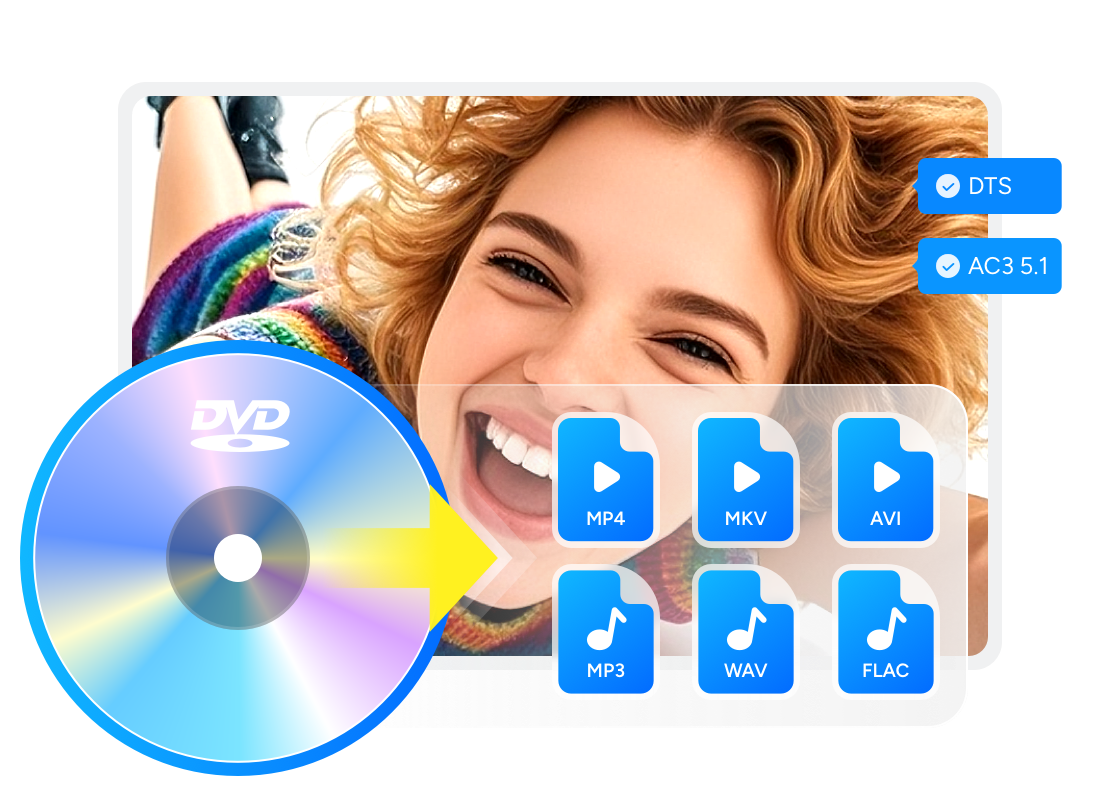
DVD to OGM in 2026: What Still Works and Better Formats

Summary: If you are trying to convert a DVD to OGM, I have some bad news: the OGM video format is officially dead, and modern devices simply won't play it. Instead of fighting with outdated tech, I will explain why this once-popular format disappeared and show you the best modern alternatives. Whether you need high-quality OGG audio or a multi-track MKV video, I'll walk you through the easiest way to digitize your discs today.
Table of Contents
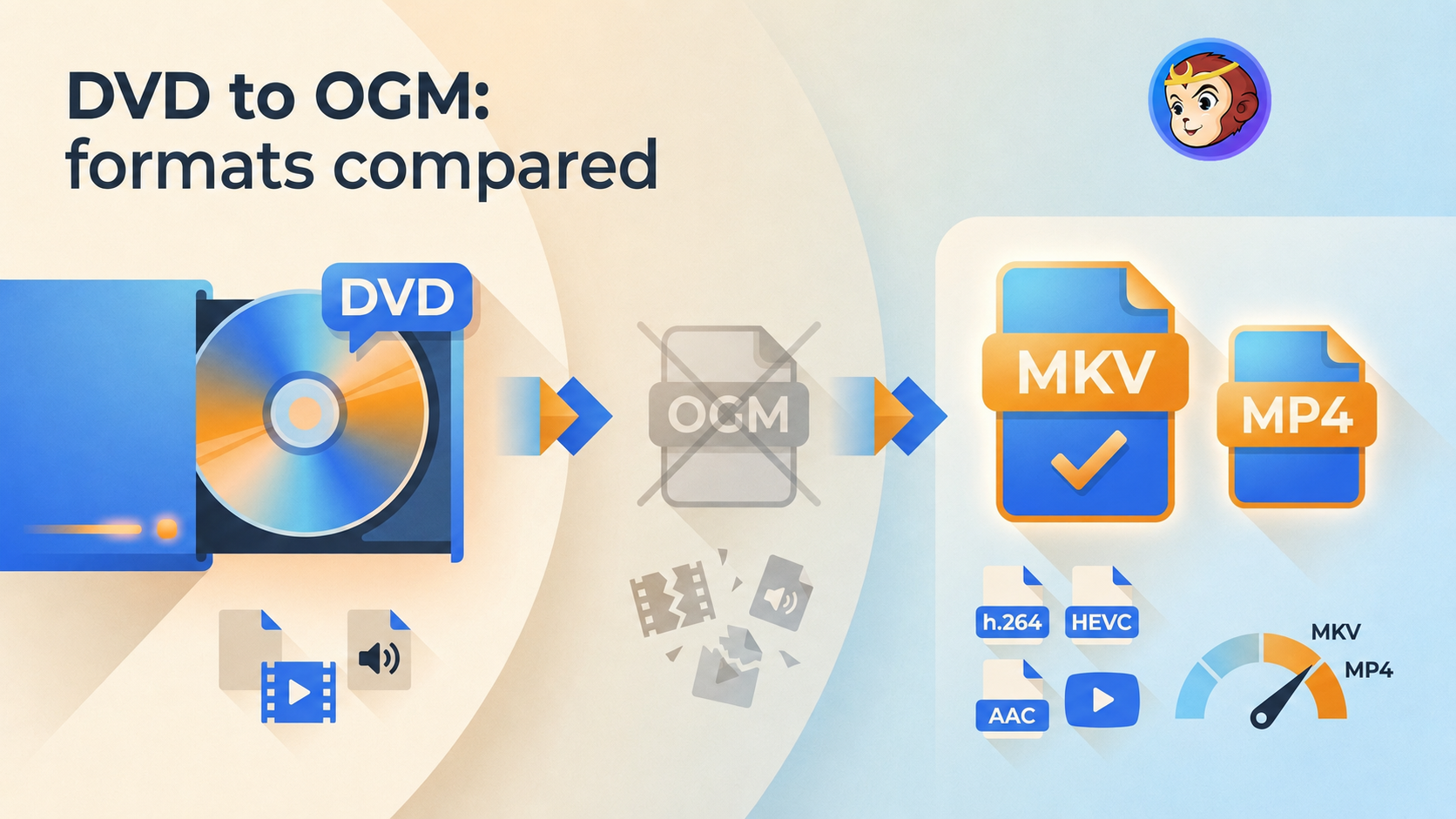
Here's the short answer: you can still create an OGM file from a DVD with legacy software like OGMRip, but limited modern playback support means the destination format is the first decision, not the last. Back in the early 2000s, OGM was a clever way to keep multiple audio tracks and soft subtitles inside one file. Today, most phones, smart TVs, and media servers no longer handle the OGM file format reliably, so an old workflow can leave you with files that open on one desktop player and fail on the next device.
In this article I walk through what still works if you truly need OGM, how the OGM file format compares to OGG, MKV, and MP4, why OGM playback fails in Plex and similar setups, and a practical DVD workflow for a modern library. My goal is to help you pick the right destination format for the discs you actually own, not to sell you on any single container.
Can You Still Convert DVD to OGM?
Yes, technically. Legacy tools such as OGMRip still document DVD-to-OGM output, and if an old workflow, a home theater PC, or a specific archive genuinely needs .ogm files, that path has not disappeared. What has changed is the environment around it: OGM was an unofficial extension of the Ogg container from the early 2000s, built to pack DivX or XviD video with multiple audio tracks and soft subtitles into one file. It solved a real problem in its era, but it was never standardized, and hardware makers moved on to Matroska (MKV) for the same job. My take, after handling plenty of legacy discs and archives: use OGM only when a specific old workflow requires it, and treat MKV or MP4 as the safer default for anything new.
What OGMRip Can Still Do
OGMRip is a historical reference rather than a current peer to maintained DVD tools. It can still read an unprotected DVD and write an OGM (or Matroska) output, which is useful if you are rebuilding a very old archive or feeding a legacy playback chain that expects .ogm files. Development activity has slowed and support for newer disc protections is limited, so I would not lean on it for a fresh library.
Why Legacy OGM Workflows Are Risky
Best for: readers with a narrow, documented need for OGM output. Not ideal for: anyone starting a new collection, migrating discs into Plex or a smart TV setup, or expecting subtitles and alternate audio to behave the same across devices. Legacy OGM converters often assume older codecs and unprotected sources, so results can be inconsistent on modern discs and modern players.
Clearing the Confusion: OGM vs. OGG
OGM and OGG share the same open-source roots, but they are not interchangeable. On forums like Reddit and Quora, people frequently mix them up when planning a DVD conversion.
- OGM (Ogg Media): A legacy video container from the early 2000s with limited modern device and player support.
- OGG (Ogg Vorbis): A widely used audio format that generally offers a good quality-to-size balance and remains common in gaming and streaming applications.
OGM, OGG, MKV, and MP4 Compared
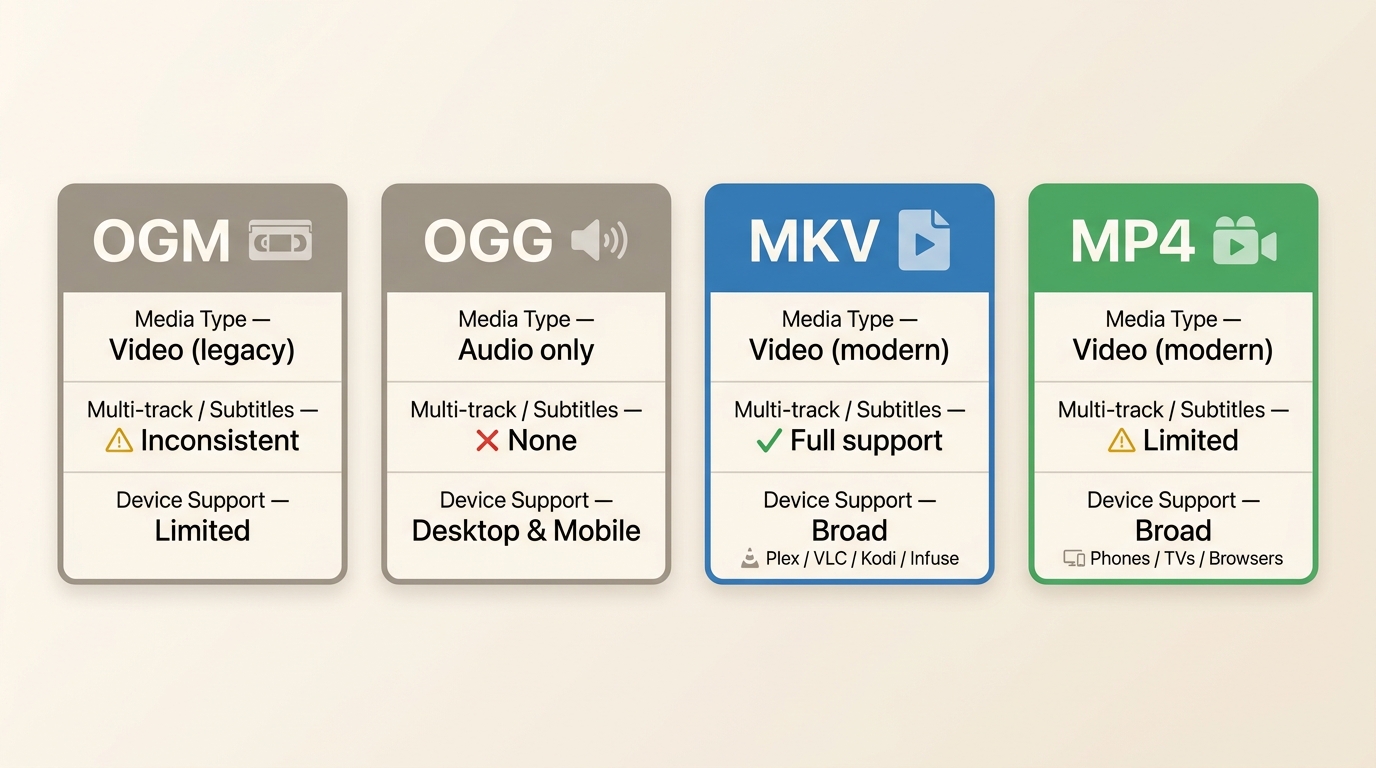
Before choosing a tool, it helps to see the four formats side by side. OGM and MKV are video containers; OGG is an audio-only format; MP4 is the broad-compatibility video container most modern devices expect.
| Format | Media type | Multiple audio / subtitles | Modern device support | Recommended use |
| OGM | Video container (legacy) | Yes, but inconsistent | Limited; often partial in Plex, smart TVs, mobile | Only for a legacy workflow that specifically requires .ogm |
| OGG | Audio only | Audio tracks only, no video | Broad on desktop and many mobile players | Extracting soundtrack, dialogue, or music from a disc |
| MKV | Video container (modern) | Yes, multiple tracks and soft subtitles | Wide on Plex, VLC, Kodi, Infuse, Apple TV apps | Multi-track archives where subtitles and audio choice matter |
| MP4 | Video container (modern) | Typically one audio track, limited subtitle handling | Very broad across phones, tablets, TVs, browsers | Everyday playback on the widest range of devices |
The pattern I keep seeing: MKV usually fits multi-track home theater archives, MP4 usually fits broad playback on mobile and smart TVs, and OGG is the right pick only when you want the audio and nothing else. OGM sits outside that shortlist unless a specific old workflow demands it.
Why OGM Playback Fails Today
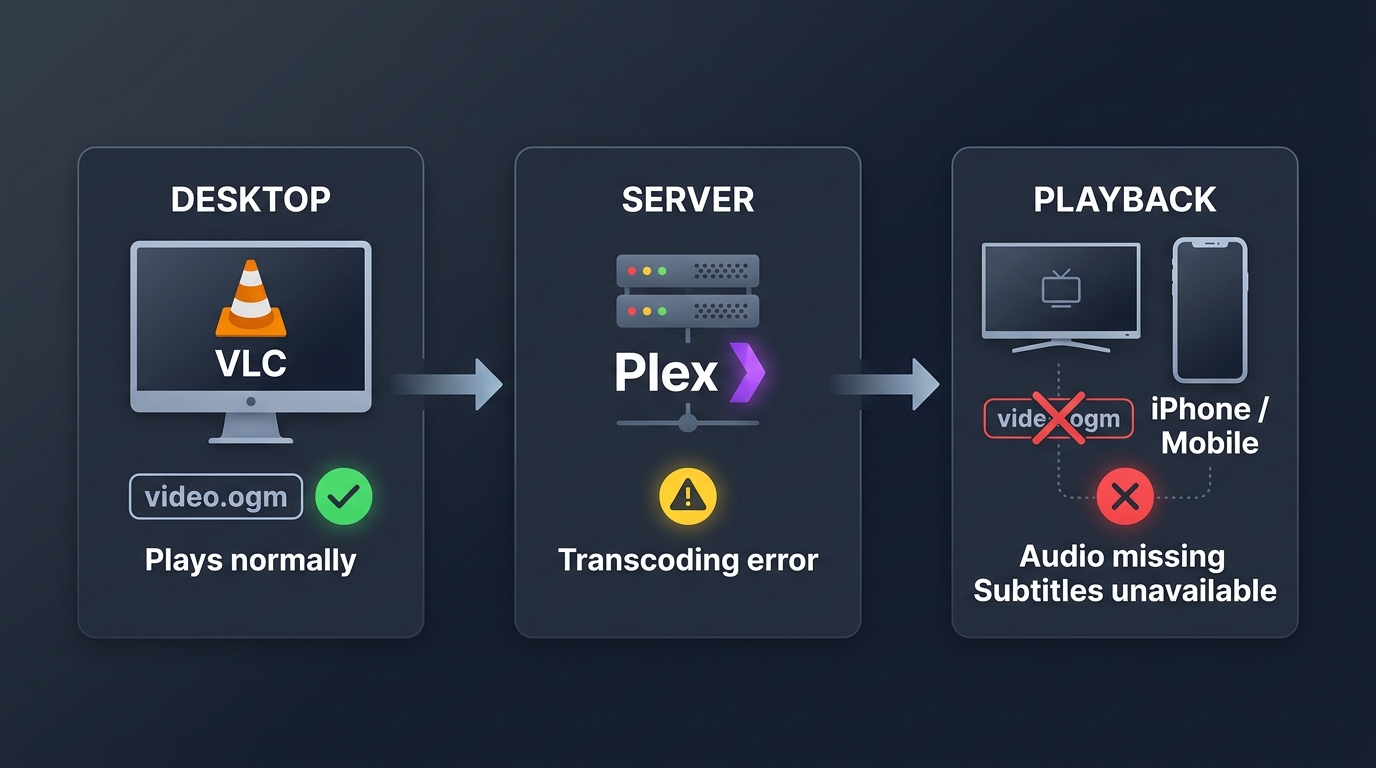
The frustrating part of OGM in a modern setup is not that files refuse to open everywhere. It's that they open partially. A file may play video but drop the alternate audio, play audio but not video, or ignore soft subtitles that looked fine in an older desktop player. In Plex libraries I've seen readers describe, an OGM file will often stream on the desktop app but transcode poorly or fail on a smart TV or mobile client.
Plex, Smart TV, and Mobile Compatibility
Media servers depend on the client device being able to either play the container directly or accept a transcoded stream. OGM's inconsistent metadata and codec combinations make this harder to predict than MKV or MP4. Expect Edge cases: missing chapters, unavailable subtitle tracks, or audio-only playback on TV apps.
When OGM Still Opens
Desktop players such as VLC or MPC-HC can still open many OGM files, which is why the format hasn't disappeared entirely. Successful desktop playback isn't proof that the same file will behave the same way in Plex, on an iPad, or on a modern TV, so I wouldn't extrapolate from one player.
The Best Output for Your DVD Ripping Goal
Since OGM is fragile in modern environments, format choice is really the first step of the workflow, not the last. Pick the destination that matches your goal, then pick the tool.
MKV for Multiple Tracks and Subtitles
MKV is a strong fit when you want to keep several audio languages, commentary tracks, and soft subtitles inside one file, which is the same problem OGM originally tried to solve. If your priority is a multi-track archive, you can convert a DVD to MKV and preserve those tracks for selection in Plex, VLC, or Infuse. Not ideal for: readers who only need one audio track and want the file to play everywhere without thought.
MP4 for Broad Device Playback
MP4 is the safer default when you plan to convert DVD to MP4 for phones, tablets, TVs, and browsers, since it hits the widest device compatibility. Not ideal for: multi-track archives, since MP4 handles multiple audio and subtitle tracks less gracefully than MKV.
OGG for Audio-Only Extraction
OGG is the right pick only when you want the disc's audio, such as a concert, soundtrack, or dialogue recording. Not ideal for: anything where the video matters or where MP3 compatibility on a specific device is a hard requirement.
How to Convert DVDs to Modern Alternatives (OGG or MKV)
DVDFab DVD Ripper is a desktop application for Windows 11/10/8.1/8/7 and macOS 10.13–15.x. It can convert DVDs to MKV, MP4, MP3, OGG, and many other video and audio formats. It supports common DVD copy protections, including CSS, APS, region codes, and Sony DADC, allowing you to back up DVDs that you own or are authorized to access. DVDFab’s Cloud Decryption Service is regularly updated to support newly released discs.
On supported hardware, NVIDIA CUDA, AMD AMF, Intel Quick Sync, and Apple VideoToolbox acceleration can reduce ripping time. You can also select the titles, audio tracks, and subtitles you want to rip and use the built-in editor to customize the video before conversion.
Load the Disc and Choose a Title
Step 1. Download and install DVDFab DVD Ripper on your Windows or Mac. Launch the program and select the "Ripper" module from the top menu.
Insert your DVD into your optical drive, and the software analyzes the disc and loads the main movie title. If you have an ISO file or a VIDEO_TS folder on your hard drive, drag and drop it into the interface. Before you go further, confirm that the detected title matches the movie runtime you expect. An unusually short title (a few seconds or minutes) is a sign of misdetection, not a problem with the output format.
Free Download Windows 11/10/8.1/8/7
Free Download macOS 10.13 - 15.x
Select MKV, MP4, or OGG
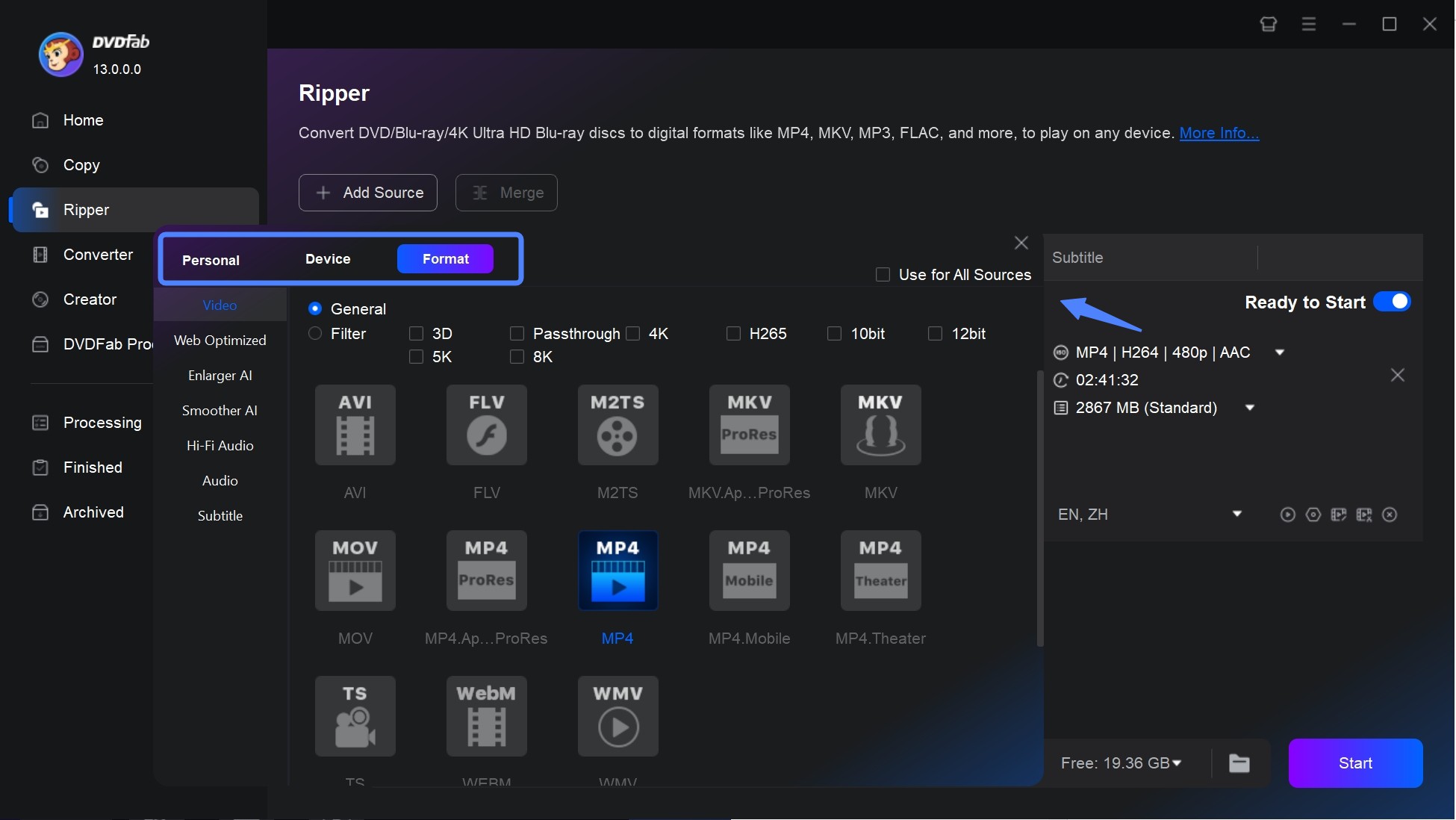
Step 2. Click the "Choose Other Profile" dropdown to pick the destination format based on the earlier matrix:
- For a multi-track video archive: Format > Video > MKV. This keeps multiple audio languages and selectable subtitle tracks, similar to what OGM was designed to do, and plays well across VLC, Plex, Kodi, and Apple TV apps.
- For broad device playback: Format > Video > MP4 with H.264 for the widest phone, tablet, and TV support.
- For audio only: Format > Audio > OGG when you want just the soundtrack or dialogue.
Set Audio, Subtitles, and Quality
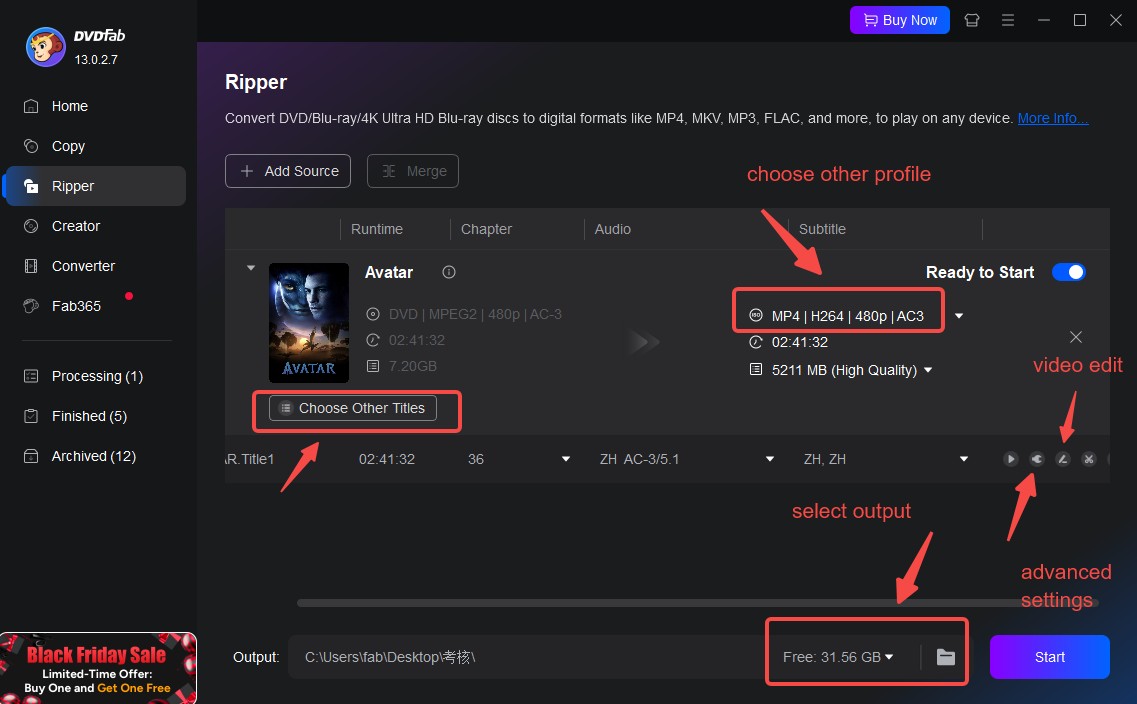
Step 3. Before converting, use the Audio and Subtitles dropdowns on the loaded title to check the boxes for the languages you want to keep. If you plan to extract subtitles from a DVD as separate files or preserve soft subtitle tracks, this is the point to confirm the tracks are detected. Open the video quality settings if you need to balance file size against visual fidelity.
Select your output destination at the bottom of the window and click "Start." Conversion time depends on the disc condition, output profile, and your hardware, so I always run one full title as a test before committing to a batch. Checking the detected title and tracks up front is the single most useful safeguard against reconverting later.
Frequently Asked Questions
Can VLC still open an OGM file?
Desktop players such as VLC or MPC-HC can open many OGM files, and results depend on the codecs, tracks, and subtitles inside the specific file. A successful open on a desktop doesn't mean the same file will play cleanly on Plex, a smart TV, or a phone, so treat desktop playback as an indicator, not a guarantee of broader compatibility.
Do I need to re-encode an old OGM file to move it to MKV?
Sometimes you can remux, which repackages the existing video and audio streams into an MKV container without re-encoding, and sometimes you have to transcode because the internal codecs aren't well supported. Check what codecs the OGM file uses first; if the streams are compatible with modern players, remuxing keeps the original quality and is much faster than a full conversion.
Can I process several DVDs in one batch?
Yes, most maintained DVD tools support a queue where you add multiple discs or ISO files with the same output profile. I would still run a small test batch of two or three discs first to confirm title detection, audio tracks, and storage headroom before committing a large legacy library, since a wrong profile applied at scale is painful to redo.
Is a free DVD converter enough for this job?
For a one-off conversion of an unprotected DVD, a free tool like HandBrake can be sufficient. If you need current disc handling, broader format presets, batch queue control, and ongoing support, a maintained paid tool usually earns its cost. Match the tool to the size of the job, not the other way around.
Conclusion
A legacy OGM path may still serve a specific old workflow, but for most readers building a new DVD library, the better destination is one of three: MKV for multi-track archives where subtitles and alternate audio matter, MP4 for broad playback across phones, tablets, and TVs, or OGG when you only need the disc's audio. Pick the format that matches how you'll actually watch or listen, then let the tool follow the format decision rather than the other way around.

 Free DVD Decoder for Windows XP and Windows 11: 3 Ways to Play DVDsBy Diana Smith - Sep 23, 2026
 How to Compress ISO Files: 4 Methods for Storage, Playback, and ArchivesBy Diana Smith - Sep 16, 2026
 How to Rip DVD to Facebook and Upload the Video in 2026By Diana Smith - Sep 15, 2026
![How to Rip DVDs for Plex: Guide to Formats, Tools, and Library Setup [2026]](https://images.dvdfab.cn/media/Screenshot_2026-09-08_at_18.53.34_j36v3l.png/public) How to Rip DVDs for Plex: Guide to Formats, Tools, and Library Setup [2026]By Diana Smith - Sep 8, 2026
How to Rip DVDs for Plex: Guide to Formats, Tools, and Library Setup [2026]By Diana Smith - Sep 8, 2026