Convert NTSC to PAL: Settings for DVDs, Files, and Analog Video

Summary: NTSC and PAL are regional analog television standards. NTSC offers smoother motion at 30 fps, while PAL provides higher resolution and better color stability at 25 fps. To convert NTSC to PAL, first identify whether you have a digital file, a DVD or ISO image, or a live analog signal. The right NTSC to PAL converter software and settings depend on that source, because a DVD region restriction, video frame rate, and analog display compatibility are separate problems.
Table of Contents
Modern TVs and media players often accept both 50 Hz and 60 Hz video, so conversion is not automatically necessary. Problems tend to appear when an older player, display, capture device, or disc setup does not support the source standard or its region settings.
This article explains the NTSC and PAL differences that still matter, helps you choose among file conversion, DVD or ISO conversion, and analog hardware, and covers settings that reduce judder, interlacing artifacts, and audio-sync drift.
NTSC and PAL Basics
NTSC in Brief
NTSC (National Television System Committee) is a legacy analog color-TV standard associated with 525 scan lines and a roughly 29.97 fps DVD rate. An NTSC DVD commonly uses 720 × 480 pixels. The analog broadcast system is largely historical, but its frame rate and DVD format still matter when working with older discs, captures, and players.
- Lines: 525
- Frame rate: 29.97 fps
- Picture resolutions: 720 x 480; 704 x 480; 352 x 480; 352 x 240
PAL in Brief
PAL (Phase Alternating Line) is a legacy analog color-TV standard associated with 625 scan lines and 25 fps video. A PAL DVD commonly uses 720 × 576 pixels. PAL’s alternating color phase was designed to reduce color shifts in analog transmission, but that historical advantage does not determine the quality of a modern digital file by itself.
For DVD playback, the actual player, display, and intended output matter more than the label on the disc. DVD regions are a separate compatibility layer from PAL and NTSC video formatting.
- Lines: 625
- Frame rate: 25 fps
- Picture resolution: 720 x 576; 704 x 576; 352 x 576; 352 x 288
NTSC vs PAL: Key Differences
Neither NTSC nor PAL is inherently better for every playback setup. The truth is, both formats have distinct technical traits that directly impact how your media looks and plays today.
Resolution and DVD Picture Size
When you digitize an old video, the physical lines of the analog broadcast translate directly into digital pixels. NTSC uses 525 lines, but only about 480 are visible. This gives NTSC media a standard digital resolution of 720x480. PAL, on the other hand, utilizes 625 lines with 576 visible, giving it a digital resolution of 720x576.
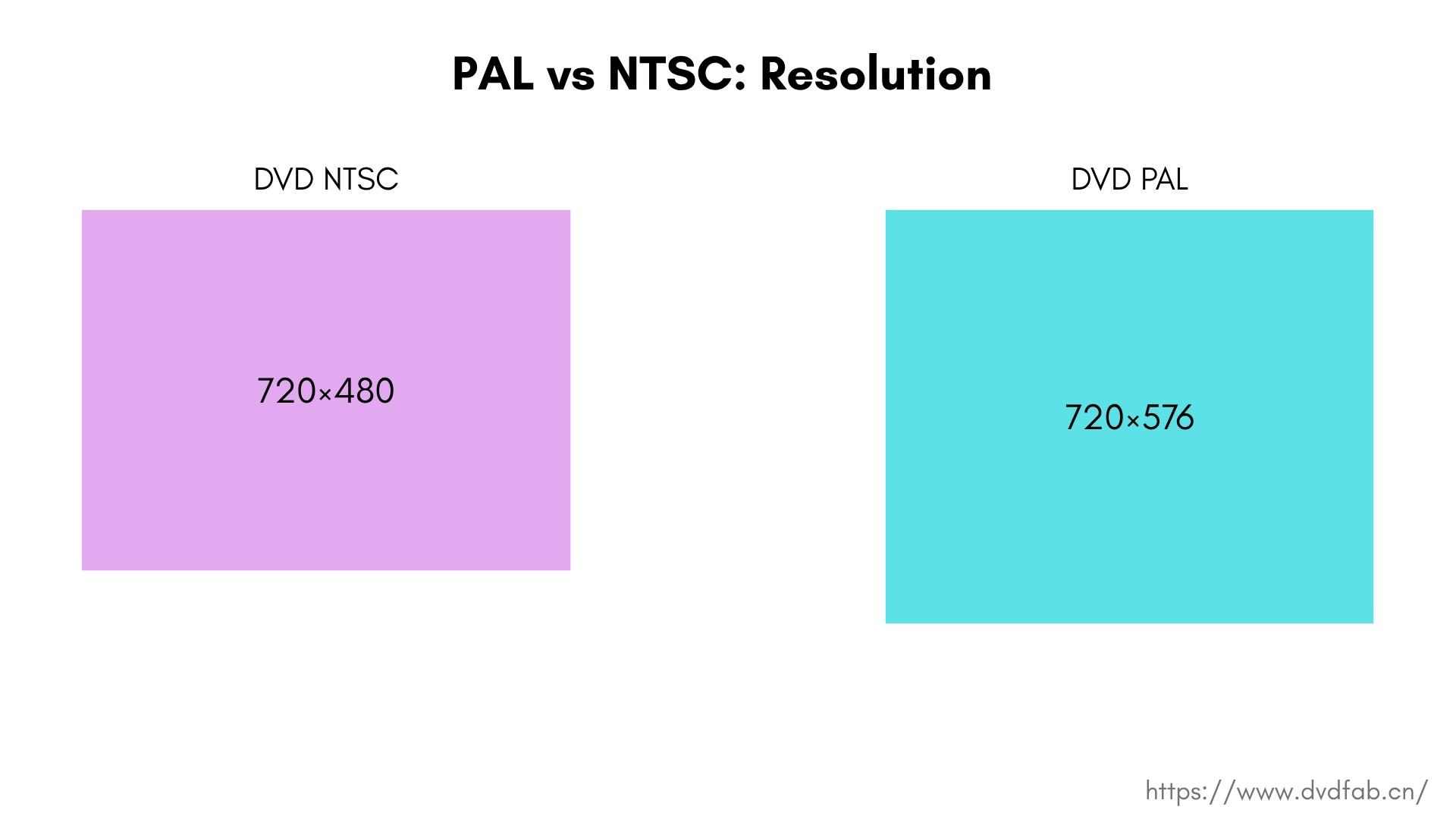
PAL DVD has more vertical pixels than NTSC DVD, but visible detail also depends on the original transfer, compression, display scaling, and viewing distance. Some older PAL game releases were adapted from 60 Hz versions without fully adjusting timing or screen layout, which can produce borders or slower gameplay on original hardware.
Frame Rate and Motion
Motion smoothness depends on frame rate, the source cadence (the pattern of frames or fields), and the destination device’s playback support. Video frame rate is measured in frames per second; analog field timing is a separate quantity. A higher nominal frame rate alone does not establish superior picture quality.

NTSC DVD video is commonly 29.97 fps, while PAL DVD video is commonly 25 fps. Converting between them requires more than changing a number in an export menu: the software may need to create or remove frames, preserve the source cadence, and keep audio duration aligned.
Some classic games released in PAL territories ran more slowly when their timing was tied to a 50 Hz refresh rate. Communities that keep separate regional leaderboards may also distinguish PAL and NTSC results, but the effect depends on the individual game and its regional release.
Color Encoding and Legacy Signals
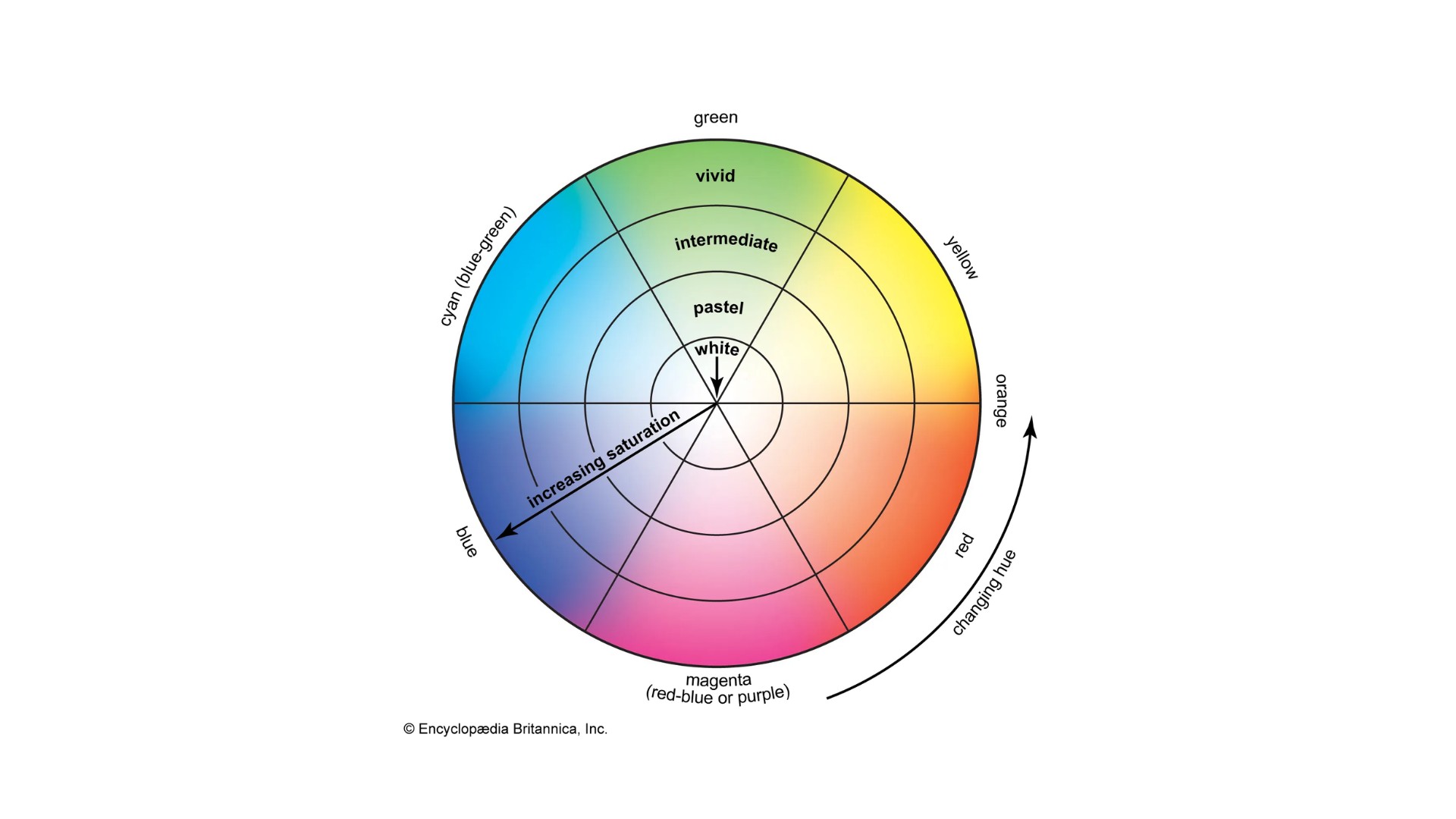
(Image from Britannica)
In color television, "luma" (black-and-white information) and "chroma" (color information) are transmitted independently. The chroma is then superimposed on a color subcarrier to follow the same path as the luma. In this manner, a color TV decodes the chroma to replicate color, whereas a black-and-white TV simply sees the luma layer.
The main method used by PAL to handle color in contrast to NTSC is line-by-line (Phase Alternating Line) chroma phase alternating. Skin tones and other colors are less likely to drift because to the receiver's usage of a one-line delay and "adjacent-line averaging," which somewhat reduces vertical color detail in exchange for small to moderate phase errors detected during transmission.
Traditional sets used a "Tint" control for manual correction since NTSC encodes "hue" directly in chroma phase; if the chain adds phase inaccuracy, the whole image may skew green or red. PAL, in contrast, is less susceptible to overall color shift and more "forgiving" of transmission problems. Although it depends more on appropriate phase and decoding, NTSC can also be correct with a clean chain. In the past, viewers frequently utilized the "Tint" control to achieve the desired skin tones.
Which Standard Fits Your Playback Setup
| Feature | PAL | NTSC |
| Common DVD picture size | 720 × 576 pixels | 720 × 480 pixels |
| Typical DVD frame rate | 25 fps | 29.97 fps |
| Legacy scan lines | 625 lines | 525 lines |
| Color encoding | Alternating chroma phase | Fixed chroma phase |
Neither standard is universally better. A compatible player can often display the original source without conversion, while a conversion is useful when your target player, editing project, broadcast requirement, or capture setup requires a different format.
A region-code restriction, a PAL/NTSC mismatch, and a device that already supports both standards call for different fixes. For an imported disc in the United States, the U.S. DVD region is separate from the video standard.
Choose the Right Conversion Path
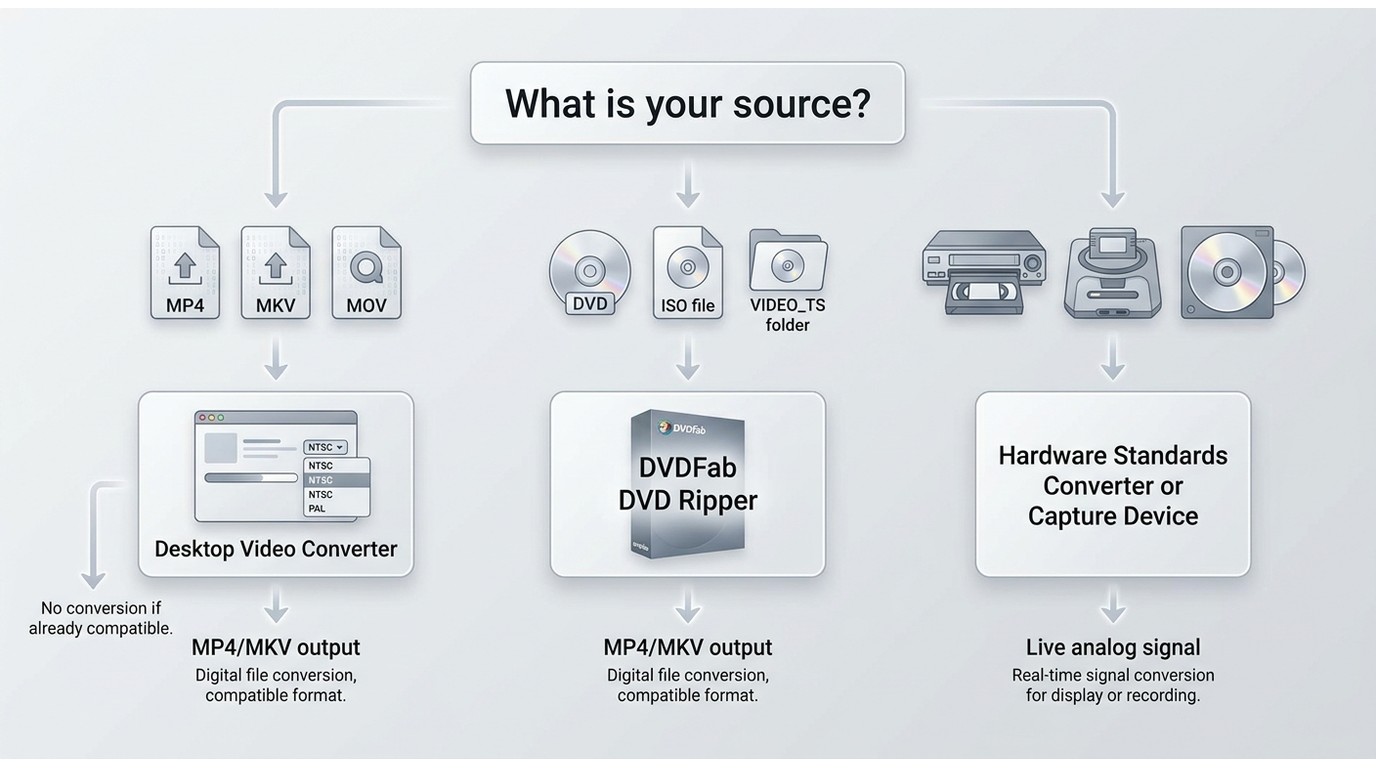
I recommend keeping the original video unchanged when your player supports it; if conversion is required, match the tool to the source before changing the frame rate. Digital files usually need software re-encoding only when the destination requires a different rate or picture size. DVDs, ISO images, and VIDEO_TS folders need a disc-reading tool before export. VHS, LaserDisc, retro consoles, and CRT setups may instead need compatible playback hardware, a standards converter, or a capture device.
Digital Files and Online NTSC to PAL Conversion
For an ordinary MP4, MOV, MKV, or AVI file, use a desktop video converter when the destination does not accept the existing frame rate or resolution. If the target player already plays the file correctly, preserving the original rate avoids unnecessary frame interpolation and audio retiming.
For online conversion with a tool such as FreeConvert, upload a short, non-sensitive file, select MP4 output, and inspect the frame-rate and resize controls only if the destination requires a change. Convert the video, download the .MP4 file, and inspect its actual frame rate, picture size, motion, and dialogue timing.
For HD or UHD delivery, a request for 25 fps does not by itself require SD DVD dimensions.
DVDs and ISO Images
For a DVD, ISO image, or VIDEO_TS folder, first save an authorized local copy in a format your player supports. MP4 is widely compatible for routine playback, while MKV can be useful when you need to retain multiple audio tracks, subtitles, or chapters. A local MP4 or MKV file is not an authored DVD-Video disc; creating a replacement disc requires DVD authoring and burning.
VHS, Consoles, and Analog Players
Live analog signals are different from files. A PAL VHS deck or 50 Hz console connected to incompatible U.S. equipment may require a multi-standard display, standards converter, or capture chain. Converting a previously captured file cannot make an incompatible analog input display correctly in real time.
For imported tapes or consoles, establish a compatible playback and capture or display chain before file conversion: it must accept the source connector and 50/60 Hz timing and supply the display's required output. Consider added input lag when selecting equipment, and check a camera pan, audio alignment, and controller response where applicable before a full capture or gaming session.
| Option | Source | Output |
| DVD ripper | Authorized DVD, ISO, VIDEO_TS | MP4, MKV, other local formats |
| General desktop video converter | Ordinary digital video files | Common video containers |
| Advanced restoration software | Interlaced or cadence-sensitive captures | Editing or delivery files |
| Hardware converter or capture chain | VHS, LaserDisc, consoles, live analog output | Display signal or captured video |
Convert NTSC to PAL or PAL to NTSC
Convert NTSC to PAL or PAL to NTSC only when the target device or delivery requirement calls for it. A digital file, DVD or ISO image, and live analog signal need different handling, and changing frame rate alone does not guarantee smooth motion or correct audio timing.
DVD and ISO Workflow with DVDFab
Instead of fighting with outdated analog hardware, I usually rip my DVDs directly to my computer. To do this, I use a specialized tool like DVDFab DVD Ripper. I prefer this approach because it tackles the two biggest hurdles of cross-region media at once:
- Automatic Region Code removing for legal and personal use: Physical discs are often locked to specific geographical regions. DVDFab can automatically remove these region codes during the reading proces.
- Preserve or change the frame rate: MKV Passthrough retains the source streams and timing, so it does not convert an NTSC stream into PAL; use an adjustable conversion profile in DVDFab DVD Ripper when the destination requires a different rate or size. Select the audio and subtitle tracks needed for playback.
By converting the physical media into a universal digital file, you will bypass the old format wars. Your newly digitized movie will play perfectly on your modern smart TV, smartphone, or Plex server without any stuttering, or frame drops.
Conversion Settings That Protect Quality
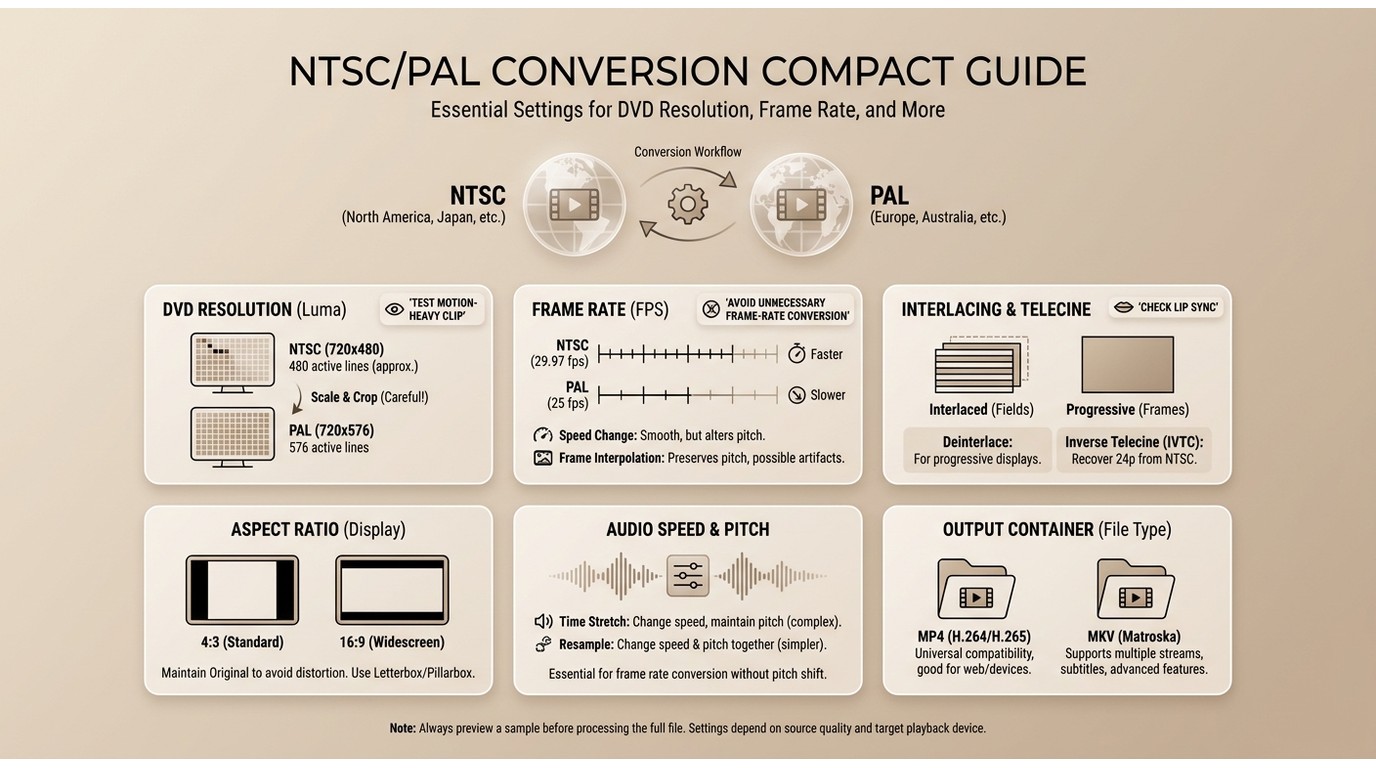
Inspect the source cadence (the pattern of frames or repeated interlaced fields), identify the destination requirement, preserve supported source settings, change the frame rate only when required, and check motion and dialogue timing in a short clip before a full export.
| Setting | What to check | Recommended direction |
| Destination requirement | Player support or delivery specification | Avoid conversion when the destination accepts the source. |
| DVD picture size | PAL 720 × 576; NTSC 720 × 480 | Preserve source size unless resizing is required. |
| Source cadence and frame rate | Repeated fields; 25 fps PAL or 29.97 fps NTSC | Resolve repeated-field patterns before required frame-rate conversion. |
| Interlacing | Interlaced fields or progressive frames | Deinterlace when progressive output is required. |
| Aspect ratio | 4:3 or widescreen; non-square DVD pixels | Preserve display proportions to avoid stretching. |
| Audio duration and sync | Dialogue timing, speed, and pitch | Check whether retiming or pitch correction is needed. |
Use MP4 for broad compatibility or MKV for flexible track retention.
Convert NTSC or PAL DVDs to Local Video
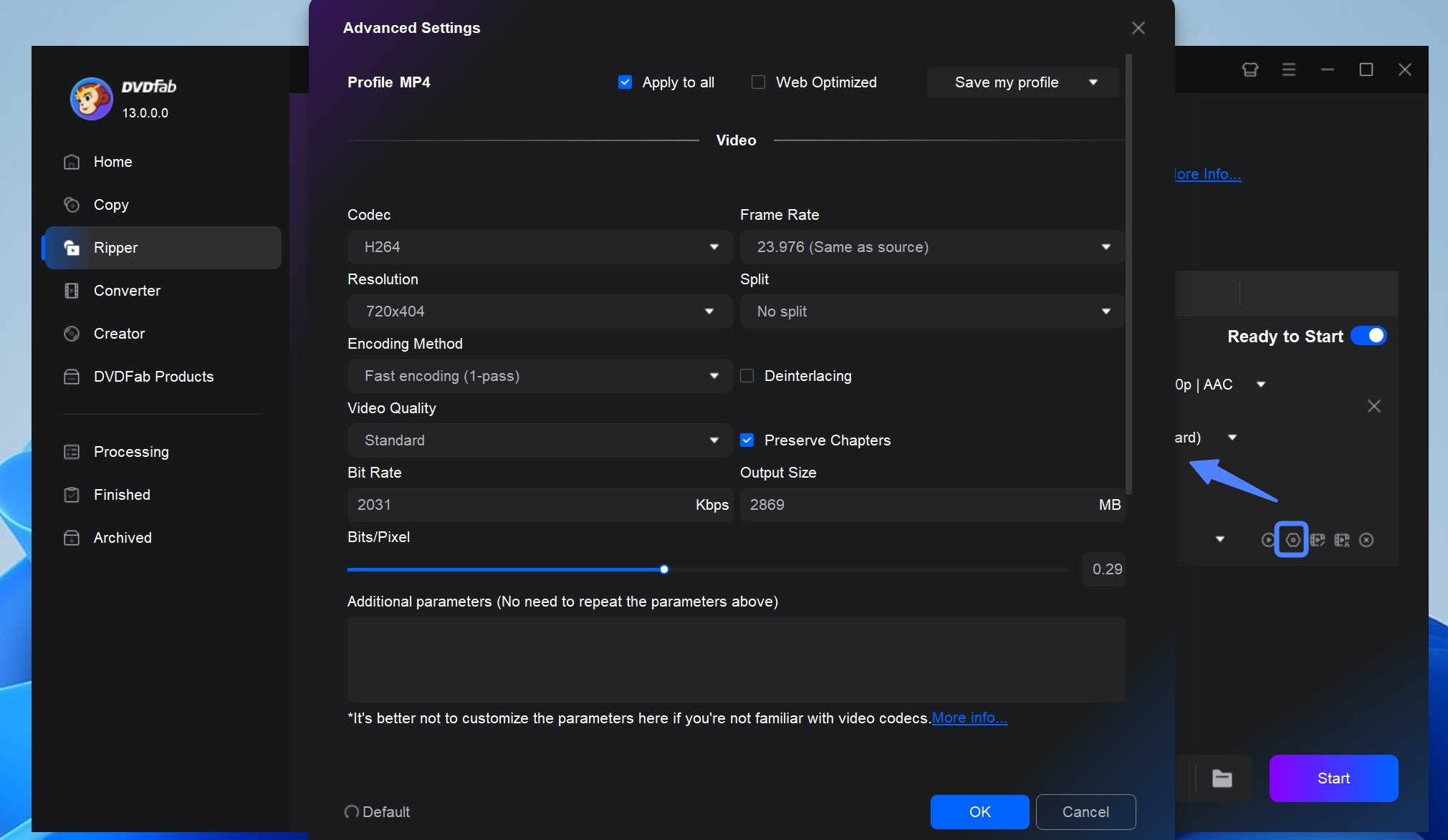
Step 1: Insert your PAL or NTSC DVD, or load an ISO image or VIDEO_TS folder, then open the conversion software. Confirm the main title, required audio tracks, subtitles, and chapters before selecting an output profile.
Step 2: Choose MP4 or MKV, then set the output resolution and frame rate for the destination device. Inspect whether the source is interlaced or uses telecine cadence, and apply the appropriate deinterlacing or cadence handling before converting between 25 fps and 29.97 fps.
Step 3: Export a short, motion-heavy test clip first and check for duplicate-frame judder, combing, stretched pictures, pitch changes, and audio-sync drift. If the clip looks and sounds correct, choose the output folder and convert the full title.
Frequently Asked Questions
Can VLC play PAL video without converting it?
VLC can often play a compatible PAL video file without conversion when the codec and display output are supported. It cannot resolve every DVD region restriction, analog signal mismatch, unsupported codec, or hardware-output limitation.
Can I convert NTSC to PAL online for free?
Online tools can be suitable for short, non-sensitive progressive files within their free-tier limits. A PAL-compatible MP4 video keeps the .MP4 extension; selecting a .pal image output does not create PAL television-standard video. They are a poor choice for DVDs, ISO images, VHS captures, long video, or interlaced footage because upload limits, compression, privacy, cadence handling, and audio timing can affect the result.
Is converting a DVD to MP4 legal in the United States?
Owning a DVD does not mean every use is authorized. Permission to make a personal MP4 backup depends on the specific use, applicable law, and license terms.
Why can converted video judder or lose audio sync?
Judder or sync drift can result from duplicated or removed frames, incorrect telecine or deinterlacing choices, PAL speed changes, pitch handling, or audio from a different source. Test a short clip with camera pans and dialogue before converting the full video.
Conclusion
NTSC and PAL still matter when older files, imported DVDs, VHS captures, consoles, and legacy displays meet newer equipment. Use the least disruptive option: keep the original file when the player accepts it, use software for ordinary digital video, use a DVD or ISO workflow like DVDFab for authorized discs, and use compatible playback or capture hardware for live analog sources.
I recommend changing the frame rate only for a specific playback or delivery requirement, with a short clip to check motion and dialogue timing before the full export.
For personal backups and playback, use only legally owned or otherwise authorized content that you are authorized to access, do not redistribute copies, and follow applicable law and platform or license terms. Permission depends on the specific use case.

 Best DVD to USB Converter in 2026: Tested WaysBy Diana Smith - Nov 20, 2026
 5 DVD to MP3 Converters for Windows and Mac [2026]By Wenny Yan - Nov 18, 2026
 2026 Tested DVD ISO to MKV Converters: Remux or Re-encodeBy Wenny Yan - Nov 12, 2026
 Convert DVD to WMV: 3 Steps for Legacy PlaybackBy Wenny Yan - Nov 10, 2026