How to Rip Blu-ray with HandBrake on Windows & Mac [2026 Tutorial]

Summary: HandBrake can rip Blu-ray discs, but only those without copy protection. This guide covers the unprotected disc workflow, how to extend HandBrake's reach using MakeMKV for encrypted discs, and when a dedicated ripper makes more practical sense. For most users, the decision comes down to whether the MakeMKV two-step workflow is worth the storage overhead compared to a single-step paid alternative.
Table of Contents
When I set out to digitize my Blu-ray collection for travel, HandBrake seemed like the obvious free option. What I found was more layered: HandBrake rips unprotected discs reliably, but most commercial Blu-rays use encryption it cannot handle without a separate tool. After working through the main workflows, this guide covers what HandBrake can and cannot do on its own, how to pair it with MakeMKV for copy-protected discs, and when a dedicated Blu-ray ripper is needed instead.
Does HandBrake Rip Blu-ray?
HandBrake 1.11.2 can rip Blu-ray discs, but only those that it can read without Blu-ray copy protection. Commercial Blu-rays commonly use AACS, BD+, or other protection that HandBrake does not process itself. libdvdcss does not change this limitation: it is a library for DVD CSS and does not provide Blu-ray AACS or BD+ support.
For unprotected discs, HandBrake reads the M2TS video streams and re-encodes them into MP4, MKV, or WebM. It also supports hardware video encoders such as Intel Quick Sync, Nvidia NVENC, AMD VCN, and Apple VideoToolbox on compatible systems. These encoders can reduce the time spent on video encoding, although the actual difference depends on the hardware, encoder, filters, and output settings.
For encrypted commercial discs, the standard workaround is to use MakeMKV to create an unencrypted MKV file first, then bring that file into HandBrake for compression and format conversion. HandBrake also handles CSS-encrypted DVDs through libdvdcss — see the guide to ripping DVDs with HandBrake for that workflow.
How to Rip Blu-ray with HandBrake (Unprotected Blu-rays)
HandBrake can help you rip Blu-ray discs, but most of the built-in drives work only for DVDs and may not support Blu-ray discs. So before starting the ripping procedure, ensure you have a capable Blu-ray drive. For UHD Blu-ray media, the optical drive must be able to read UHD Blu-ray discs. To do so, you can either install an internal drive or connect a compatible external Blu-ray drive using a USB.
Then let's see how to rip unprotected Blu-ray content with HandBrake.

Step 1: Load Your Blu-ray Disc and Open HandBrake
To begin, insert your unprotected or home-recorded Blu-ray. Remember that HandBrake works only with Blu-rays structured in a playable format and with standard video content in M2TS or similar format.
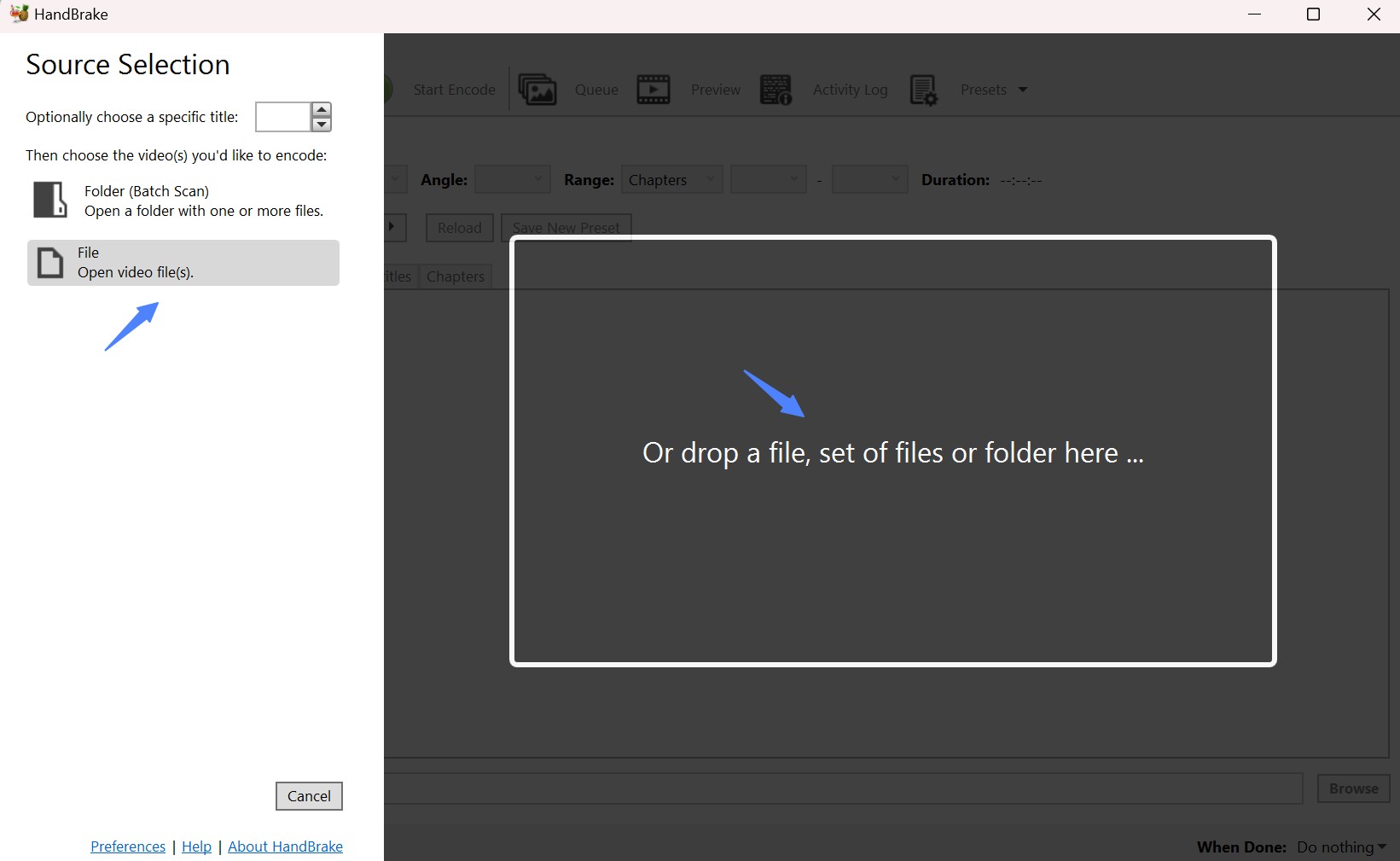
Next, move to the Source Selection menu and select your preferred Blu-ray drive as the input source. HandBrake will scan the contents, and depending on the number of titles (up to 95 or more), the process may take a few extra minutes.
Step 2: Select the Blu-ray Titles to Convert
After scanning, HandBrake lists all detected titles. The main movie is usually the longest title with the largest file size.
💡Use "Preview" to play a few seconds if you're unsure. If several titles have similar runtimes, compare them with the movie or episode you intend to encode rather than assuming the longest entry is always correct.
Step 3: Select an Output Format and Preset
Now, pick your preferred output format and preset. HandBrake supports MKV, MP4, and WebM formats, each offering distinct benefits. Then click the Presets dropdown menu to choose from a variety of options, whether standard quality or HD settings.
- MP4 – Widest compatibility across phones, TVs, gaming consoles, and media players
- MKV – Better for archiving, multiple audio tracks, and subtitles (e.g., Plex, HTPC).
- WebM – Mainly for web use; not ideal for offline playback.
💡Don't pick 4K unless your device supports it, and stick to H.264 for widest compatibility. Presets are your friend—customize only if you're comfortable.
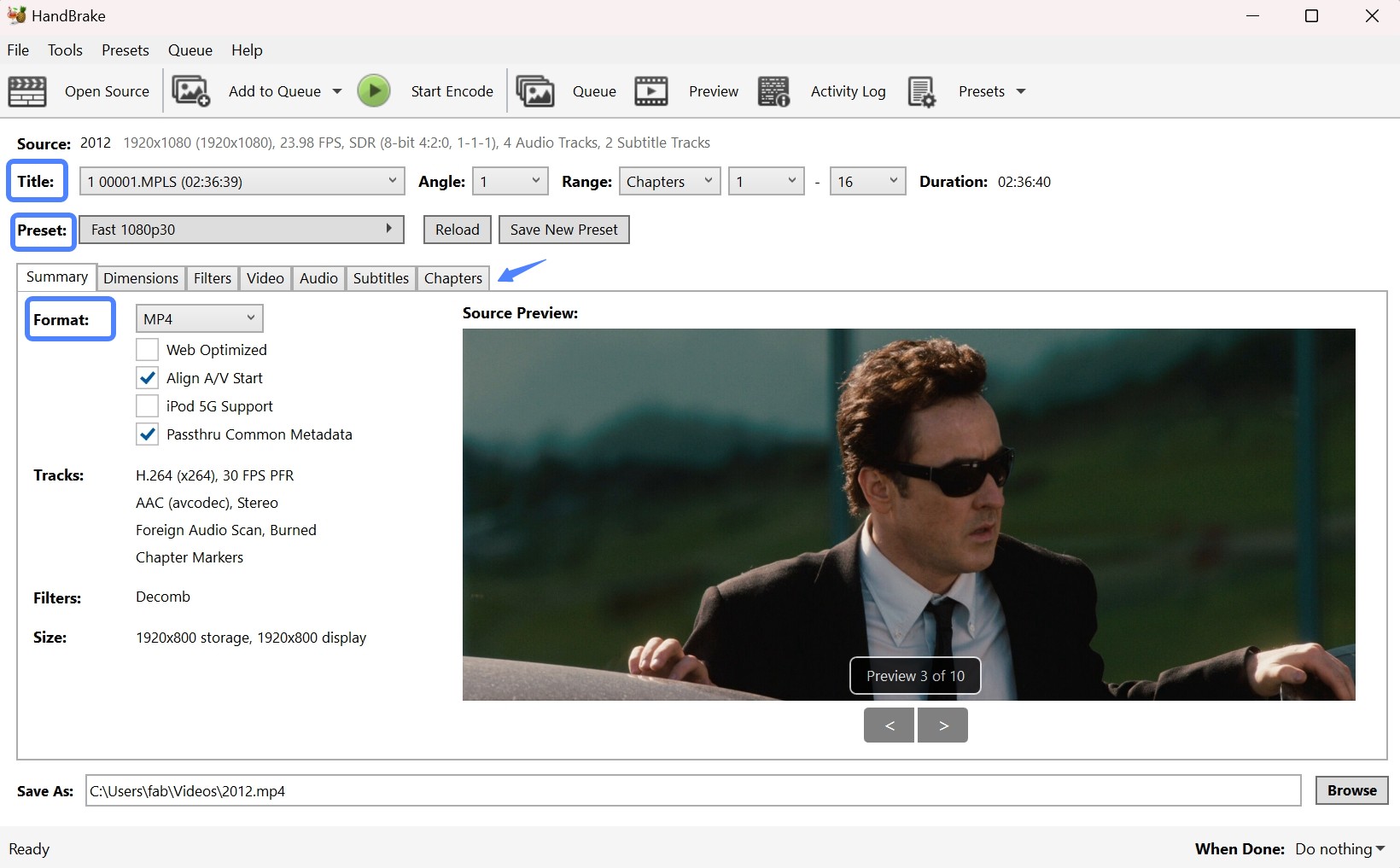
Select a format and then pick a Preset for quality and resolution:
- Default Fast 1080p30 is a good speed/quality balance.
- Higher presets (e.g., Super HQ 1080p30) look better but encode slower and create larger files.
- 720p presets reduce size but also reduce detail.
You'll see Fast 1080p30 as the default for a good balance between encoding speed, output size, and broad compatibility. For a higher-quality preset with surround audio, HandBrake also provides HQ 1080p30 Surround and Super HQ 1080p30 Surround, which encode more slowly and generally create larger files. You can select a 720p30 preset when reducing resolution and file size matters more than retaining the source's 1080p detail.
For a readable 2160p source, HandBrake also provides 2160p 4K presets, including H.265/HEVC options. Keep the source at 2160p only when you need the 4K output and your playback devices support the selected codec.
On macOS with compatible hardware, VideoToolbox encoders appear in the Video tab's Encoder menu and apply hardware acceleration automatically.
Step 4: Adjust the Video and Audio Settings
In the Video tab, configure the codec (H.264 for broad compatibility, or H.265 for supported devices when compression efficiency matters), resolution, quality, and frame rate. For x264/x265 1080p output, HandBrake recommends starting around RF 20–24; for 2160p, the recommended range is RF 22–28. Lower RF values increase quality and usually increase file size.
In the Audio tab, select which tracks to include. Passthrough can keep a compatible source audio stream without re-encoding, but availability depends on the source codec, output container, and playback requirements.
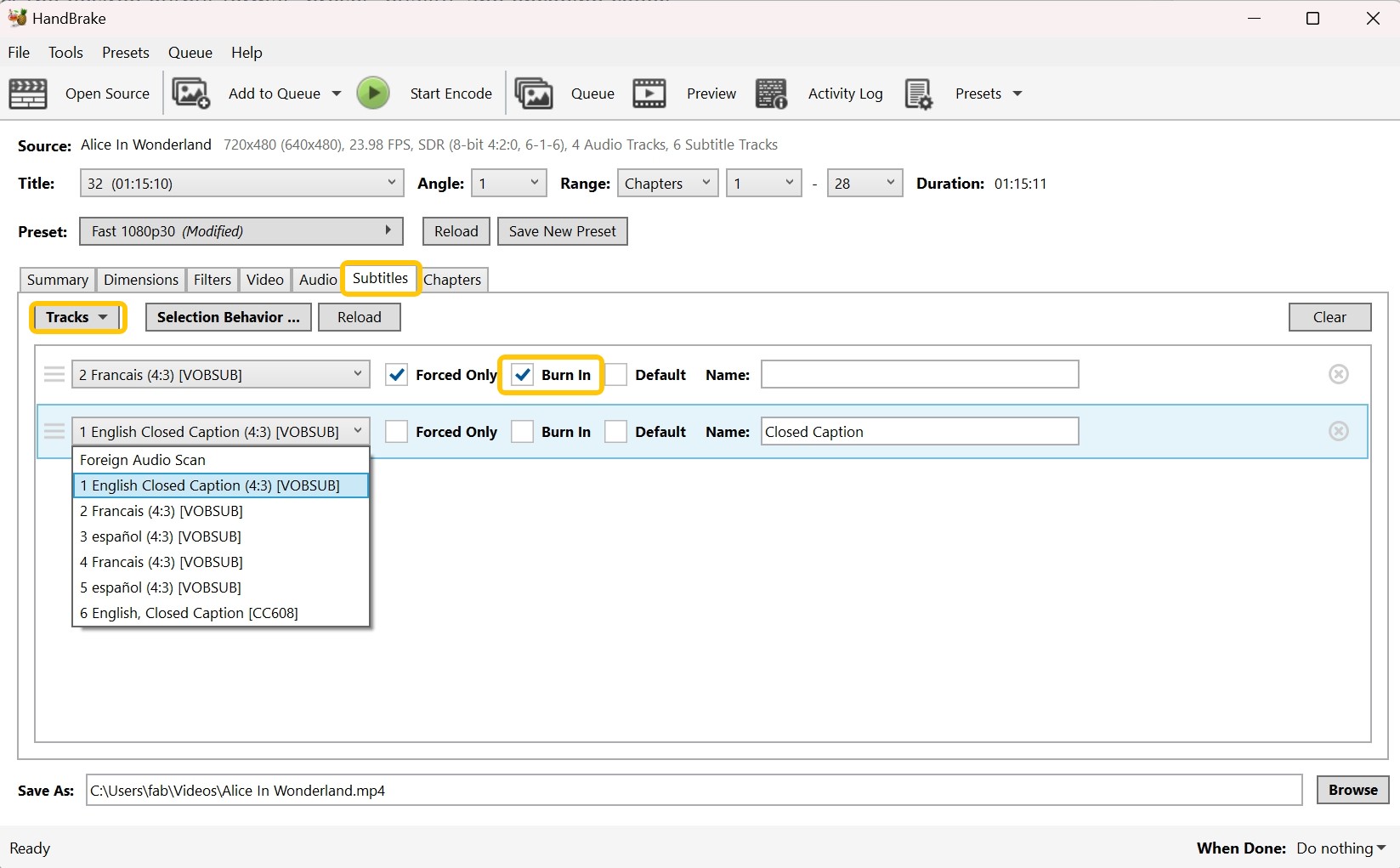
In the Subtitles tab, Blu-ray PGS tracks are handled differently by container. With MP4, HandBrake can burn one PGS subtitle track into the picture but cannot keep PGS as a selectable subtitle track. With MKV, multiple PGS tracks can be passed through and remain selectable; one track can also be burned in if needed.
Step 5: Set a Destination and Start Encoding
Choose where to save the output file in the Save As field (click Browse to change folder) and make sure you have enough free space.
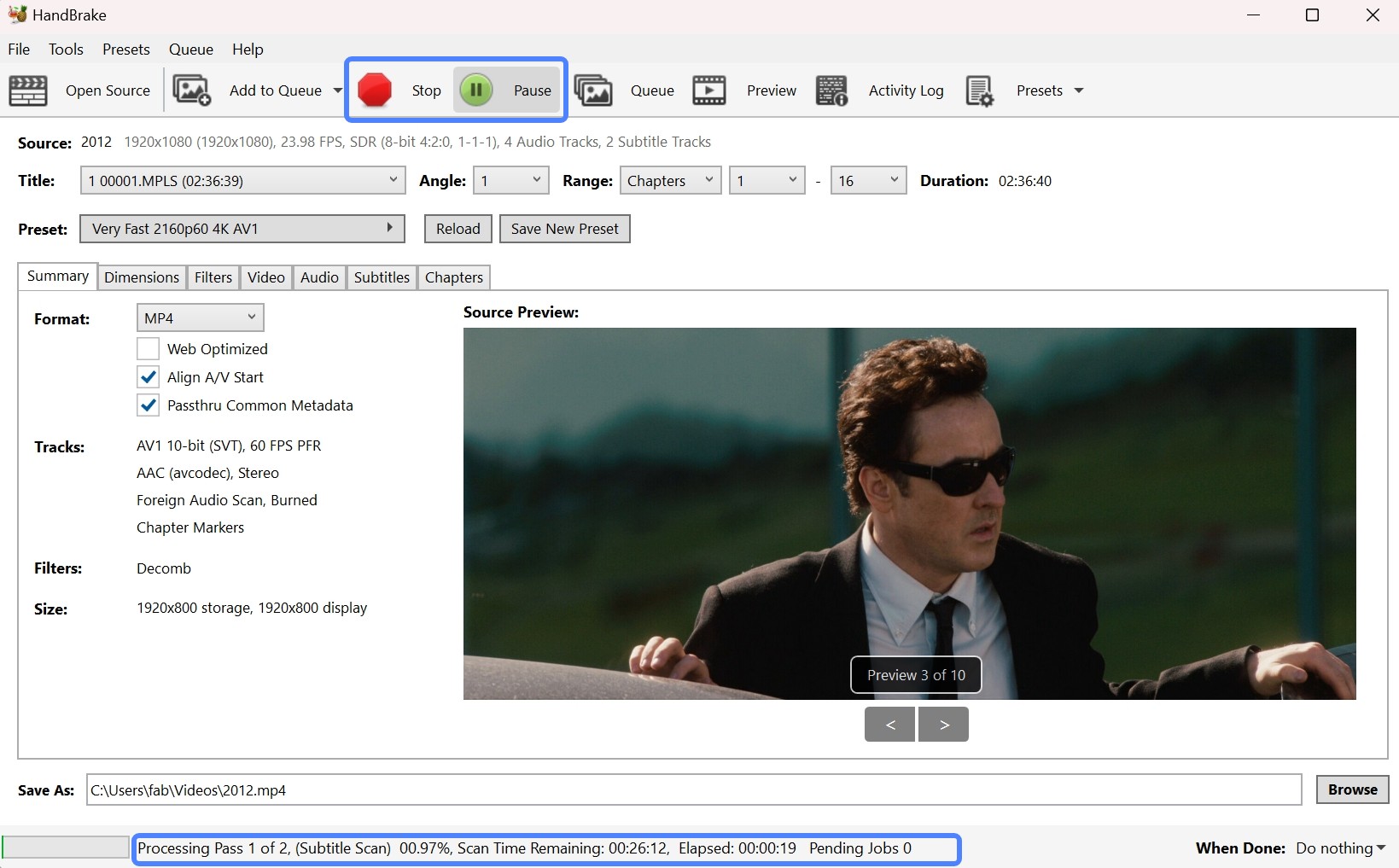
The final file size can vary widely even for Blu-rays with similar runtimes. Encoder choice, RF value, film grain and image complexity, audio tracks, and subtitle tracks all affect the result. If storage size matters, use HandBrake Preview to compare a short sample before encoding the full movie.
Click Start Encode to begin. HandBrake will:
- Decode the Blu-ray's M2TS streams
- Re-encode them with your chosen settings
- Save them into the selected container
Encoding can take a long time for full-length movies, especially at high quality, so it's normal for the process to run for hours on slower hardware.
How to Rip Blu-ray with HandBrake + MakeMKV (Some Protected Blu-rays)
HandBrake alone can't read many commercial Blu-rays protected with AACS or BD+. MakeMKV can first remux the selected Blu-ray streams into an MKV file without re-encoding the video; HandBrake can then encode that MKV when you want a smaller file or a different codec/container.
Always make sure your usage complies with local laws before copying commercial discs.
Step 1: Install MakeMKV and Scan the Disc
- Download and install MakeMKV 1.18.4, then insert the Blu-ray you want to rip into your Blu-ray drive.
- Launch MakeMKV and click the Blu-ray drive icon on the main screen to scan the disc.
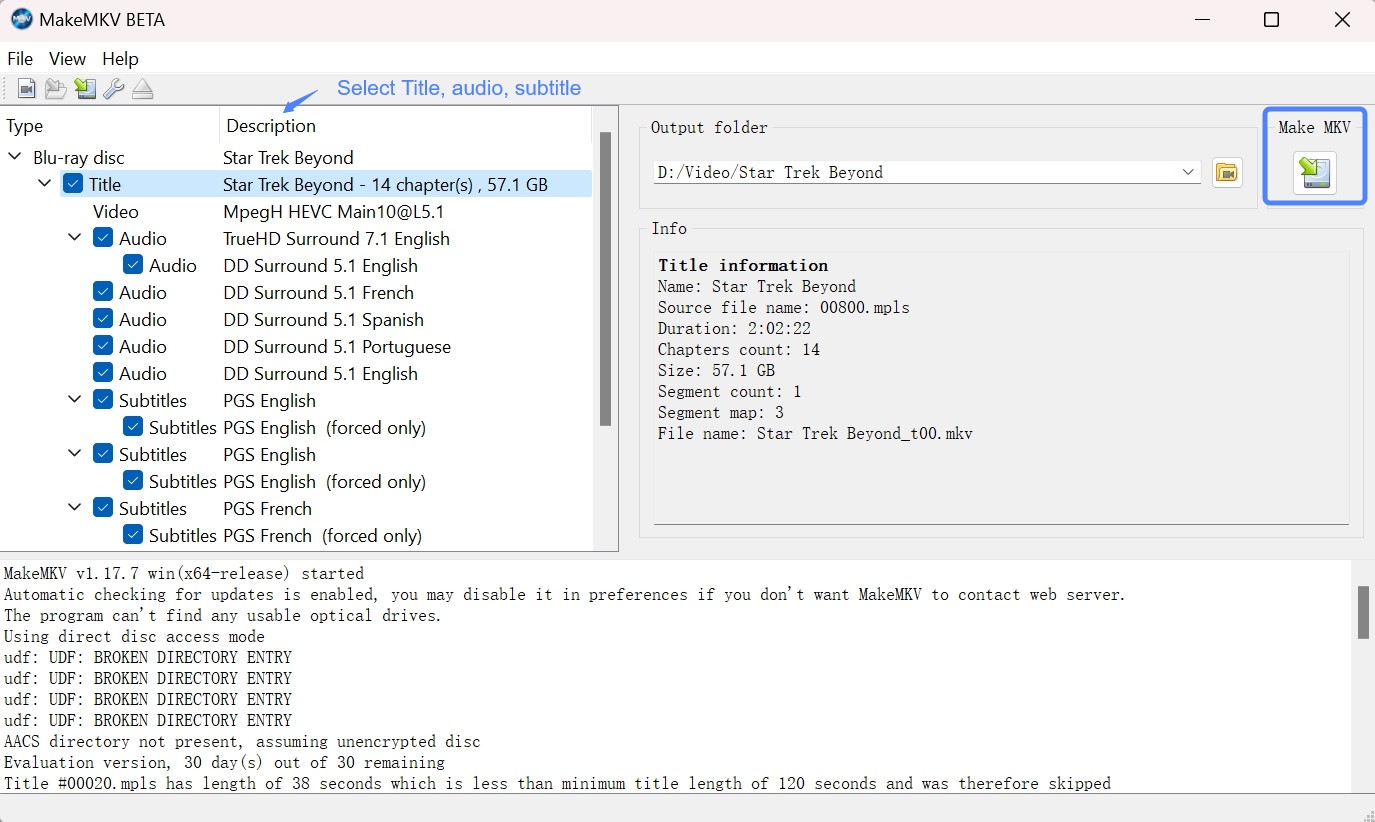
- When the title list appears, select the one you need—usually the main movie with the longest runtime / largest size.
💡MakeMKV does not compress the selected video stream, so a main-feature Blu-ray MKV is often tens of gigabytes. Check that the destination drive has enough free space before starting.
Step 2: Ripping the Disc with MakeMKV
Choose an output folder for the ripped file and check that you have enough free space (one movie can take 30 GB or more). Then click the green "Make MKV" button to start. MakeMKV will convert the selected title to an MKV file. The time required depends mainly on the amount of data being read, optical-drive speed, and disc condition.
Step 3: Load the Ripped File into HandBrake
Open HandBrake, click File → Open Source (or drag the ripped MKV into the window), and let it scan the file. Then click Browse to choose where to save the new, compressed output.
Step 4: Configure Settings and Encode
Select a preset from the sidebar. In the Video tab, set the frame rate to Same as Source unless you have a specific reason to change it. For x264/x265 1080p output, HandBrake recommends starting in the RF 20–24 range; for 2160p output, start around RF 22–28. Lower RF values increase quality and normally increase file size.
In the Audio tab, use Passthrough when the source audio codec is compatible with the selected container and your playback device. Once the settings are configured, click Start Encode. HandBrake will encode the MKV into the selected output container and settings.
For maximum MP4 compatibility, this configuration works as a consistent baseline:
- Preset: General → Fast 1080p30 (as a base), then tweak below
- Video encoder: H.264 (x264)
- Quality: Constant Quality RF 20 as a starting point; HandBrake's recommended x264/x265 range for 1080p is RF 20–24
- Frame rate: Same as source + CFR (Constant Frame Rate) for widest device support
- Tune/preset: x264 Preset = Medium (move to Slow for smaller files/slower encodes)
- Profile/Level: High / 4.1 (1080p)
- Filters: Decomb only if the source is interlaced; otherwise Off
- Audio: Track 1 AAC 2.0 160–192 kbps (universal).
- Optional Track 2 AC-3 5.1 Passthrough (many players OK; DTS/TrueHD in MP4 has limited support).
- Subtitles: Burn one PGS track into MP4 when needed; use MKV to keep multiple PGS tracks selectable.
HandBrake Alternative for Protected Blu-rays
While HandBrake plus MakeMKV can handle some encrypted Blu-rays (such as discs using AACS or BD+), this setup still struggles with newer or more complex protection schemes. It also requires switching between two separate programs, which adds extra steps and time.
If you want a streamlined, all-in-one tool that can deal with a wider range of protections and handle ripping in a single workflow, DVDFab is a more convenient alternative.
DVDFab Blu-ray Ripper serves as the best HandBrake alternative that can rip copy-protected commercial Blu-ray discs into more than 1000 digital formats for playback on any device, whether mobile phones, computers, or home theatres. Its advanced decryption technology can decrypt even the latest released Blu-rays at super-fast speed.
💻Supported OS:
Free Download Windows 11/10/8.1/8/7
Free Download macOS 12 or newer
💡Key Features:
- Rips 2D/3D Blu-ray discs to 1000+ digital (video and audio) formats
- Supports an exclusive Cloud Decryption Service to remove protection
- Lossless (1:1) quality for a seamless visual experience
- GPU-accelerated encoding via Intel Quick Sync, Nvidia NVENC, and AMD VCE
- Batch ripping for processing multiple discs in sequence
- Provides a built-in video editor for users' customization
Comparison of DVDFab and HandBrake Blu-ray Ripper
This comparison table explores the critical differences between the two popular Blu-ray ripping software programs: DVDFab Blu-ray Ripper and HandBrake. I have covered the necessary parameters to help you compare the two on common grounds and settle on the right tool with a smooth user experience for your needs.
| Various Parameters | DVDFab Blu-ray Ripper | HandBrake |
| Platform Availability | Windows and macOS | Windows, macOS, and Linux |
| Input | Newest Commercial Blu-ray discs, ISO files and folders | Unprotected or home-recorded DVDs and Blu-ray discs |
| Output | Over 1000 digital formats (audio and video) | Only 3 formats (i.e., MP4, MKV, and WebM) |
| Decryption Services | Yes, including the latest released Blu-ray discs | No, it requires third-party tools for encrypted DVDs and Blu-rays |
| Editing Features | Built-in video editor (trim, crop, merge, add watermark, adjust video appearance) | Basic editing features (crop and resize) |
| Video Quality | Lossless (1:1) copy available | Re-encoded output |
| Device Optimization | Pre-configured profiles for 260+ devices | General format presets (MP4, MKV) |
| GPU Hardware Acceleration Technology | Yes | Yes |
To ensure the objectivity of the comparison, both software programs were tested under the same testing environment. The table below presents the actual test data. It can be seen that, with comparable output file sizes, DVDFab Blu-ray Ripper's ripping speed is 24 times faster than HandBrake's, while also providing higher resolution and default audio quality.
| HandBrake vs DVDFab Blu-ray Ripper (Blu-ray to MP4 Test) | ||||||
| Tool | Codec | Preset Bit Rate | Ripping Time | Output Size | Resolution | Audio |
| DVDFab | H.265/AAC | 3000 kpbs | 13m 49s (Very fast) | 3.74 GB | 1920x1080 | AAC 5.1 |
| HandBrake | H.265/AAC | N/A | 5h 34m (Very slow) | 3.46 GB | 1920x800 | AAC 2.0 |
| Test Environment: Windows 10 X64 system equipped with 16GB of RAM, RTX 4060 Ti 8GB GPU, and Intel i7-6700 CPU. The test source was the movie 2012 (2h36m, 33.43GB source). | ||||||
How to Rip Protected Blu-rays with DVDFab Blu-ray Ripper
Step 1: Download DVDFab 13.0.6.6 on your PC or Mac, and rip your Blu-ray content by tapping the Ripper module. Click Add or drag your source file into the main window.
Step 2: Select your output profile from the Choose Other Profile menu.
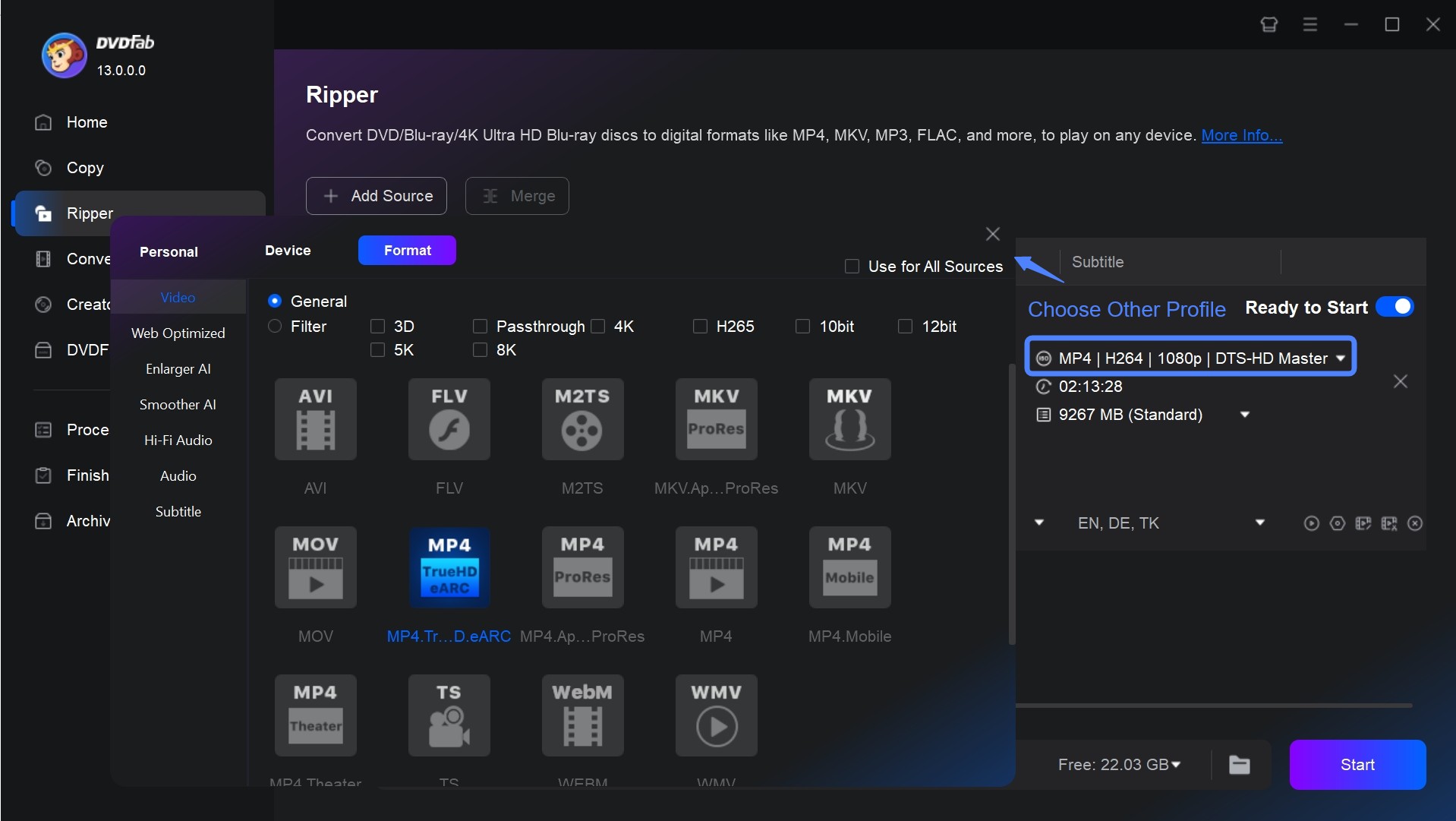
Step 3: Choose the titles, audio tracks, and subtitles to include.
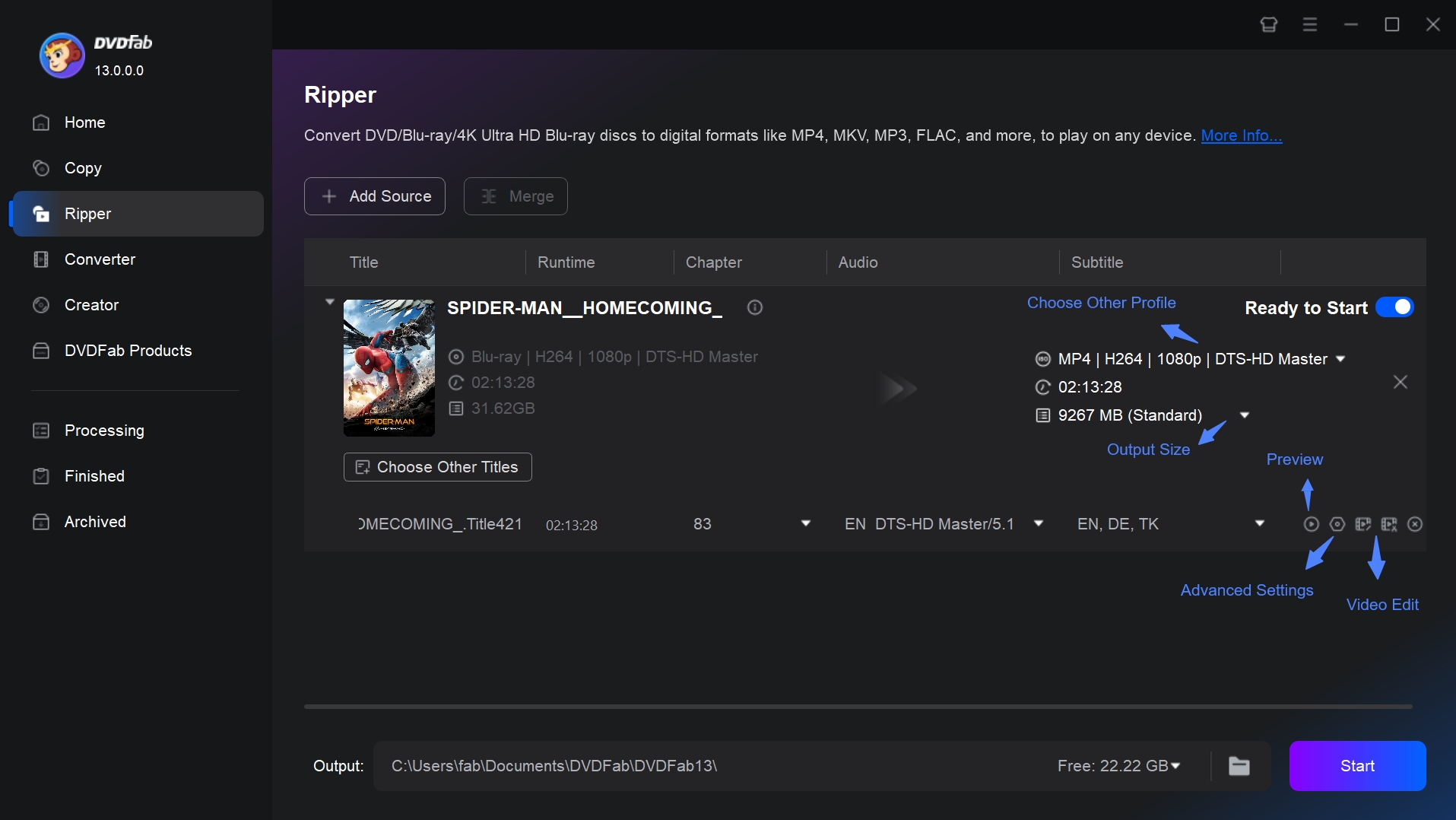
Step 4: Configure video and audio output in Advanced Settings. The built-in video editor handles crop, trim, merge, watermark, and color adjustments.
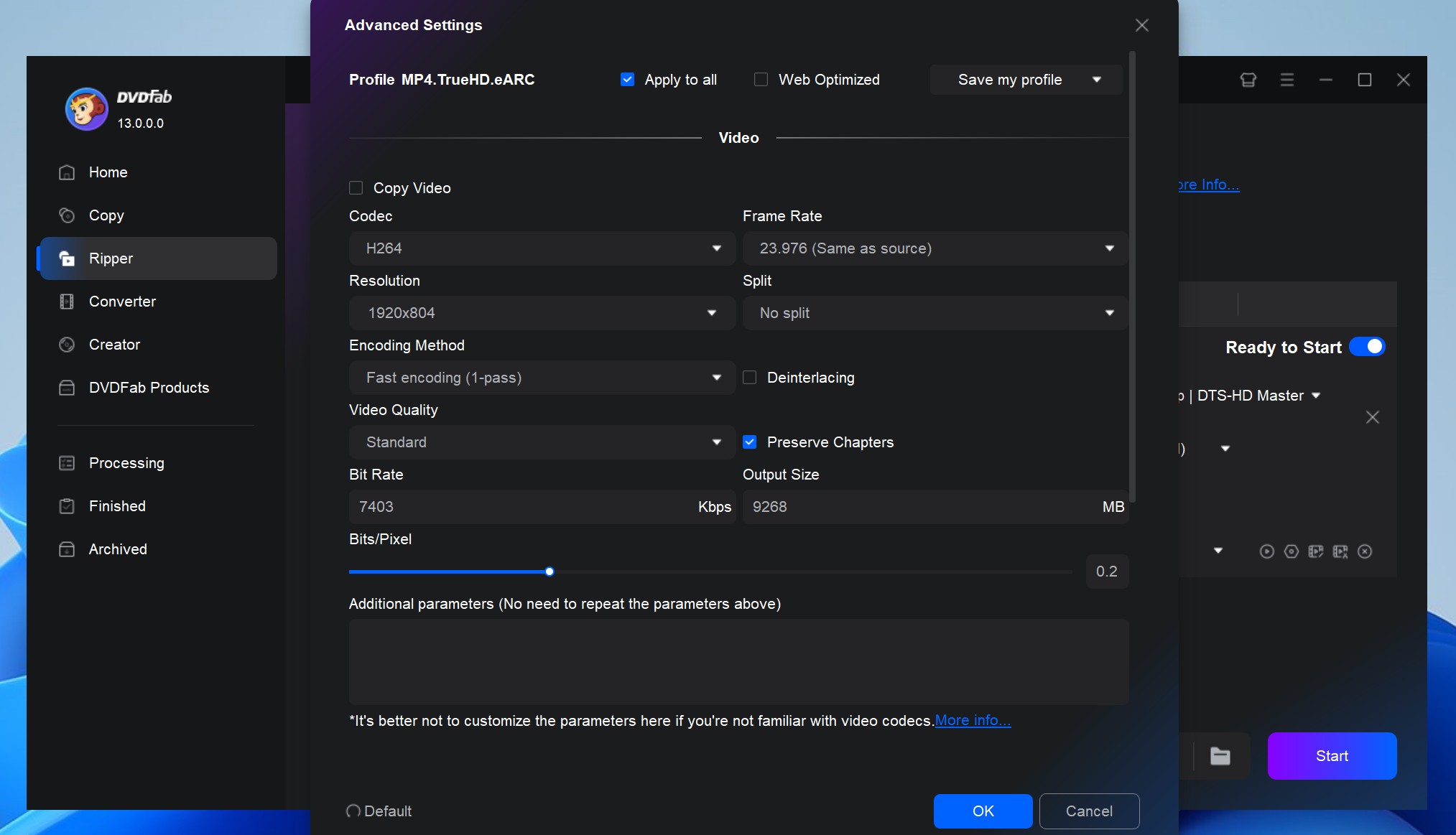
Step 5: Click Start to begin Blu-ray ripping with GPU acceleration.
FAQs
Does libdvdcss work with Blu-ray?
No. libdvdcss is designed for CSS-protected DVDs. It does not provide AACS or BD+ support for Blu-ray discs, so installing libdvdcss does not make a protected Blu-ray readable in HandBrake.
Does HandBrake support GPU acceleration for Blu-ray encoding?
Yes. HandBrake supports hardware video encoding through Intel Quick Sync, Nvidia NVENC, AMD VCN, and Apple VideoToolbox on supported systems. Hardware acceleration affects the video-encoding stage; total processing time still depends on decoding, filters, audio, subtitles, the CPU, and the selected settings.
Can HandBrake Rip 4K Blu-ray?
HandBrake can encode a 2160p source that it can read, but it does not process commercial UHD Blu-ray protection itself. Your optical drive must also be able to read UHD Blu-ray media. For x264/x265 2160p encoding, HandBrake recommends starting around RF 22–28 and adjusting according to the quality and file size you need.
Conclusion
HandBrake is a capable free tool for unprotected Blu-rays. Pairing it with MakeMKV extends that to many encrypted commercial discs, with the trade-offs of a two-step workflow, large intermediate files, and gaps with newer protection schemes.
Choose the HandBrake plus MakeMKV combination if you primarily work with unprotected discs or have a small collection of encrypted titles and don't mind managing intermediate storage. Choose DVDFab Blu-ray Ripper if you rip commercial Blu-rays regularly, need 4K HDR support with protection removal, or want a single-step process without intermediate files.
Note: Use Blu-ray copying or conversion tools only with discs you own or are authorized to use, and follow the requirements that apply where you live.

![How to Rip and Extract Hi-Fi Audio from Blu-rays? [2026 Update]](https://r4.dvdfab.cn/upload/resource/en/how-to-convert-blu-rays-to-hi-fi-audio-files-AGcW.jpg) How to Rip and Extract Hi-Fi Audio from Blu-rays? [2026 Update]By Diana Smith - Sep 1, 2026
How to Rip and Extract Hi-Fi Audio from Blu-rays? [2026 Update]By Diana Smith - Sep 1, 2026 How to Convert BDMV to MKV/MP4 on Windows or macOS: 6 Tested ToolsBy Diana Smith - Aug 31, 2026
 How to Rip 3D Blu-ray to MVC, SBS or TAB for Quest 3, Projectors & PCBy Wenny Yan - Aug 26, 2026
 How to Convert 3D Blu-ray to SBS 3D MKV/MP4: Detailed Guide in 2026By Diana Smith - Aug 18, 2026