How to Enable HandBrake GPU Acceleration: Encoders, Setup, and Fixes

Summary: HandBrake supports GPU acceleration through NVIDIA NVENC, AMD VCE/VCN, and Intel Quick Sync. To enable it, load a video, open the Video tab, and select a compatible hardware encoder before starting or queueing the job. GPU encoding is faster and reduces CPU usage, but it may produce slightly larger files or lower quality than slower CPU encoding. Supported systems can also use hardware decoding to speed up input processing.
Table of Contents
Among various popular video converters and transcoders, HandBrake stands out as a free and open-source program that converts digital files into different formats hassle-free. Seasoned and new users prefer HandBrake for its ease of use and versatility. However, many users wonder, "Does HandBrake use GPU?" Only a few users know they can harness HandBrake GPU acceleration to boost the transcoding process using the system's graphics card.
In this guide, I'll explain whether HandBrake uses the GPU, show how to enable hardware acceleration, and discuss the trade-offs in speed, file size, and output quality. I'll also compare it with an alternative for users who want a simpler or more automated transcoding workflow.
Does HandBrake Use the GPU?
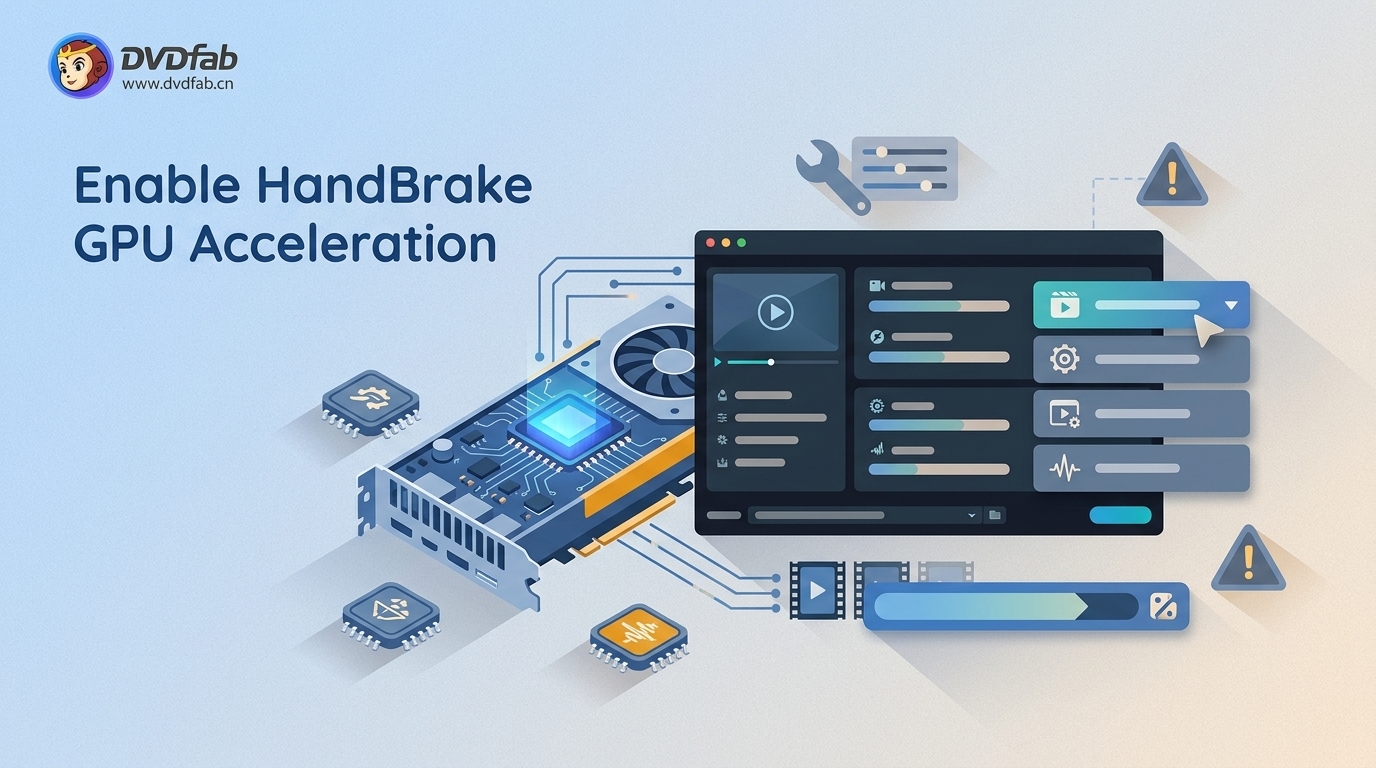
Yes. HandBrake use GPU resources when you select a supported hardware video encoder, while the CPU continues to run the rest of the job. The practical question is not simply HandBrake CPU or GPU; it is which stage handles each part of the transcode.
What the GPU Actually Handles
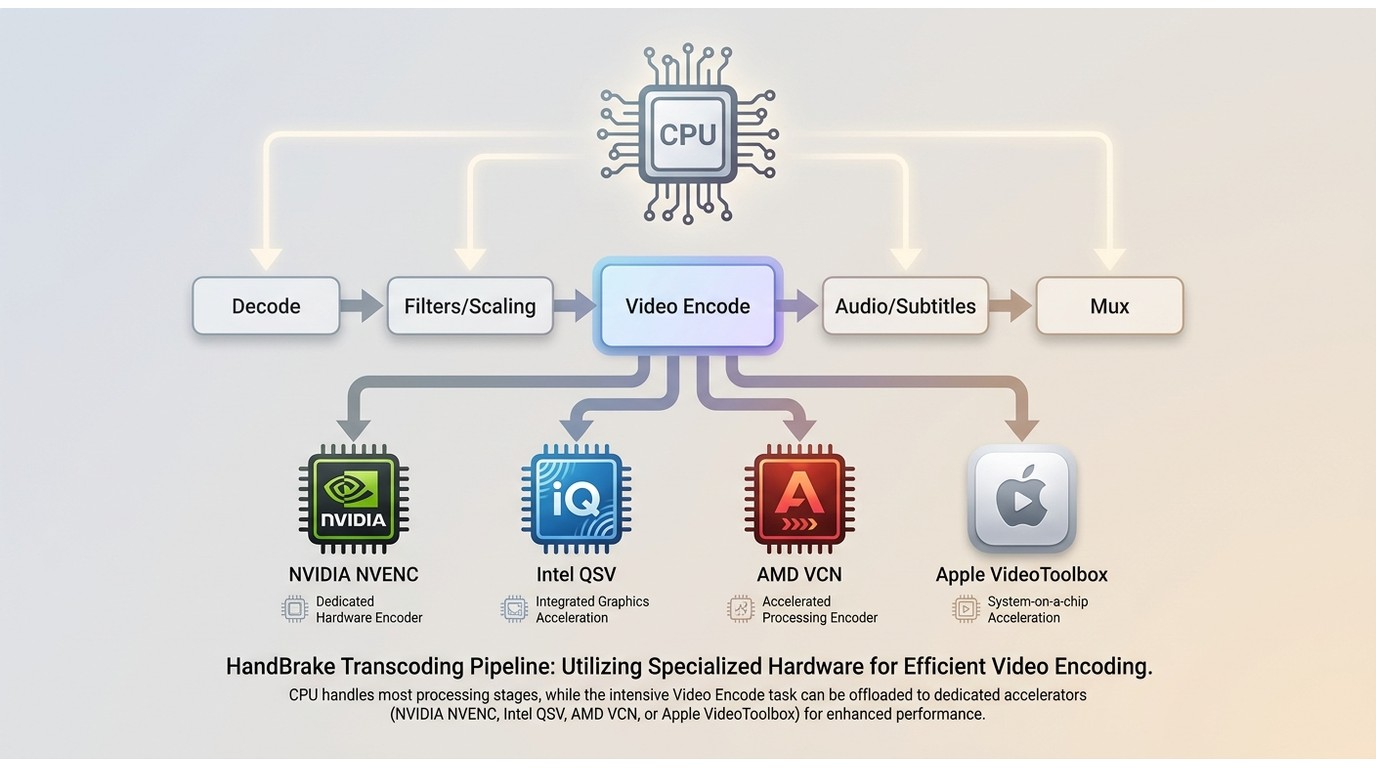
HandBrake GPU encoding primarily accelerates the video-encode stage. Hardware decoding may also be available, but decoding support is separate from encoding support and varies by source codec, vendor, operating system, driver, and hardware generation.
| Pipeline Stage | Typical Processor | What to Check |
| Video decoding | GPU when a supported hardware decoder is active; otherwise CPU | Source codec and decoder entry in the activity log |
| Scaling and filters | Often CPU, depending on the filter and hardware path | Crop, deinterlace, denoise, subtitle burn-in, and scaling settings |
| Video encoding | GPU or fixed-function media engine with NVENC, QSV, AMD VCN, or VideoToolbox | Selected Video Encoder and activity log |
| Audio and subtitles | Usually CPU | Audio conversion, subtitle handling, and burn-in |
| Synchronization and muxing | CPU | Container assembly and final write speed |
- Queue multiple encode jobs and save settings per item
- Select titles, chapters, and source ranges
- Preserve chapter markers and supported subtitle tracks
- Choose variable or constant frame rate when the source requires it
- Encode with software or supported NVIDIA, Intel, AMD, and Apple hardware paths
- Convert audio with common codecs or use pass-through when compatible
- Write MP4, MKV, or WebM output
- Preview the selected crop, scale, filters, and subtitle treatment
- Apply deinterlace, decomb, denoise, deblock, and detelecine filters when needed
- Adjust color, grayscale, crop, and scale settings before encoding
Why the CPU Remains Active
HandBrake high CPU usage is normal when decoding, filters, audio, subtitles, synchronization, or muxing need substantial work. A hardware encoder accelerates one stage, not the complete job.
The useful test is whether the log names the intended hardware encoder. In my editing work, I do not disable a necessary deinterlace or subtitle step merely to raise a GPU graph; a faster result is not useful if it no longer meets the playback goal.
HandBrake GPU Compatibility by Platform
HandBrake hardware acceleration depends on the installed build, operating system, driver, GPU generation, and selected codec. As of July 2026, the current families are NVIDIA NVENC/NVDEC, Intel QSV, AMD VCN, and Apple VideoToolbox.
| Hardware Path | Encoding | Decoding | Platform Notes | Verification |
| NVIDIA NVENC / NVDEC | NVENC appears for supported codecs and hardware | NVDEC availability depends on source codec and configuration | Requires a supported NVIDIA GPU and current driver | Check the Video Encoder menu and activity log |
| Intel Quick Sync Video | QSV appears when the Intel media engine is exposed | Hardware decoding depends on platform and codec support | Documented for Windows, some modern Linux distributions, and FreeBSD when requirements are met | Check the QSV encoder name in each job log |
| AMD VCN | AMD hardware encoders appear on supported systems | Decode support varies by source and software stack | Use current AMD VCN terminology rather than the older VCE-only label | Confirm the AMD encoder in the menu and log |
| Apple VideoToolbox | VideoToolbox encoders appear on supported Macs | Available decoding depends on Mac hardware, macOS, and codec | macOS uses VideoToolbox rather than Intel QSV | Confirm the VideoToolbox encoder in the activity log |
NVIDIA NVENC and NVDEC
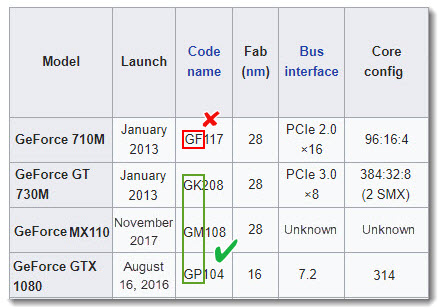
HandBrake NVENC handles supported video encoding, while NVDEC may handle supported decoding. Do not use an old GPU code-name prefix as the compatibility test. Update the NVIDIA driver, then confirm that the intended NVENC encoder appears in HandBrake.
An older version of this page sent readers to a general NVIDIA GPU list. That list may identify a model, but current support should be verified through HandBrake, the installed driver, and the activity log.
Intel Quick Sync Video
HandBrake Intel QSV uses the media engine built into supported Intel processors. It can be available on Windows, some modern Linux distributions, and FreeBSD when the hardware and software requirements are met. A disabled integrated GPU or unsuitable driver can hide the encoder.
AMD VCN Hardware Encoding
HandBrake AMD VCN is the current AMD hardware-encoding path. Availability varies with the GPU generation, operating system, driver, and codec, so the encoder menu is more reliable than a generic list of graphics-card families.
Apple VideoToolbox on macOS
HandBrake VideoToolbox provides hardware encoding on supported Macs. The codecs shown in the Video Encoder menu depend on the Mac hardware and operating system. If the expected option is absent, update HandBrake and macOS before checking the menu again.
How to Enable GPU Acceleration in HandBrake?
Despite using old hardware or OS, you can take advantage of the GPU acceleration of HandBrake, even if the video transcoder program does not support it. However, I recommend upgrading the software to its latest version before you proceed. Here's how to configure HandBrake to use GPU acceleration.
Step 1: Check Hardware Support and Enable the Encoder
Update your graphics driver, then open HandBrake. On Windows, go to Tools > Preferences > Video and enable the available hardware encoder. HandBrake may display one or more of the following options:
- NVIDIA NVENC
- Intel Quick Sync Video (QSV)
- AMD VCN
On supported Macs, HandBrake automatically adds options such as H.264 (VideoToolbox), H.265 (VideoToolbox), and H.265 10-bit (VideoToolbox) to the Video Encoder menu. If an encoder or hardware preset is unavailable, HandBrake may not have detected compatible hardware or a supported driver.
Step 2: Load the Video and Select a Hardware Preset
Click Open Source and select the video you want to convert. After HandBrake scans the source, open the Presets menu and expand the Hardware category.
Choose a preset that matches your graphics hardware and target resolution, such as:
- H.265 NVENC 1080p60 or H.265 NVENC 2160p60 4K
- H.265 QSV 1080p60 or H.265 QSV 2160p60 4K
- AV1 QSV 2160p60 4K on supported Intel hardware
- H.265 VCN 1080p60 or H.265 VCN 2160p60 4K
- H.265 Apple VideoToolbox 1080p60 or H.265 Apple VideoToolbox 2160p60 4K
Hardware presets provide a useful starting point because they automatically apply compatible video, audio, resolution, and frame-rate settings.
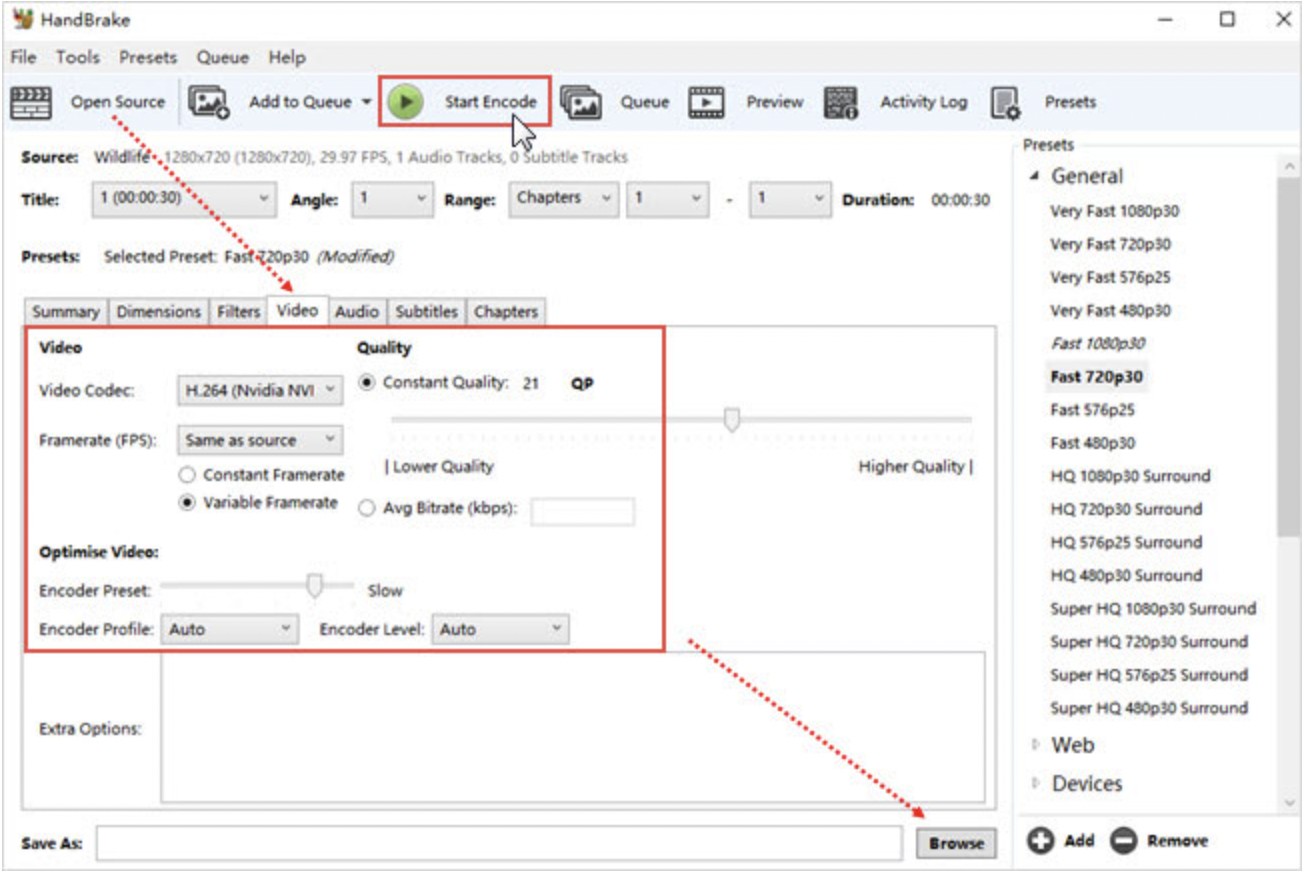
Step 3: Adjust the GPU Encoder and Quality Settings
Open the Video tab and confirm that the Video Encoder field shows a hardware option rather than a software encoder such as x264 or x265. Available choices depend on your system and may include:
- H.264 (NVEnc), H.265 (NVEnc), or a 10-bit NVENC option
- H.264 (Intel QSV), H.265 (Intel QSV), or AV1 (Intel QSV)
- H.264 (AMD VCN) or H.265 (AMD VCN)
- H.264 (VideoToolbox), H.265 (VideoToolbox), or H.265 10-bit (VideoToolbox)
Choose H.264 for wider device compatibility or H.265 for more efficient compression on newer devices. For HDR or other 10-bit sources, select a compatible 10-bit encoder. Start with the preset's default quality setting and use HandBrake's Preview feature to test a short section before encoding the entire video.
Disable filters you do not need. Cropping, scaling, denoising, subtitle rendering, and other processing stages may still rely on the CPU and can reduce the overall speed advantage of GPU encoding.
Step 4: Choose the Output and Start Encoding
Select the output container, audio tracks, subtitles, and destination folder. Enter the output filename under Save As, then click Start Encode. To process several videos, configure each job and click Add to Queue before starting the queue.
Fix HandBrake Not Using the GPU
When HandBrake not using GPU appears to be the problem, verify the encoder and log first. Then check the driver, supported codec, filters, decoder, and saved queue settings. Low generic GPU use or high CPU use is not conclusive by itself.
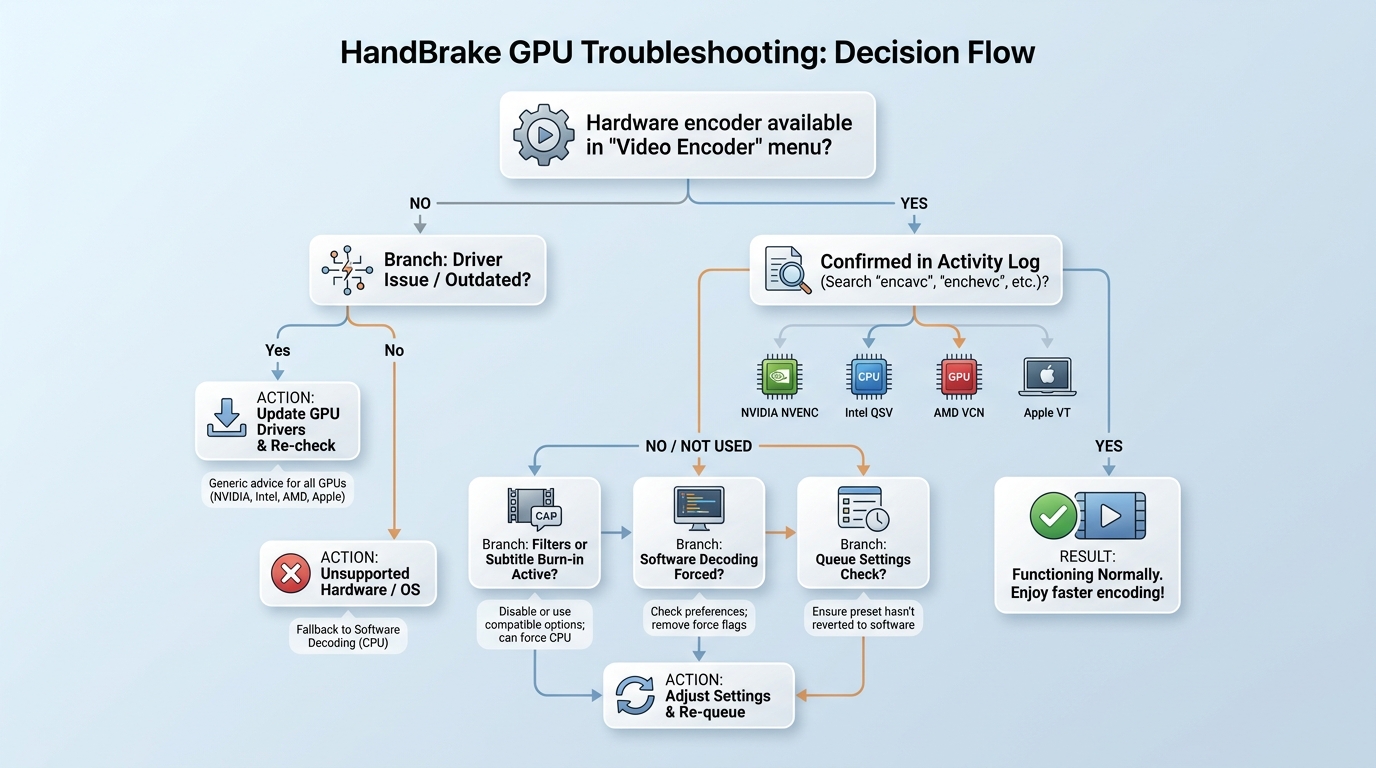
The Hardware Encoder Is Missing
A hardware encoder missing from the menu usually points to an unsupported GPU generation, operating system, driver, codec, or HandBrake build. Update HandBrake and the vendor driver, restart the application, and confirm that the relevant graphics device is enabled.
- Check that the system detects the intended GPU or integrated graphics device.
- Use the vendor's current driver rather than an obsolete compatibility lookup.
- Try a codec known to be exposed by that hardware path.
- Confirm that a remote session or virtual environment is not hiding the media engine.
CPU Usage Still Reaches 100%
HandBrake high CPU usage can coexist with active hardware encoding. Software decoding, scaling, denoise, deinterlace, audio conversion, subtitle burn-in, synchronization, and muxing can keep CPU cores busy.
My next check is the activity log, followed by one controlled change at a time. If the log confirms the hardware encoder, a busy CPU identifies another bottleneck rather than proving the GPU path failed.
Filters or Decoding Limit Throughput
HandBrake not using GPU efficiently may actually be waiting on a CPU-bound stage. Filters, scaling, software decoding, audio encoding, subtitles, synchronization, and muxing can cap the rate at which frames reach the hardware encoder.
- Test with unnecessary filters disabled, but keep any filter required by the source.
- Check whether hardware decoding is available for the input codec.
- Compare a subtitle pass-through job with a subtitle burn-in job.
- Write to a local drive if the source or destination storage is unusually slow.
A clean diagnostic preserves the intended output. Disabling a required filter can make the job faster while making the result less useful, so speed should never be the sole success measure.
Queued Jobs Fall Back to Software
Each queued item stores its own encoder and quality settings. If one item uses a hardware encoder and another uses software, inspect both job configurations and verify hardware encoding separately in each HandBrake activity log.
Persistent fallback across all jobs suggests a system or compatibility issue. A single unexpected queue item is more likely to have been added with different saved settings.
CPU vs GPU Encoding Tradeoffs
The HandBrake CPU or GPU choice depends on the target. Hardware encoding favors fast turnaround and lower CPU demand; software x264 or x265 generally offers stronger compression efficiency when file size and archival quality targets matter more.
Speed, Quality, and File Size
GPU encoding quality is not a fixed ranking. At the same bitrate, a well-tuned software encoder can preserve more detail or produce a smaller file at comparable quality, while a current hardware encoder can finish much sooner and reduce CPU work.
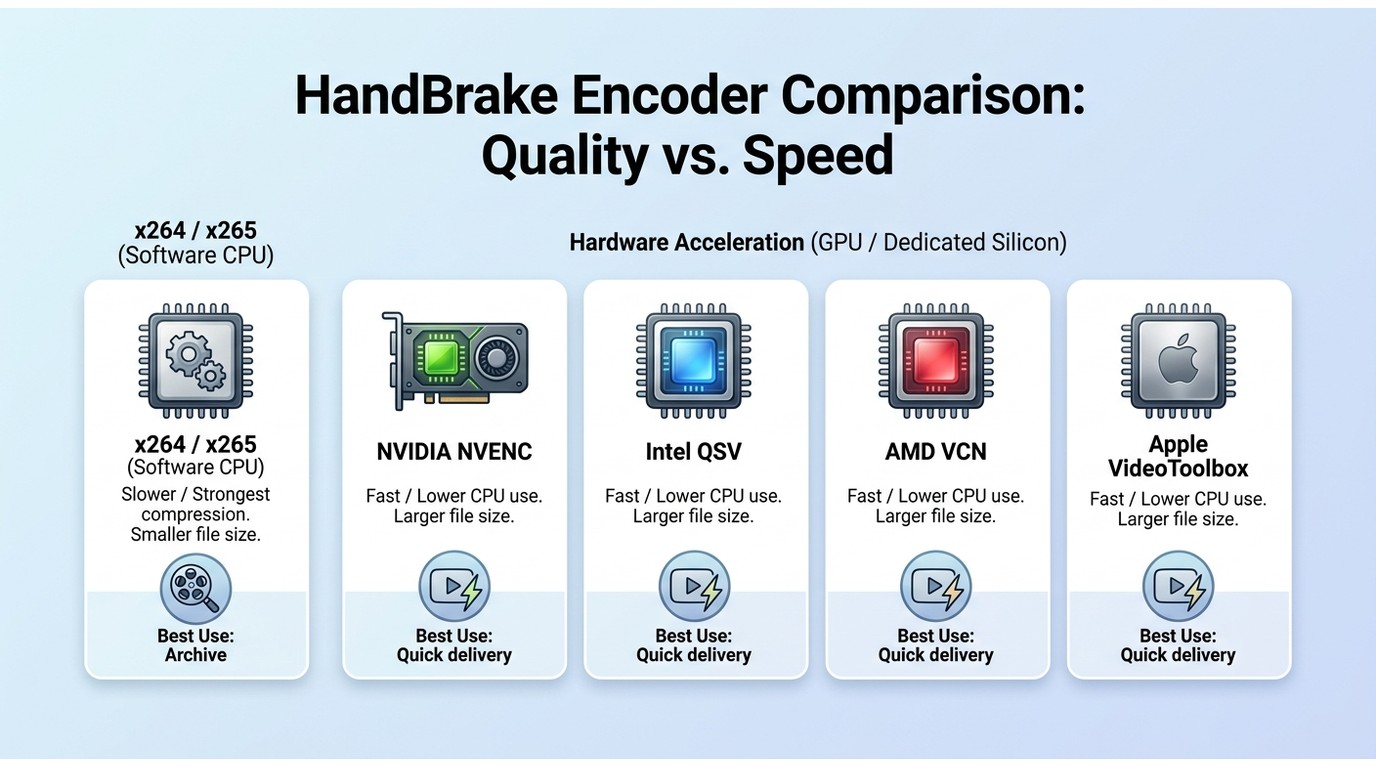
Best Uses for Each Encoder Type
Choose hardware encoding for previews, frequent conversions, streaming transcodes, or jobs where completion time and lower CPU demand matter. Choose software encoding when the smallest practical file at a demanding quality target matters more than turnaround time.
I use a short representative segment for the final decision. Keeping the source, resolution, audio, filters, and playback check consistent reveals whether the speed gain is worth the file-size or detail tradeoff.
When to Choose a DVD Ripper with Efficient GPU Acceleration
HandBrake does not handle copy protection. If it cannot open a DVD, enabling GPU acceleration will not solve the problem because hardware acceleration only speeds up encoding after the source has been successfully loaded. In this case, you need a dedicated DVD ripper that can remove copy protections and use GPU acceleration for faster disc encoding.
DVDFab DVD Ripper combines disc decryption with GPU-accelerated encoding, which makes it better suited to protected DVD workflows than a standard video transcoder. Its Cloud Decryption Service can identify supported protections and load many discs within seconds, while NVIDIA CUDA/NVENC, AMD AMF, Intel Quick Sync Video, and Apple VideoToolbox accelerate the conversion stage on compatible hardware. In practice, the main benefit is shorter encoding time and lower CPU usage, especially when converting full-length DVDs to H.264, H.265, or other compressed formats
Supported OS:
Free Download Windows 11/10/8.1/8/7
Free Download macOS 10.13 - 15.x
How to Enable GPU Hardware Acceleration in DVDFab DVD Ripper:
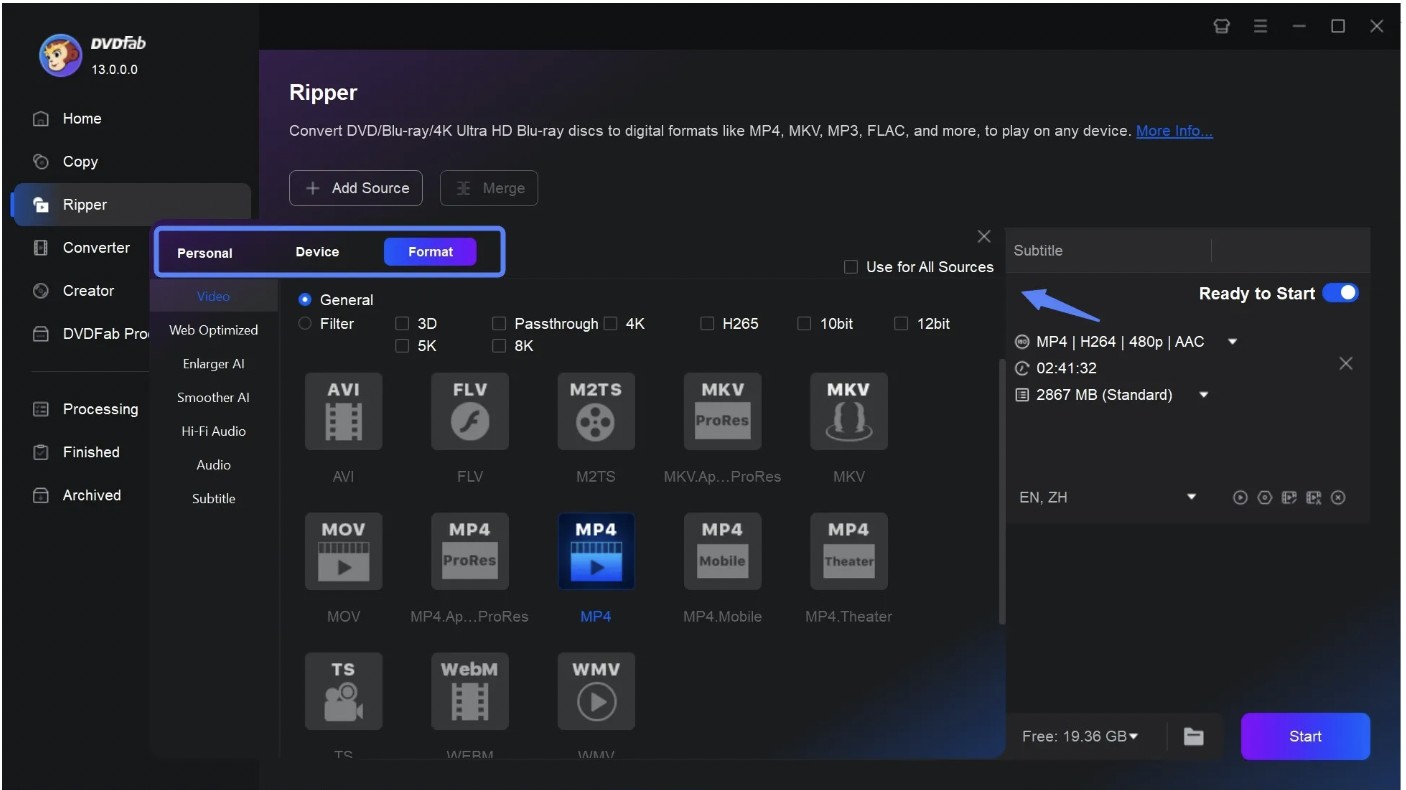
- Step 1: Open DVDFab DVD Ripper, load your DVD, and select a re-encoding profile such as MP4 H.264 or H.265.
- Step 2: Go to Common Settings > General > A/V Codec and choose the detected GPU engine for decoding and encoding, such as NVIDIA CUDA/NVENC, AMD, Intel Quick Sync, or Apple VideoToolbox.
- Step 3: Return to the Ripper module and adjust the resolution, codec, quality, audio, and subtitle settings as needed.
- Step 4: Select the output folder and click Start; DVDFab will use the compatible GPU to accelerate video encoding and reduce CPU usage.
FAQs
Can HandBrake Use the CPU and GPU Together?
Yes. A selected hardware encoder can process video encoding while the CPU handles decoding fallbacks, filters, audio, subtitles, synchronization, and muxing. This is why HandBrake high CPU usage can appear during a valid hardware encode.
Why Does Task Manager Show Low GPU Use?
A generic GPU percentage may not represent the dedicated video-encode engine. Check the relevant Video Encode graph when available, then confirm the selected encoder in the HandBrake activity log before assuming HandBrake is not using GPU resources.
Do Queued Jobs Keep the Hardware Encoder?
Each queue item keeps its own saved settings. Inspect the Video Encoder field for every job and verify each active or completed item in the activity log if you suspect a fallback to software encoding.
Is GPU Encoding Suitable for Archival Video?
It can be useful when speed or power use is the priority, but software x264 or x265 is generally the stronger fit when compression efficiency, file-size control, and an archival quality target matter most. Compare a representative segment before committing a large collection.
Does HandBrake support GPU hardware decoding, and how do I enable it?
Yes. HandBrake supports hardware decoding through Intel Quick Sync and NVIDIA NVDEC on compatible systems. Open Tools > Preferences > Video on Windows, or HandBrake > Settings/Preferences > Video on macOS, and enable the available hardware-decoding option; for Intel graphics, make sure Disable Quick Sync Decoding is not selected. HandBrake may return to software decoding when unsupported filters are applied, and AMD VCN currently supports hardware encoding but not hardware decoding.
Conclusion
HandBrake can use the GPU when a supported hardware encoder is selected, but GPU acceleration does not move the entire transcode away from the CPU. Decoding, filters, audio, subtitles, synchronization, and muxing may still keep CPU usage high, so the activity log is the best place to confirm whether NVENC, QSV, AMD VCN, or VideoToolbox is actually active.
Choose GPU encoding when speed and lower CPU usage matter more, and choose software encoding when compression efficiency, smaller file sizes, or archival quality is the priority. If HandBrake cannot open a protected DVD, GPU acceleration will not fix the problem. In that case, you can try a dedicated DVD ripper, such as DVDFab DVD Ripper, that supports protected DVDs and uses GPU hardware acceleration to speed up ripping.

![How to Rip DVDs for Plex: Guide to Formats, Tools, and Library Setup [2026]](https://images.dvdfab.cn/media/Screenshot_2026-09-08_at_18.53.34_j36v3l.png/public) How to Rip DVDs for Plex: Guide to Formats, Tools, and Library Setup [2026]By Diana Smith - Sep 8, 2026
How to Rip DVDs for Plex: Guide to Formats, Tools, and Library Setup [2026]By Diana Smith - Sep 8, 2026![Top 12 DVD to MP4 Converter Software for Win & Mac [2026 Tested]](https://r3.dvdfab.cn/upload/resource/convert-dvd-to-mp4-p2X3.jpeg) Top 12 DVD to MP4 Converter Software for Win & Mac [2026 Tested]By Diana Smith - Sep 4, 2026
Top 12 DVD to MP4 Converter Software for Win & Mac [2026 Tested]By Diana Smith - Sep 4, 2026 10 Best DVD Rippers for Windows & macOS: 2026 TestedBy Diana Smith - Sep 2, 2026
![How to Rip Audio from DVD with 5 Best Free DVD Audio Extractors [2026]](https://images.dvdfab.cn/media/how_to_rip_audio_from_dvd_5r8iyw.png/public) How to Rip Audio from DVD with 5 Best Free DVD Audio Extractors [2026]By Diana Smith - Aug 31, 2026
How to Rip Audio from DVD with 5 Best Free DVD Audio Extractors [2026]By Diana Smith - Aug 31, 2026