Convert DVD to MP4 with HandBrake: Settings, ISO Tips, and Fixes

Summary: This guide explains how to convert a readable DVD, ISO, or VIDEO_TS source to MP4 with HandBrake. It covers title and chapter checks, NTSC/PAL framerate choices, RF and encoder trade-offs, subtitle handling, and playback targets. When HandBrake cannot parse the source, it shows how to prepare an authorized local file or choose a broader desktop DVD tool.
Table of Contents
I wanted a DVD-to-MP4 file that kept the right title, chapters, audio, and subtitles, not just a file that finished encoding. HandBrake can do that for a readable, authorized source; when the scan is incomplete, source preparation comes before changing presets.
This guide covers the HandBrake DVD to MP4 decision, the source check, the full conversion steps, ISO and VIDEO_TS handling, settings for NTSC and PAL, playback targets, and fixes for partial or failed scans. A dedicated DVD to MP4 guide is useful when you need a broader desktop path.
- Output choices: MP4, MKV, and WebM containers are available.
- Control: Video quality, audio tracks, subtitles, filters, and queue order are adjustable.
- Boundary: A source that HandBrake cannot scan needs preparation before encoding.
Can HandBrake Convert DVD to MP4?
HandBrake is a capable encoder for a readable DVD, and the HandBrake DVD to MP4 path gives you control over the container, codec, audio, subtitles, and file size. It is not a universal reader for every disc structure.
The useful dividing line is simple: a complete title list can move to encoding, while a missing or misleading list needs source checks first. Use only DVDs you own or are authorized to access, keep the output for personal use where permitted, do not redistribute it, and follow local law and platform terms.
| DVD source | HandBrake result | What to check |
| Homemade or unprotected DVD | Usually readable | Open the source and preview the title |
| Authorized source with complex structure | Scan may be incomplete | Verify titles and chapters before encoding |
| Damaged disc or drive mismatch | Partial or failed scan | Clean the disc, check the drive, or try another drive |
| Source needing extra preparation | HandBrake may expose too little | Prepare an authorized local file before encoding |
Before You Start: Check HandBrake and the DVD
Check the software package and the disc before touching RF or encoder presets. In my Windows 10 checks with an LG WH16NS60 drive, a missing title list sends me back to source readability rather than to another quality setting.
As of September 2026, the official HandBrake downloads page lists HandBrake 1.11.2 with separate Windows Intel/AMD x64 and Qualcomm ARM64 packages, plus macOS and Linux downloads. Choose the package that matches the platform, then confirm that the DVD drive exposes the expected source.
When You Need libdvdcss
libdvdcss can affect whether HandBrake reads some CSS-authored DVDs, but it does not repair a damaged disc, a misleading title list, a region mismatch, or an incomplete ISO. The libdvdcss HandBrake guide carries platform-specific prerequisite detail; here, keep the decision focused on whether the authorized source is readable.
If the source still does not scan, stop changing MP4 settings. Check the drive, disc condition, title list, and local-file preparation path instead.
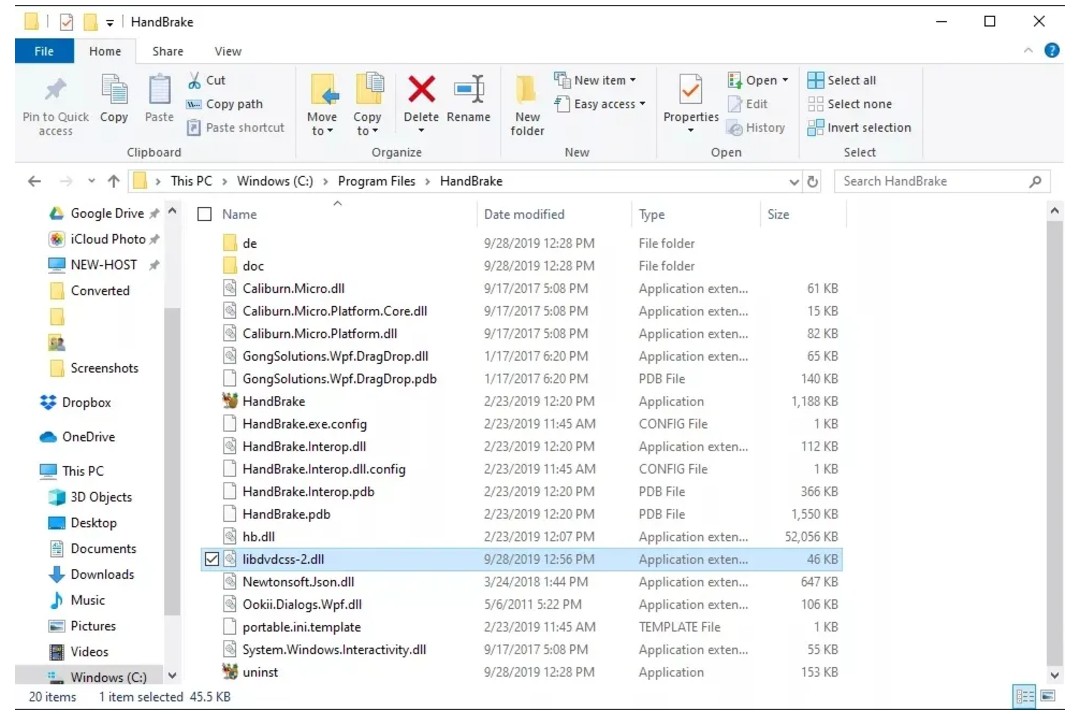
Install libdvdcss on Windows
On Windows, package availability and permissions can vary by installation. Use a trusted, platform-appropriate package only for an authorized source, restart HandBrake after any library change, and confirm that the DVD exposes a complete title list before encoding.
Install libdvdcss on Mac
On macOS, keep the library and HandBrake builds aligned with the system. After any prerequisite change, reopen HandBrake and test the source scan; a complete title and chapter list matters more than the installation command itself.
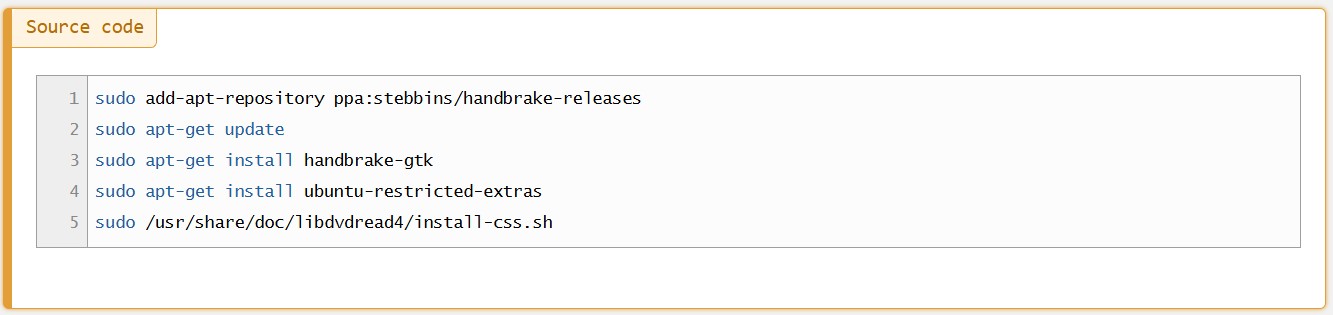
Install libdvdcss on Linux
Linux package names depend on the distribution. Use its trusted package guidance, then check that HandBrake can read the authorized DVD or local folder before selecting an encoder preset.
Convert a DVD to MP4 with HandBrake
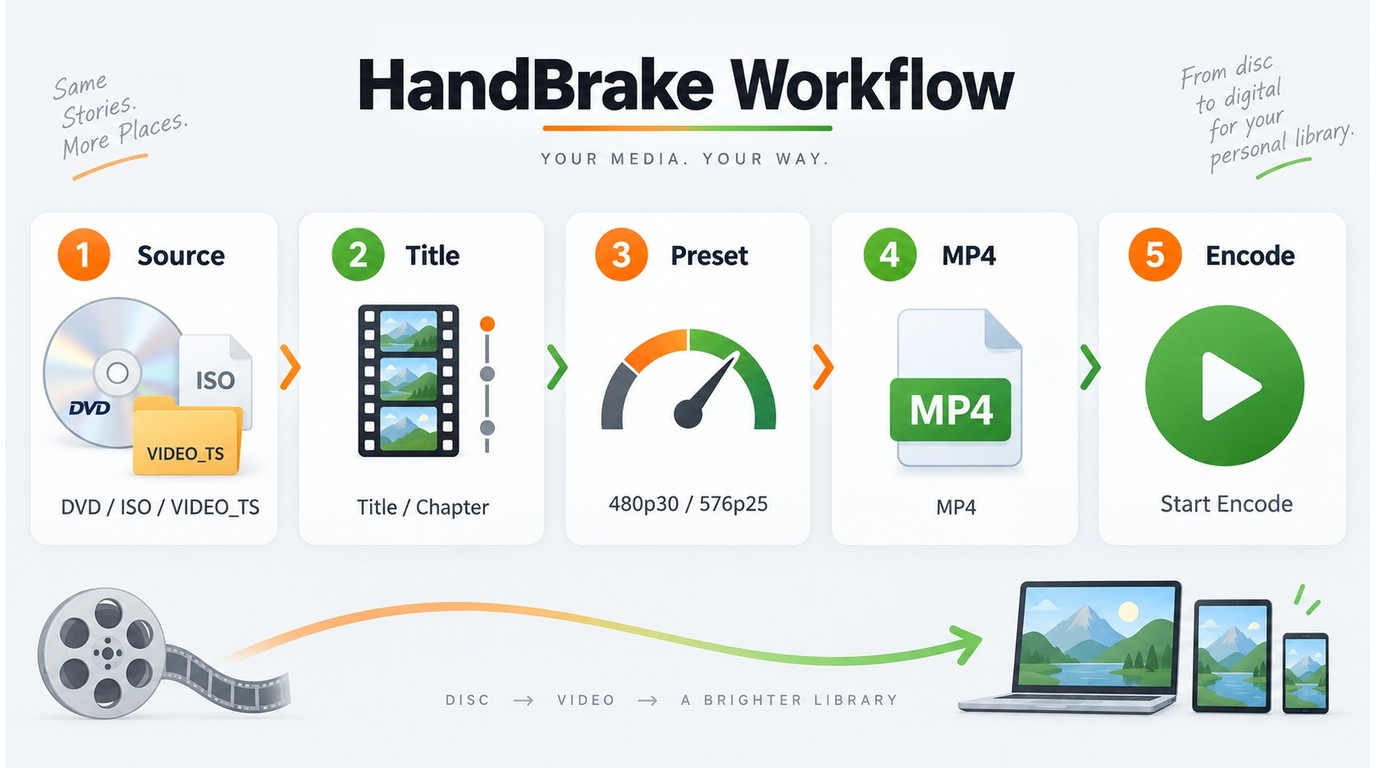
The HandBrake rip DVD to MP4 sequence is straightforward once the source scan is complete. The steps below keep source selection, title verification, format choice, track selection, and the final encode in that order.
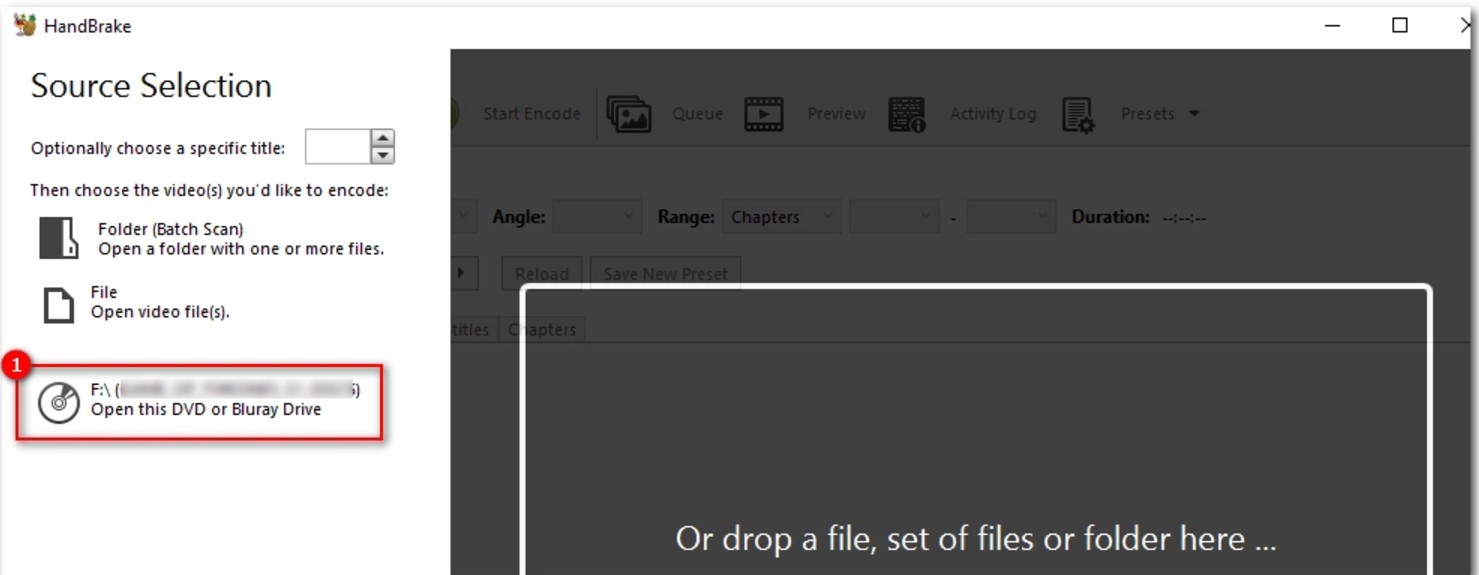
Start HandBrake and Select the Source
- Insert the DVD, or make the authorized VIDEO_TS folder or ISO available.
- Open HandBrake and select Open Source.
- Choose the DVD drive, VIDEO_TS folder, or ISO file.
Wait for the scan to finish before changing settings. If HandBrake reports no usable source, move to the troubleshooting section instead of forcing an encode.
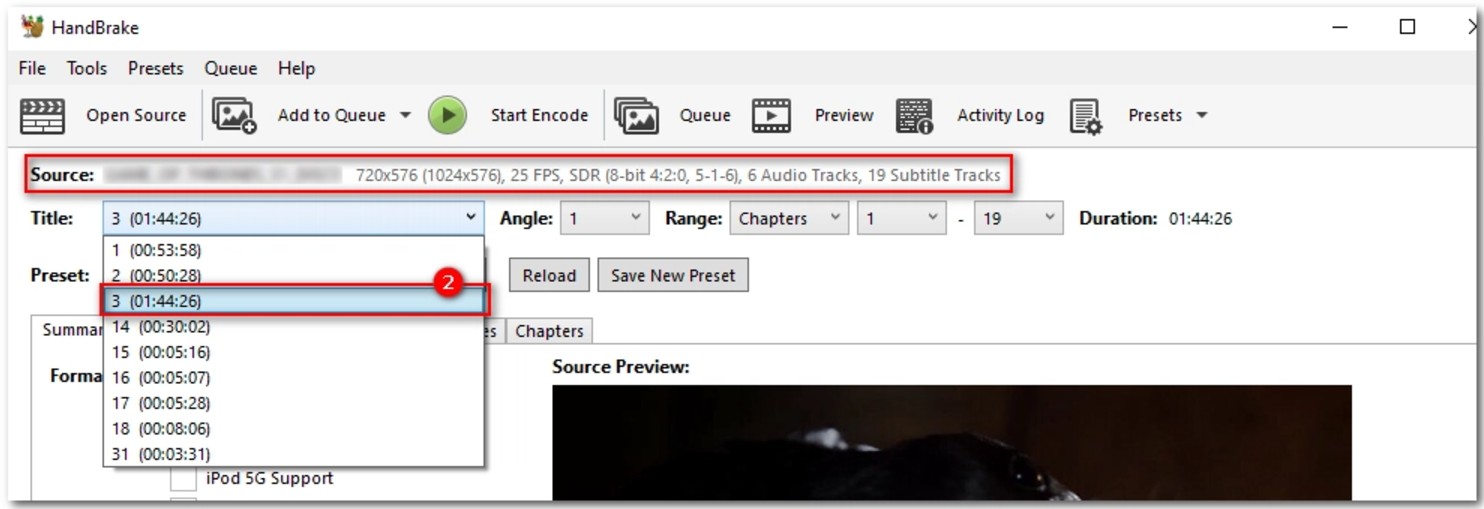
Select and Preview the Main Title
- Open the Title menu.
- Choose the main movie title or the episode you need.
- Use Preview when several titles have similar lengths.
For a movie, the longest title is often the main feature; for episodic discs, each episode may be separate. Check the chapter list and preview a representative scene before committing to the full encode.
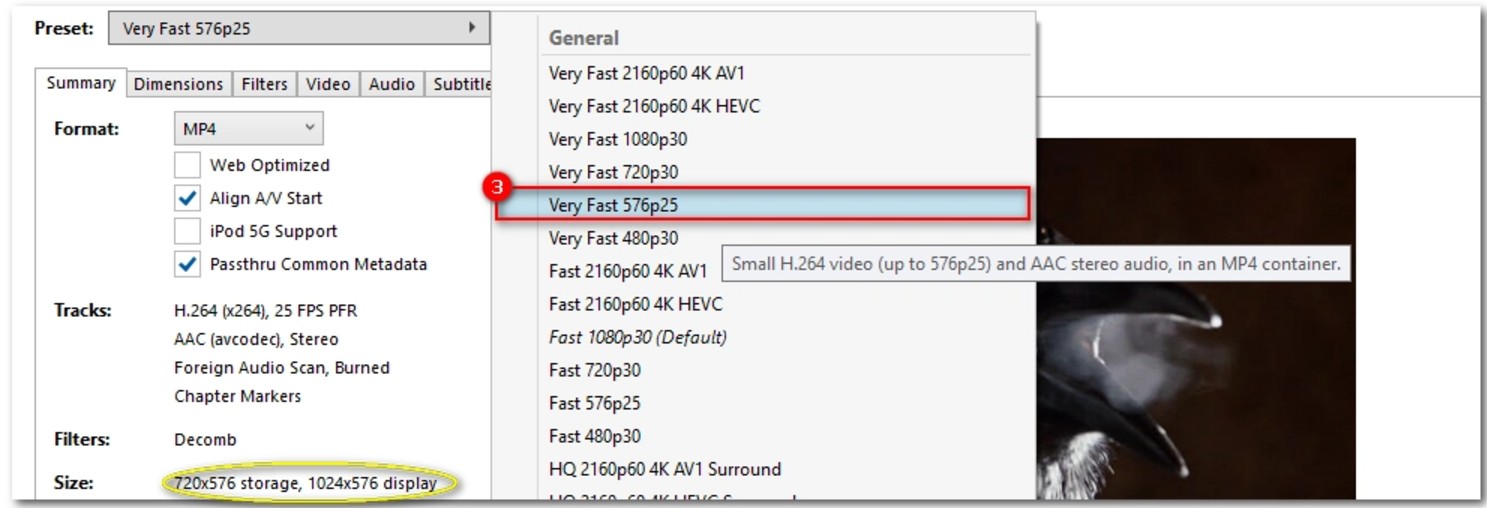
Choose a DVD-Level Preset
- Open the Preset panel.
- Start with Fast 480p30 for NTSC or Fast 576p25 for PAL.
- Keep 720p or 1080p presets for a specific downstream need, not as a way to add source detail.
These starting points keep the output close to DVD dimensions. My judgment is to preview one short section first, because a higher preset can enlarge the file without improving detail that was never present on the disc.
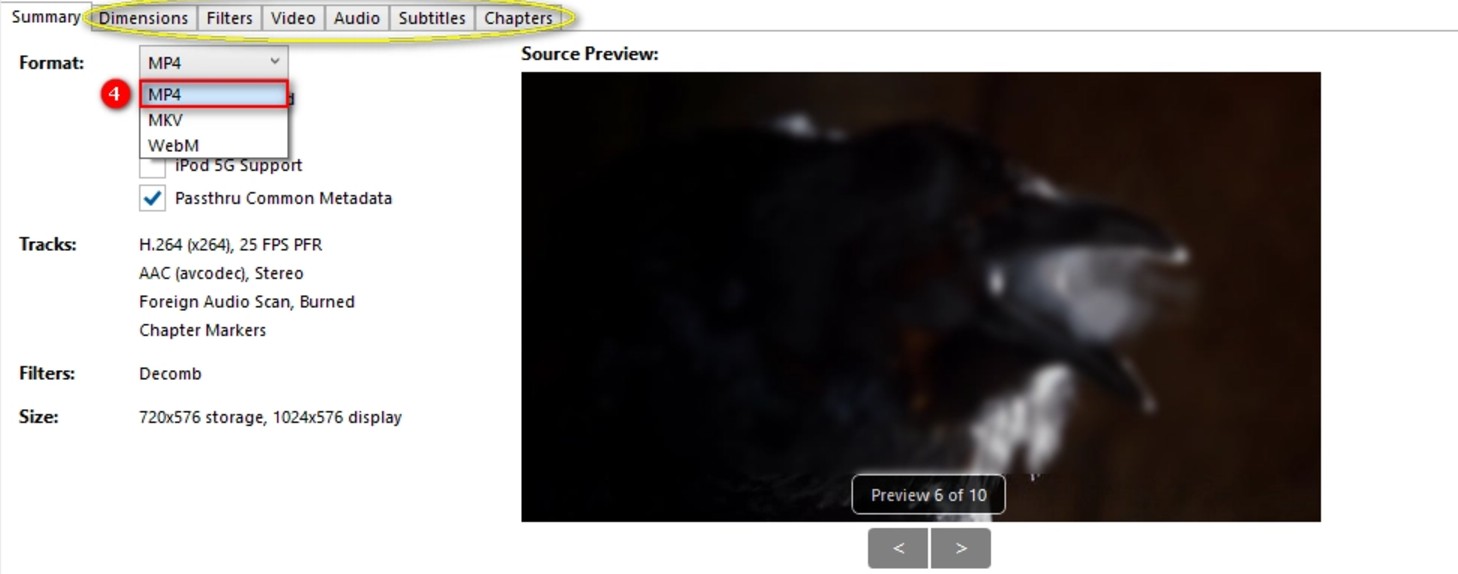
Choose MP4 as the Format
- Open the Summary tab.
- Set Format to MP4.
- Leave Web Optimized off unless the file will be served from a web server.
For a DVD to MP4 HandBrake conversion, MP4 is a sensible starting container for phones, tablets, computers, many smart TVs, and media servers, but the extension alone does not guarantee playback on an older player.
Set Audio and Subtitles
- In Audio, keep the language track you need.
- Choose AAC stereo for a smaller file, or AC3 passthrough when the playback chain accepts the surround track.
- In Subtitles, distinguish a full soft track from a forced-only track.
- Use Burn In when the subtitle must be visible on players that ignore selectable tracks.
Preview the chosen track before encoding. Soft subtitles remain selectable, forced-only tracks show only marked lines, and burned-in subtitles become part of the picture. Difficult sources can still need a timing check after the preview.
Save and Start the Encode
- Click Browse next to Save As.
- Choose a folder with enough free space.
- Use a filename that identifies the title and language.

- Click Start Encode.

Play the finished MP4 through the intended device and check the title, chapter order, audio track, and subtitle behavior before archiving the source.
Convert ISO or VIDEO_TS to MP4
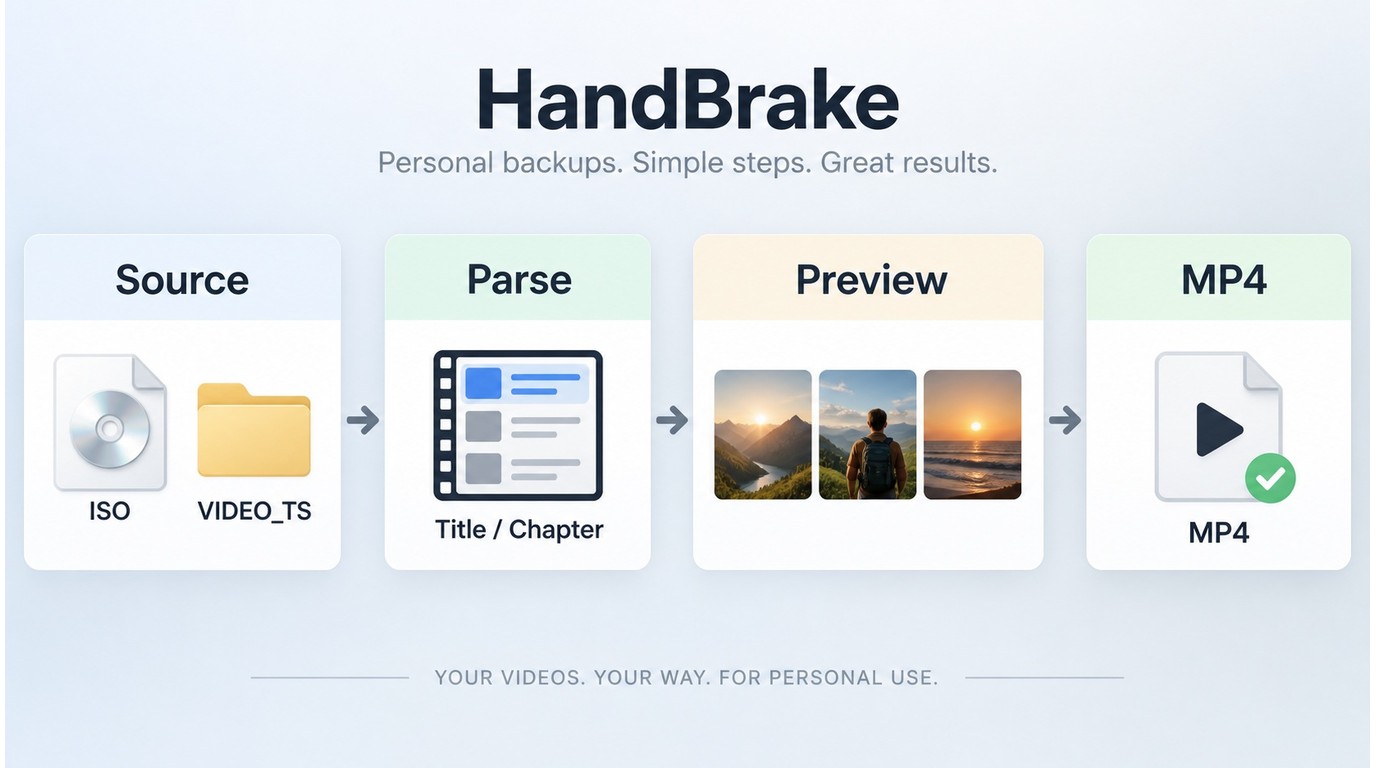
To convert ISO to MP4, treat the image or folder as the source and verify what HandBrake actually parsed. The same check applies to a VIDEO_TS folder: scan first, confirm the complete program, and preview before encoding.
Verify Titles, Chapters, and the Preview
- Open the ISO or VIDEO_TS folder with Open Source and wait for the scan.
- Compare the title list and chapter count with the program you expect.
- Preview the opening, a middle scene, and the ending when the source has several similar titles.
- If only one title or chapter appears, remount the ISO or prepare an authorized local source before encoding the full program.
On an M4 MacBook Air running macOS Tahoe 26.2, I use the complete title-and-chapter list as the go/no-go check for a DVD ISO; a short or incomplete list means the source needs preparation, not a different RF value.
Best HandBrake Settings for DVD to MP4
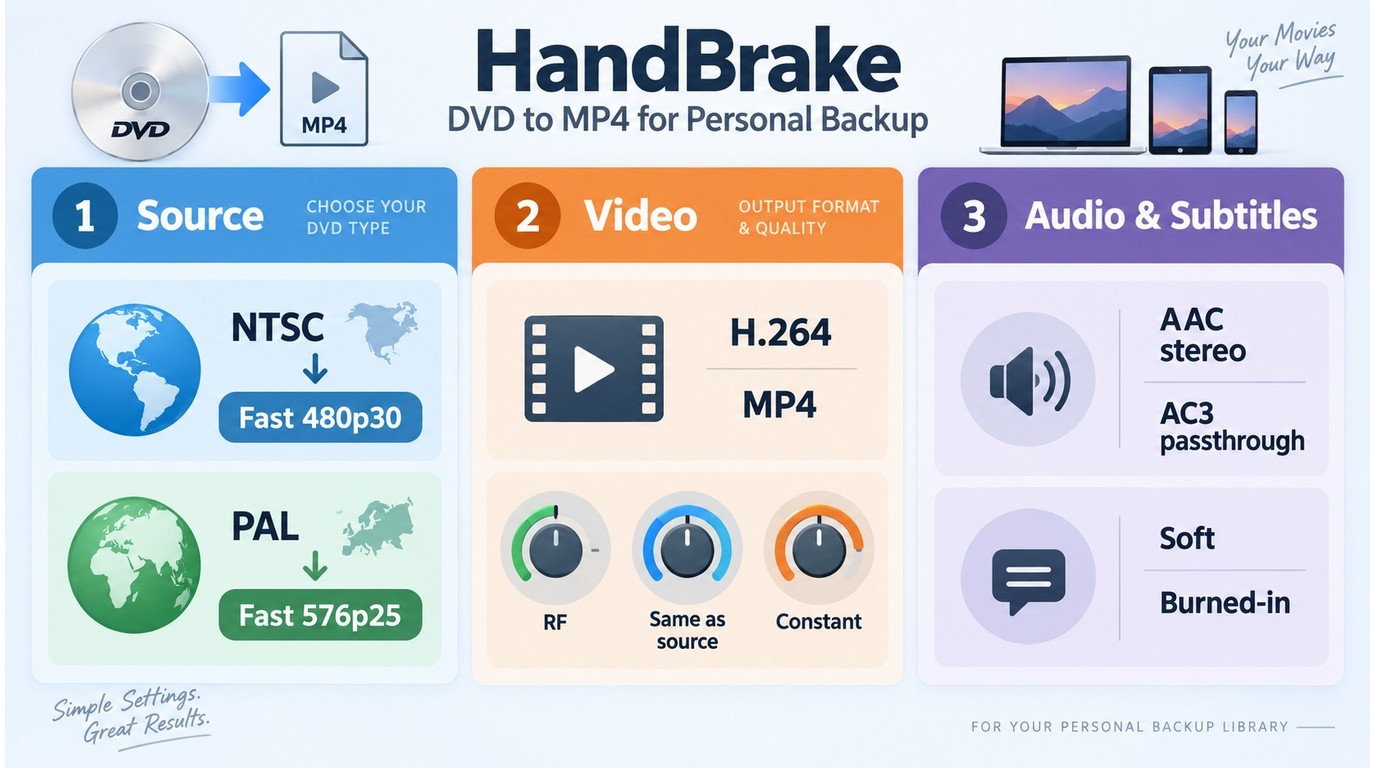
The best HandBrake settings for DVD to MP4 depend on the source cadence, the target player, and how much storage you can give the file. Start with H.264 in MP4, preview a short section, and adjust only the setting tied to the problem you see.
| Setting | Starting choice | Why it matters |
| Container | MP4 | Broad support on common players |
| Video | H.264 (x264) | A safer choice for older devices |
| Framerate | Same as source; constant when needed | Keeps timing predictable |
| Quality | RF 20; RF 18 for more detail | Lower RF increases file size |
| Audio and subtitles | AAC stereo or AC3 passthrough; soft or burn-in | Match the player and listening needs |
| Filters | Decomb for interlaced DVDs | Reduces combing lines |
For the handbrake dvd to MP4 settings most readers need, the starting matrix above is more useful than one universal preset. I would change one variable at a time and preview again, especially when a home-video source contains grain or interlaced motion.
Match Framerate to the DVD Source
Match the output cadence to the DVD's NTSC or PAL source before you convert PAL to NTSC for a specific device. Same-as-source preserves the original timing, while constant framerate makes timing more predictable for some editing and playback chains.
- Use an NTSC-oriented preset for an NTSC source and a PAL-oriented preset for a PAL source.
- Choose same-as-source when the playback chain accepts the original cadence.
- Choose constant framerate when an editor, server, or older player needs predictable timing.
- Preview motion and subtitles before encoding the complete title.
Choose the setting that keeps motion and subtitle timing consistent on the device you will actually use, not the one with the largest number in the preset name.
Balance Speed, Quality, and File Size
HandBrake DVD converter settings trade processing time against file size and visible detail. A faster preset finishes sooner, a slower preset spends more time on compression decisions, and RF controls the quality-size balance.
- Use a fast or medium preset for routine playback files.
- Lower the RF value when you want more retained detail and can accept a larger file.
- Use a slower preset when storage efficiency matters more than completion time.
- Use two-pass encoding when a predictable average bitrate matters; expect a longer encode than one pass.
In a July 2026 Windows 10 test with an i7-6700, 16 GB RAM, an RTX 4060 Ti, and a 6.13 GB 8mile.iso source, DVDFab DVD Ripper produced an H.264 MP4 in 5m31s. That result describes this hardware and source, not every HandBrake or DVD conversion.
Choose Settings for Your Playback Device
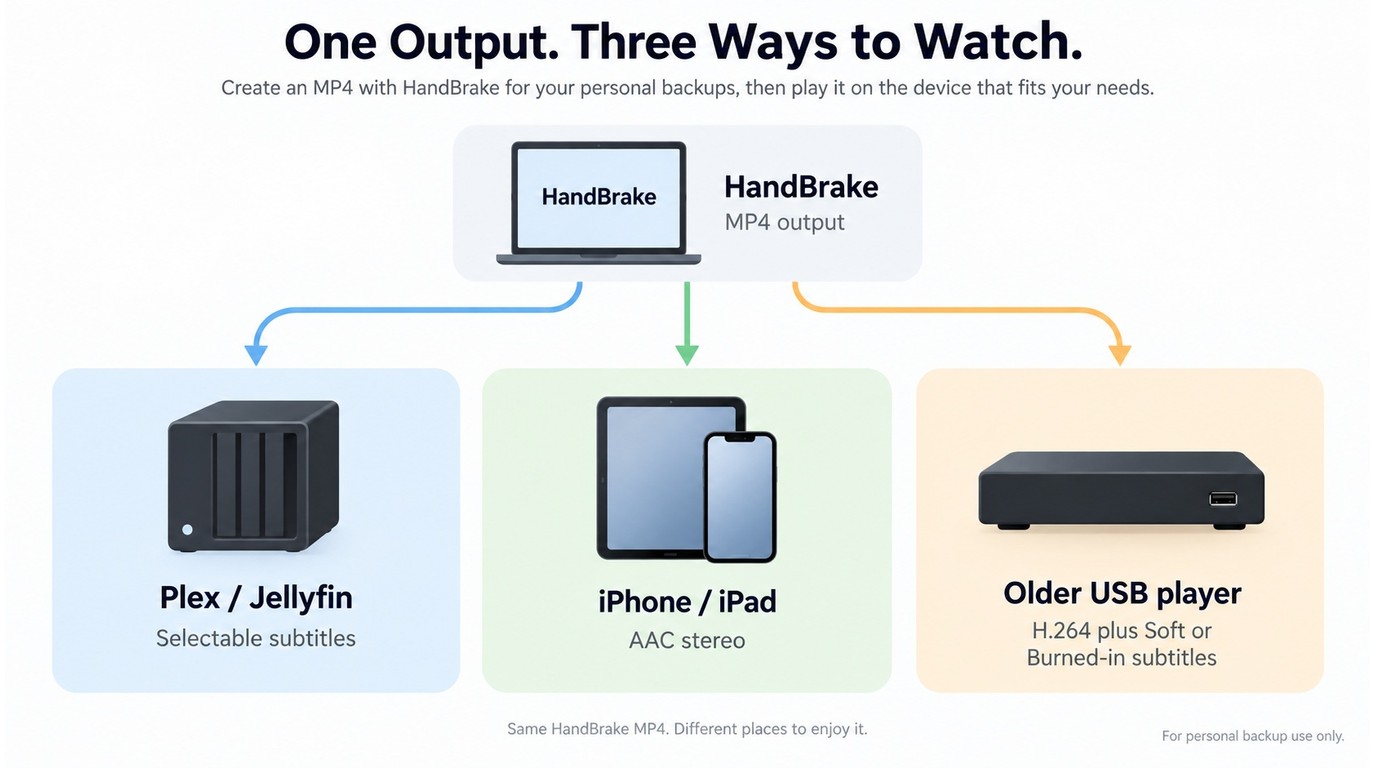
A DVD to MP4 converter should be chosen around the playback target, not around the MP4 extension alone. Container, H.264 profile, audio track, subtitle mode, and the player's age all affect whether the file starts and plays correctly.
| Playback target | Container | Video and audio | Subtitle choice |
| Smart TV or USB player | MP4 | H.264 with AAC or AC3 | Soft if supported |
| Phone or tablet | MP4 | H.264 with AAC stereo | Soft subtitles |
| Plex or Jellyfin | MP4 or MKV | H.264 with the needed audio track | Soft tracks for control |
| Older hardware | MP4 | H.264 with AAC | Burn in if soft tracks fail |
For a Plex or Jellyfin library, keep selectable subtitles and the audio track your clients support. For a phone or tablet, AAC stereo in MP4 keeps the handoff simple. For an older USB player, H.264 with a soft subtitle fallback or burned-in text is usually easier to test than a newer codec.
In my Windows 10 media-library checks, I preview the finished file on the target player before queuing a batch; that small check catches audio and subtitle incompatibilities while the source is still available.
Troubleshoot DVD-to-MP4 Errors
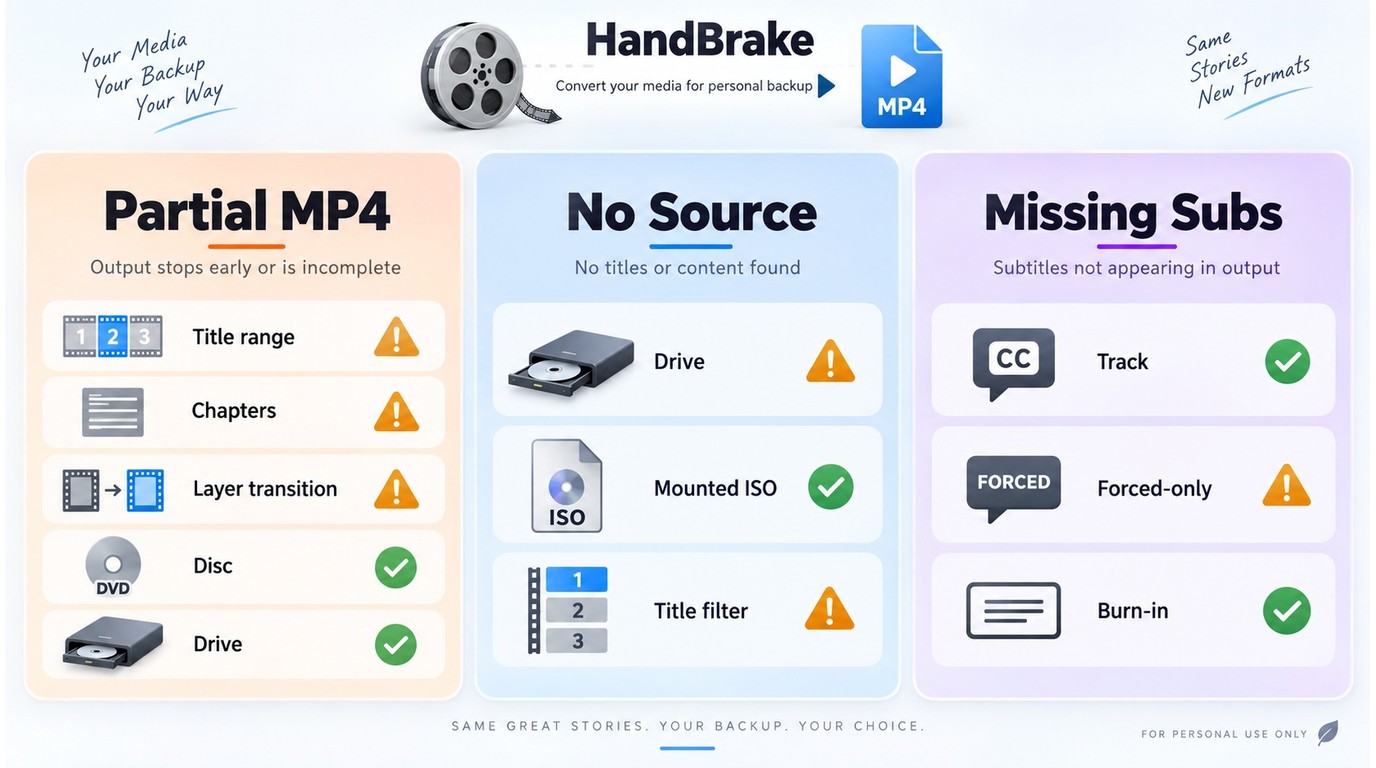
Most HandBrake DVD to MP4 errors begin with source reading, title parsing, or track selection. Check the visible symptom first, then change one condition and preview again instead of replacing the whole preset.
When HandBrake Converts Only Part of the DVD
A half-length MP4 usually means the title range, chapter list, layer transition, disc surface, or drive connection was not read completely.
| Cause | What it looks like | Next check |
| Scratched or dirty disc | Playback or encode stops at the same point | Clean the disc and test another physical copy or drive |
| Aging or faulty drive | The scan or encode loses the source mid-way | Try a different optical drive or a powered USB connection |
| Incomplete title or chapter range | The output ends before the program ends | Recheck the full title, chapters, and preview before encoding |
Do not judge the final file from its duration alone. Compare the last chapter and ending scene with the source before deleting or moving the original.
When No Valid Source or Titles Appear
When HandBrake shows no valid source, confirm that the drive can open the DVD, the ISO is mounted correctly, and the title-duration filter is not hiding short segments. If the scan still fails, the no-valid-source troubleshooting page provides a fuller diagnostic path.
| Cause | What it looks like | Next check |
| Source structure is not fully exposed | No usable title or only a fragment appears | Remount or prepare an authorized local source |
| Short titles are filtered | Brief segments do not appear | Review the minimum-title-duration preference |
| Drive access or connection issue | The scan stops before the title list | Check permissions, cable, and another drive |
When Subtitles Are Missing or Out of Sync
Subtitle problems usually come from selecting the wrong track, choosing a forced-only stream, or using a soft track that the player cannot read.
| Cause | What it looks like | Next check |
| Wrong subtitle track | Text is blank or appears in the wrong language | Preview each track and note full versus forced-only content |
| Timing delay | Text arrives before or after speech | Check the preview and adjust timing after the encode if needed |
| Burn-in not enabled | Forced lines are missing on the target player | Enable Burn In for the required track |
My preference is to keep a soft track when the player supports it, then use burn-in only when the target device cannot display selectable subtitles.
Prepare Difficult Sources Before HandBrake
When HandBrake cannot expose a usable title structure, prepare an authorized local file with a dedicated desktop tool, then load that file into HandBrake for MP4 encoding. HandBrake is a good encoder for readable sources; source preparation is the better path when scanning remains incomplete.
This division keeps the job clear: the preparation tool creates a readable local source, while HandBrake controls the MP4 codec, RF, framerate, audio, and subtitles. Readers searching for a HandBrake DVD ripper usually need this distinction before they choose another preset.
In a July 2026 Windows 10 test using the same i7-6700, 16 GB RAM, RTX 4060 Ti, and 6.13 GB 8mile.iso source, DVDFab DVD Ripper produced a lossless MKV in 1m37s. I treat that as a source-and-hardware observation, not a promise for other discs or encoders.
When a HandBrake Alternative Fits
Stay with HandBrake when the source scans correctly and you mainly need controlled MP4 encoding. Consider a desktop DVD application with broader source handling when title parsing stays incomplete or you want more device profiles in one place.
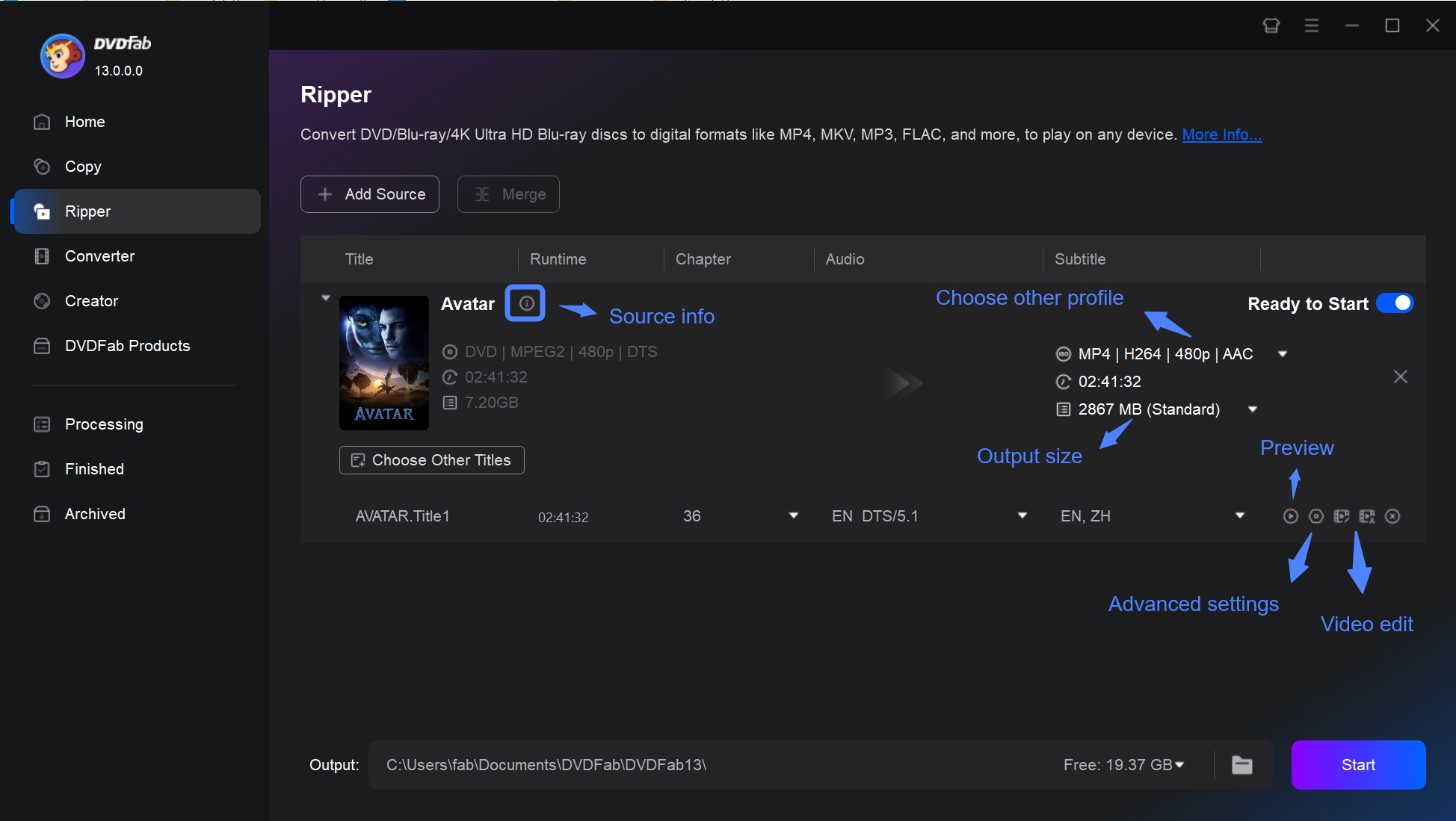
A HandBrake alternative can make sense for an authorized personal backup when the readable-source path does not meet the task. DVDFab DVD Ripper supports DVD input, MP4/MKV and other mainstream outputs, Direct Copy or Passthrough, selectable tracks, basic video edits, batch tasks, and device profiles; its supported DVD protection list includes CSS, APS, RC, RCE, UOPs, Sony ARccOS, RipGuard, Core X2, and FluxDVD.
The product's DVD Ripper trial allows up to three DVDs during 30 days, so you can check source handling and output suitability before deciding. Use the official download and product information for the platform and license details that apply to your setup.
Free Download Windows 11/10/8.1/8/7
Free Download macOS 12 or newer
HandBrake and DVDFab DVD Ripper Compared
Both tools can produce a playable video file, but they start from different source assumptions. HandBrake is focused on encoding a readable source; DVDFab DVD Ripper adds source handling and device-profile choices for authorized local DVDs.
| Tool | Readable source scope | Output and device choices | Quality, speed, and batch | Use it for |
| HandBrake | Readable DVD, ISO, or VIDEO_TS | MP4, MKV, WebM; manual targets | Preset, RF, passes, queue | Encoding a readable source |
| DVDFab DVD Ripper | Authorized local DVD sources with broader source handling | MP4, MKV, AVI, WMV, MOV, FLV, M2TS, WebM; profiles | Direct Copy/Passthrough, codecs, batch queue | Source preparation plus device-targeted output |
My judgment is straightforward: choose HandBrake for a readable source and detailed encoder control; choose the broader desktop option when the source itself is the obstacle or when device presets and batch handling save setup time.
FAQs
Can HandBrake convert a DVD ISO to MP4?
Yes, when HandBrake scans the ISO and exposes the complete title and chapter list. Preview the expected program first; if only one segment appears, remount the ISO or prepare an authorized local source before encoding.
Why does HandBrake show only one title or chapter from my DVD?
Incomplete parsing, a title-duration filter, or a source structure that is not exposed cleanly can leave one title or chapter visible. Check the full list and preview, then prepare or remount the source if the program is still incomplete.
Which settings give a DVD-to-MP4 file a good balance of quality and compatibility?
Start with MP4, H.264, source-matched framerate, RF around 20, and AAC stereo unless your playback chain needs AC3 passthrough. Use the playback matrix above, preview a short section, and adjust one setting at a time.
Is HandBrake free and safe to download?
HandBrake is free and open source. Download it from the official HandBrake downloads page, choose the package for your platform, and keep the installer source official. No download page can promise that every third-party file is safe, so avoid unofficial mirrors.
Conclusion
HandBrake is a solid choice for converting a readable DVD, ISO, or VIDEO_TS source to MP4 when you verify the title, chapters, framerate, tracks, and target player. The best settings are source- and device-matched, not universal.
If the source will not scan or only part of the program appears, prepare an authorized local file before encoding. Keep HandBrake for the codec and subtitle decisions, and use a desktop DVD application with more source or device controls when those features decide the result.

 Free DVD Decoder for Windows XP and Windows 11: 3 Ways to Play DVDsBy Diana Smith - Sep 23, 2026
 How to Compress ISO Files: 4 Methods for Storage, Playback, and ArchivesBy Diana Smith - Sep 16, 2026
 How to Rip DVD to Facebook and Upload the Video in 2026By Diana Smith - Sep 15, 2026
![How to Rip DVDs for Plex: Guide to Formats, Tools, and Library Setup [2026]](https://images.dvdfab.cn/media/Screenshot_2026-09-08_at_18.53.34_j36v3l.png/public) How to Rip DVDs for Plex: Guide to Formats, Tools, and Library Setup [2026]By Diana Smith - Sep 8, 2026
How to Rip DVDs for Plex: Guide to Formats, Tools, and Library Setup [2026]By Diana Smith - Sep 8, 2026