DVD Recorder with Hard Drive: 3 Legacy Models and Alternatives

Summary: DVD recorders with built-in hard drives are no longer manufactured, but refurbished units remain available for specific use cases. This guide covers which Freeview-based models are still worth considering, how regional tuner standards affect buyers outside the UK, and when switching to a PC-based DVD authoring workflow removes the mechanical constraints of aging hardware.
Table of Contents
In the United States, mainstream new DVD recorders with hard drives are effectively unavailable. A used unit is worthwhile only when its tuner and export path match the job. For authorized personal recordings, use an ATSC-compatible recorder for antenna TV, a USB capture device for VHS to DVD transfers, or authoring software for finished files.
The models below are legacy examples, not current US-market recommendations. This article compares their regional tuner limits and preservation options, explains what to test before buying used, and shows when a capture device plus DVD authoring software is a better choice.
Are DVD Recorders with Hard Drives Still Worth Buying?
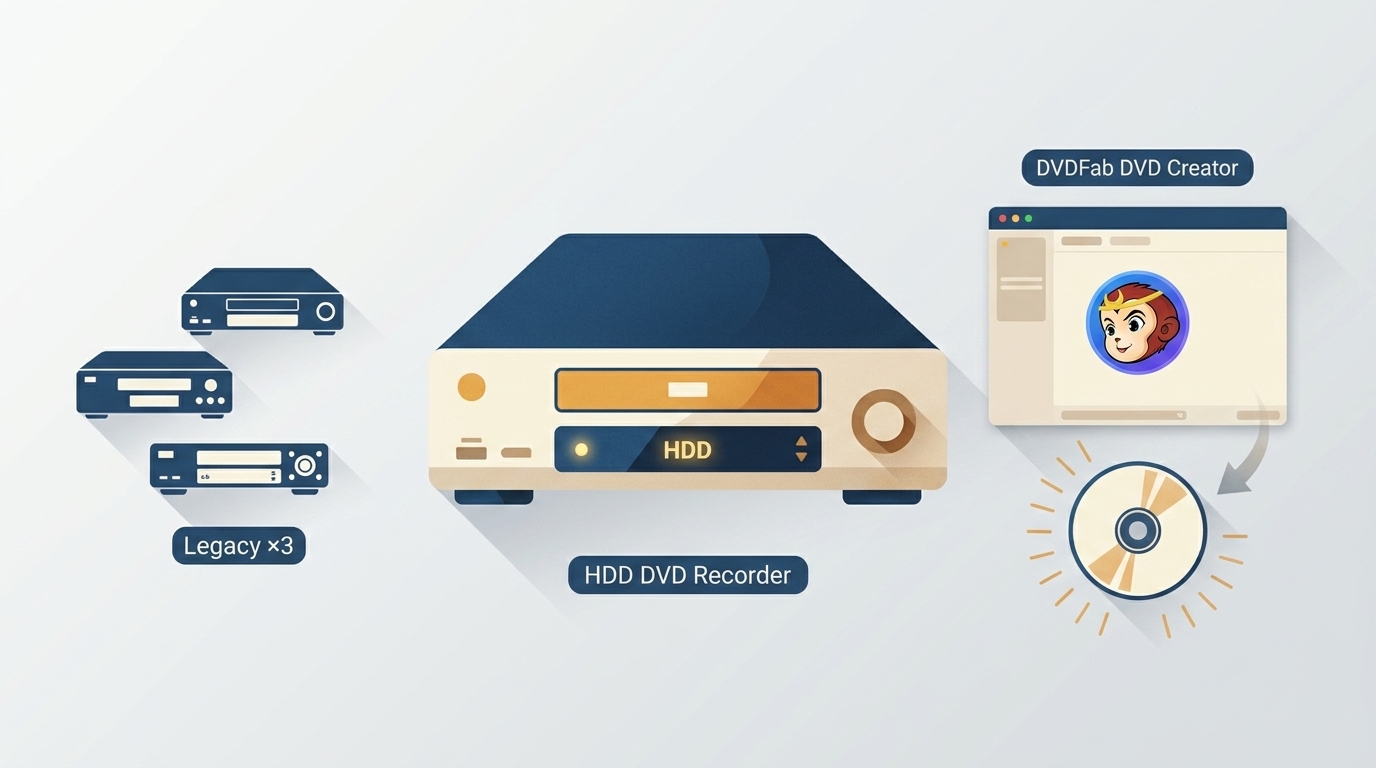
Mainstream new US-market DVD recorders with built-in hard drives are effectively unavailable. The last major brands phased out this product category by the mid-2010s, and what is available today comes through used listings, refurbished stock, and specialty retailers. Many users still look for them to record broadcast TV, preserve older tapes, or make simple edits before burning discs. Understanding the limitations before purchasing avoids compatibility surprises.
Key Limitations to Know
| Option | US TV and analog input | Output path | Editing | Main limitation |
| Legacy HDD/DVD recorder | ATSC tuner or analog inputs, model dependent | Internal HDD, finalized DVD, model-specific export | Basic trimming | Aging HDD, laser, and tuner |
| USB capture device plus authoring software | Analog VHS or camcorder; separate ATSC tuner for TV | Computer file, DVD, or ISO | Software editing and menus | Capture setup affects quality |
| Digital files plus DVDFab DVD Creator | No live-TV or analog capture | DVD-5, DVD-9, ISO, or VIDEO_TS | Menus, chapters, and video edits | Requires finished digital files |
Suitable Use Cases
Recording over-the-air or unencrypted TV broadcasts
- Users who still rely on antenna TV can store long programs on the hard drive and burn selected episodes to disc.
Transferring family tapes to DVD
- When paired with a functioning VCR or camcorder, the recorder acts as a stable middle step. You can capture the tape to the hard drive, trim unwanted parts, and then create a DVD.
Working with legacy equipment
- Some households still keep older TVs or AV systems that match the recorder's connectors. In this context, the device integrates smoothly without extra adapters.
US Tuner Fit and Used-Unit Buying Checks
ATSC, Freeview, and Analog Inputs
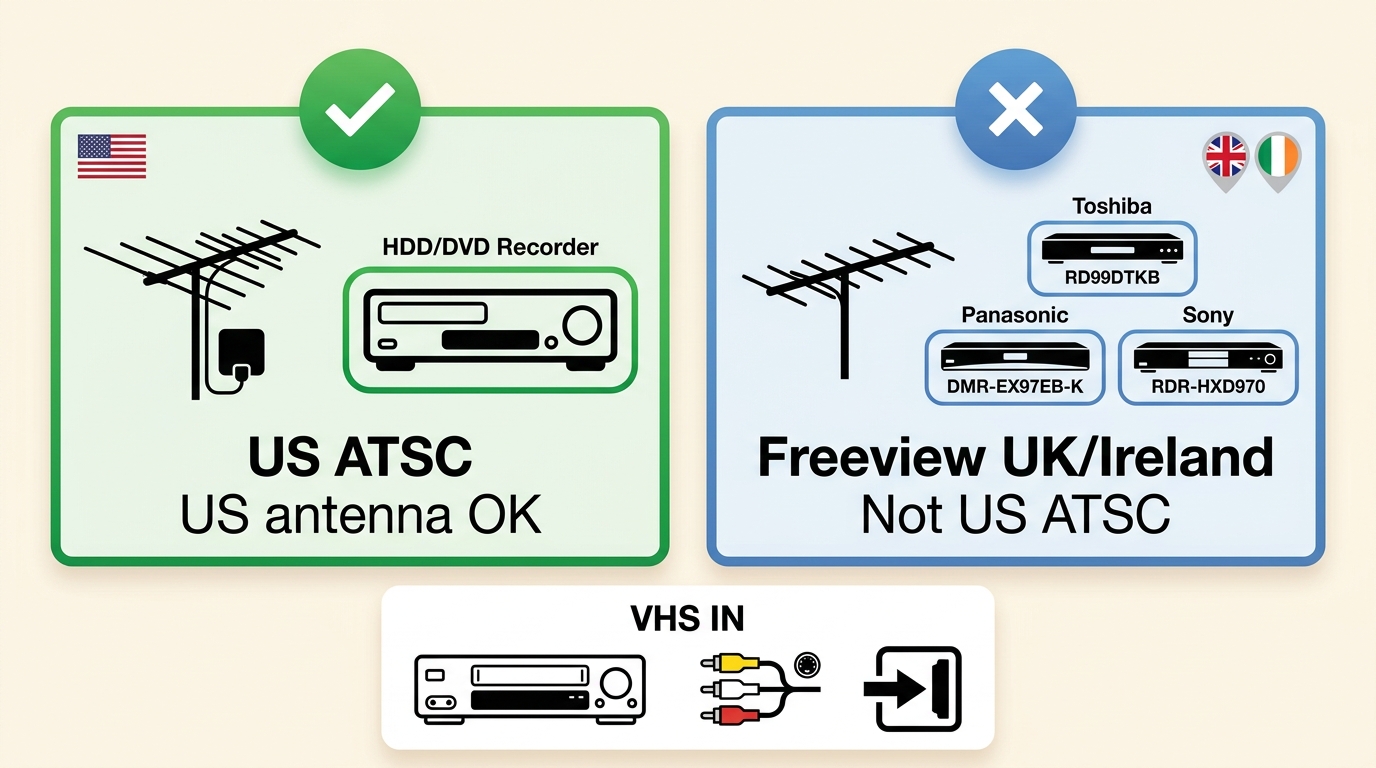
Freeview and Freeview+ tuners are designed for over-the-air broadcasts in the UK and Ireland. They do not receive US ATSC antenna signals, so a Freeview DVD recorder is not a suitable US antenna recorder. HDMI is generally useful for playback on a modern TV, but it does not turn the recorder into an HDMI capture device. Analog inputs such as composite or S-Video remain important for VHS and camcorder preservation.
I would check the tuner region before comparing hard-drive capacity: a Freeview DVD recorder is built for UK and Ireland broadcasts, while US antenna recording needs an ATSC-compatible tuner or a separate tuner-and-capture setup.
Tests Before Buying Used
Before relying on a used DVD hard drive recorder for family recordings, test it during the return window. Let it boot from a cold start, play a recording from the internal drive, record to a blank DVD, and finalize that disc in the recorder. Then play the finalized disc in another DVD player if possible.
- Confirm that the remote is included and that its record, menu, and finalization controls work.
- Check the tuner region, analog inputs, HDMI or composite outputs, and the connectors required by your VCR, camcorder, or TV.
- Listen for repeated HDD clicking, stalled loading screens, or disc-writing errors.
- Keep a migration plan: move important recordings to finalized DVDs or capture them to a computer before the recorder becomes your only copy.
A legacy recorder makes sense when its tuner or analog inputs match an existing setup and its recording can be exported. It is a poor choice for anyone who needs dependable long-term storage without testing aging hardware first.
3 Legacy DVD Recorders with Hard Drives
Toshiba RD99DTKB
The Toshiba RD99DTKB is a legacy Freeview+ recorder that may appear in used listings. Its tuner supports UK and Ireland broadcasts, not US ATSC antenna signals, so US buyers should treat it as an analog-input and disc-authoring example rather than a TV-recording recommendation. Its internal hard drive can hold recordings before DVD dubbing where the unit remains functional.
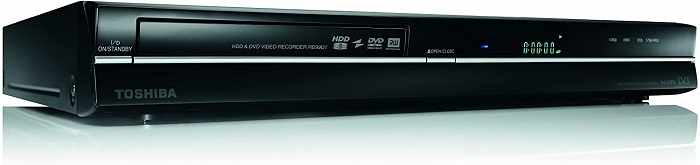
- 250 GB built-in hard drive for storing long TV recordings without juggling discs.
- DVD recording support for DVD-R, DVD-RW, DVD+R, and DVD+RW formats.
- Basic editing tools to trim footage or divide recordings before burning to disc.
- Analog input options such as SCART and composite, suitable for older camcorders and VCRs.
Suitable for: Used-market buyers in the UK or Ireland who need Freeview recording, or users with compatible analog sources who can verify DVD writing and finalization before relying on the unit.
Panasonic DMR-EX97EB-K
The Panasonic DMR-EX97EB-K distinguishes itself from the other units in this list through its dual-tuner design, which allows two different channels to be recorded simultaneously. Its Twin Freeview HD tuners are designed for UK and Ireland broadcasts and will not receive US ATSC signals. For users outside a Freeview region who still want to use this unit for analog source archiving, the dual-tuner advantage is simply unused, but the rest of the recording and disc-creation functions remain available.
- 500 GB internal hard drive that stores long recordings without the need to manage discs immediately.
- Twin Freeview HD tuners allowing simultaneous recording of two different channels.
- DVD recording support for DVD-R/RW and DVD+R/RW formats.
- Time-shift viewing to pause and resume live broadcasts.
- HDMI output for connecting to modern TVs, plus legacy inputs for older devices.

Suitable for: Users in a Freeview region who find a working used unit, or analog-archiving projects where the inputs, HDD playback, and finalized DVD output have been checked first.
Sony RDRHXD970
The Sony RDR-HXD970 is another legacy example with a single Freeview tuner and a menu system intended for straightforward recording. Its tuner works with UK and Ireland broadcasts, not US ATSC antenna signals. Outside those markets, it may still be relevant for analog VCR or camcorder input, provided the used unit can play its HDD recordings and create a finalized DVD.
- 250GB internal HDD that stores extensive SD recordings with simple scheduling.
- Freeview tuner for standard-definition live viewing and recording.
- Chase play / time-shift to pause or rewind current broadcasts.
- HDMI and legacy outputs for flexible connection to both old and newer televisions.

Suitable for: Buyers who understand the Freeview limitation and need a tested used recorder for standard-definition analog input or regional broadcast recording.
HDD Recording Export and Preservation Paths
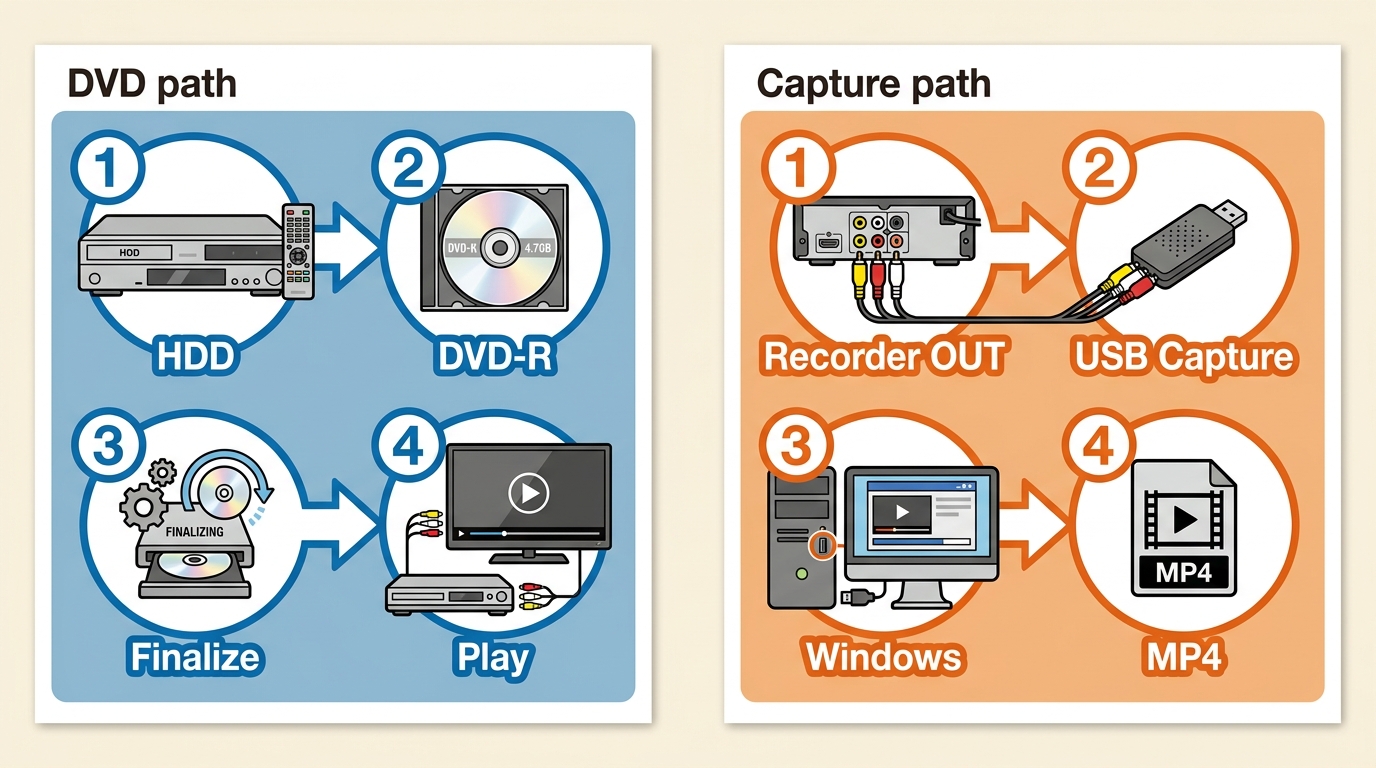
HDD to DVD and Finalization
For a working recorder, the most common way to preserve an internal-HDD recording is to dub it to a recordable DVD and finalize the disc. Finalization closes the recording session so the disc can play in other compatible DVD players. Copy an important program as soon as possible, then test the finished disc before deleting the HDD version.
Some recorders restrict dubbing, split recordings across discs, or fail during finalization. If a recording matters, keep the original on the HDD until the finalized DVD has been checked, and make another copy if the model allows it.
USB Limits and Capture-to-PC Fallbacks
A USB or SD slot does not automatically provide computer-playable video files. Use direct media export only when the recorder's documentation specifically supports it. Many recorders store recordings in proprietary HDD structures that a computer cannot read directly.
When a recorder can play the recording but cannot export a standard file, connect its analog output to a USB capture device and save the playback on a computer. This path re-records the signal, but it can preserve footage that would otherwise remain trapped on a failing recorder. Capture important material before boot failures, unreadable discs, or HDD errors worsen.
Hardware Recorder or Capture Plus Authoring Software?
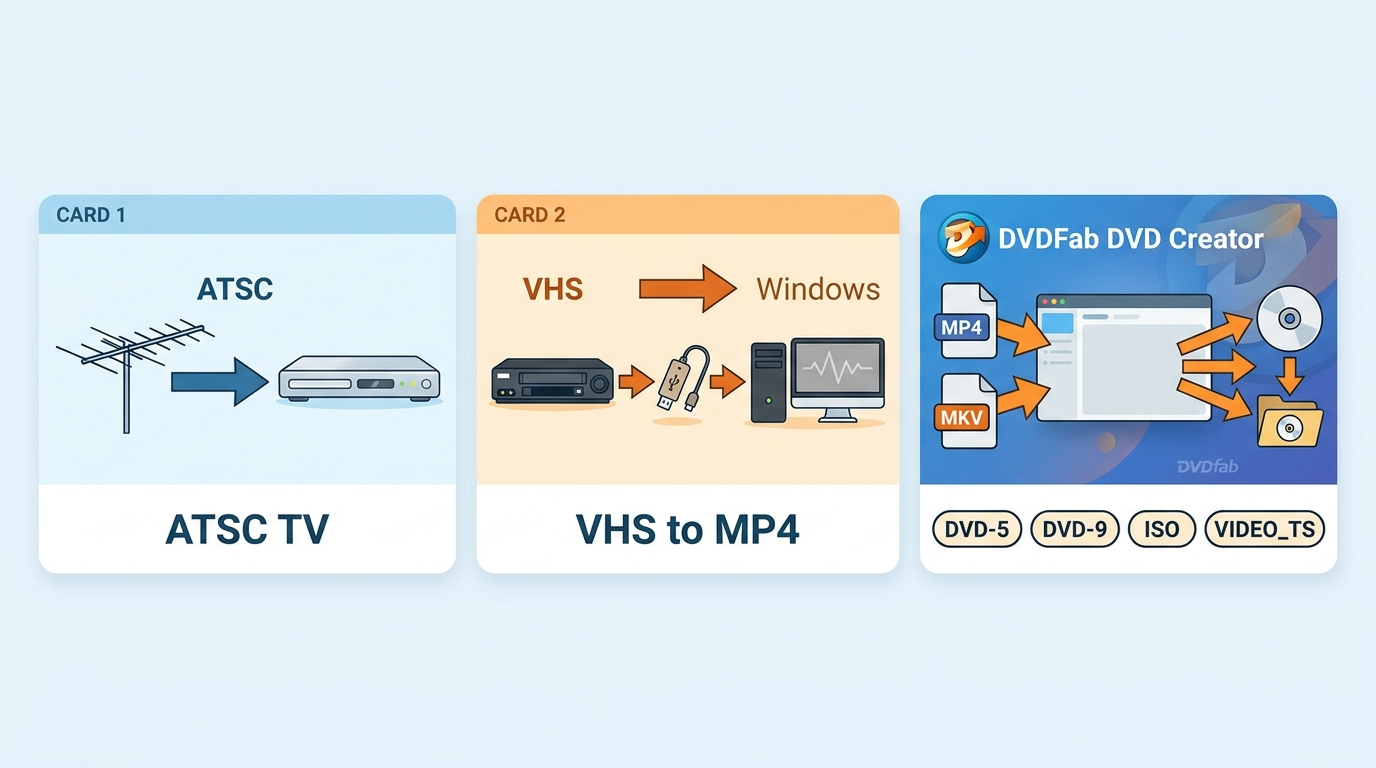
Used HDD/DVD recorders can record compatible TV or analog inputs, while a USB capture device turns VHS and camcorder playback into computer files. For footage that is already digital, DVD authoring software provides control over disc structure, menus, and output copies. DVDFab DVD Creator is a desktop app that accepts 200+ video formats and creates DVD-5, DVD-9, ISO, or VIDEO_TS output from existing digital files. It does not capture live TV or ingest VHS without a separate tuner or capture device.
If you are working with VHS tapes and do not already own a functioning standalone recorder, a USB video capture device connected to a computer is a sensible alternative. It creates a digital file that can be archived, edited, and burned with the same authoring steps described below. I would favor this option for preservation when the old recorder's HDD or disc-writing hardware has not passed a complete test.
Free Download Windows 11/10/8.1/8/7
Free Download macOS 12 or newer
Key features:
- Accepts more than 200 video formats, including MKV, MP4, TS, MOV, and WMV.
- Creates DVD-Video in standard disc types such as DVD-5, DVD-9, DVD±R/RW, and DVD±R DL.
- Offers video editing tools and customizable menu templates; compare DVD menu maker options when menu style is a priority.
- Supports flexible menu customization with layout, text, and thumbnail options.
- Supports hardware acceleration; encoding and disc-writing time depends on the computer, source file, and DVD burner.
How to Create a DVD From Video Using DVDFab DVD Creator
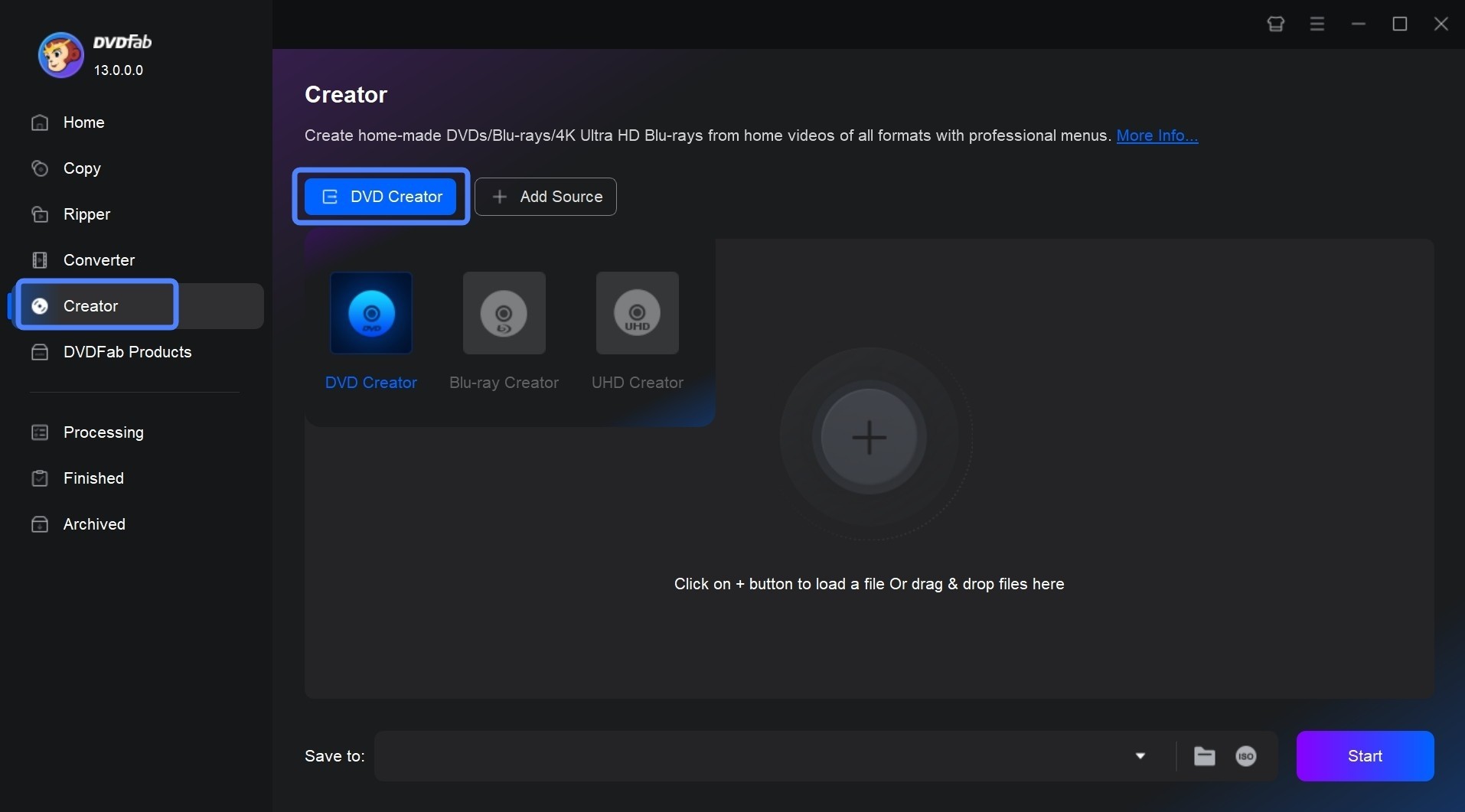
Step 1: Start with a finished digital video file, whether it came from a camera, a USB capture device, or existing storage. Download DVDFab 13 and install it on your PC. Launch the application and select Creator from the module bar. Click the Creator Mode Switcher and choose DVD Creator. Load the source video using the Add button on the main interface, or drag and drop the file directly.
Step 2: After the video is loaded, open Advanced Settings to choose disc type, encoding quality, aspect ratio, and playback mode.
If you want to shape the visual style of your disc, select Menu Settings to customize layout, background images, text, and thumbnails.
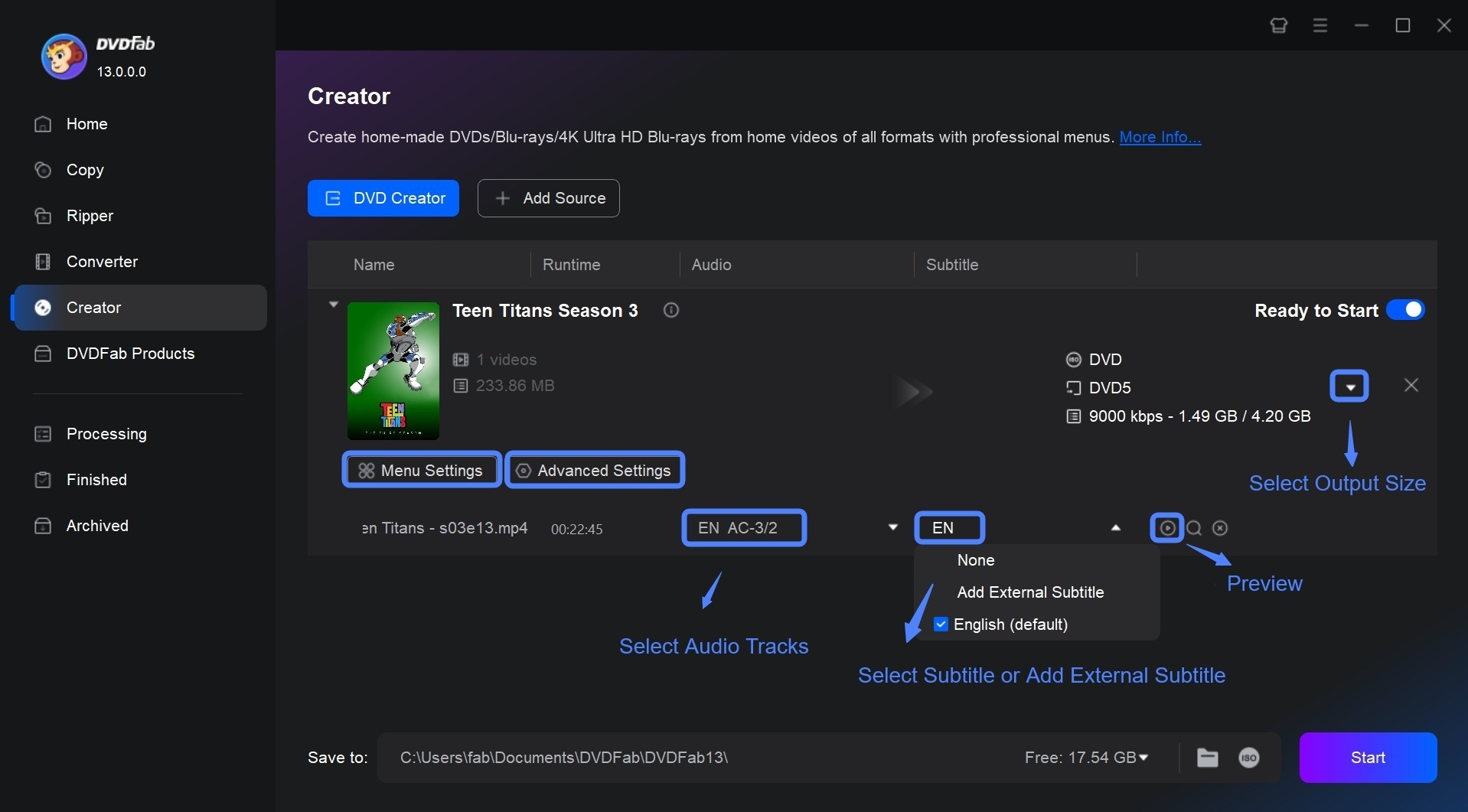
You can also access the built-in Video Editor from this stage to trim clips, crop the frame, or adjust contrast before authoring the final DVD.
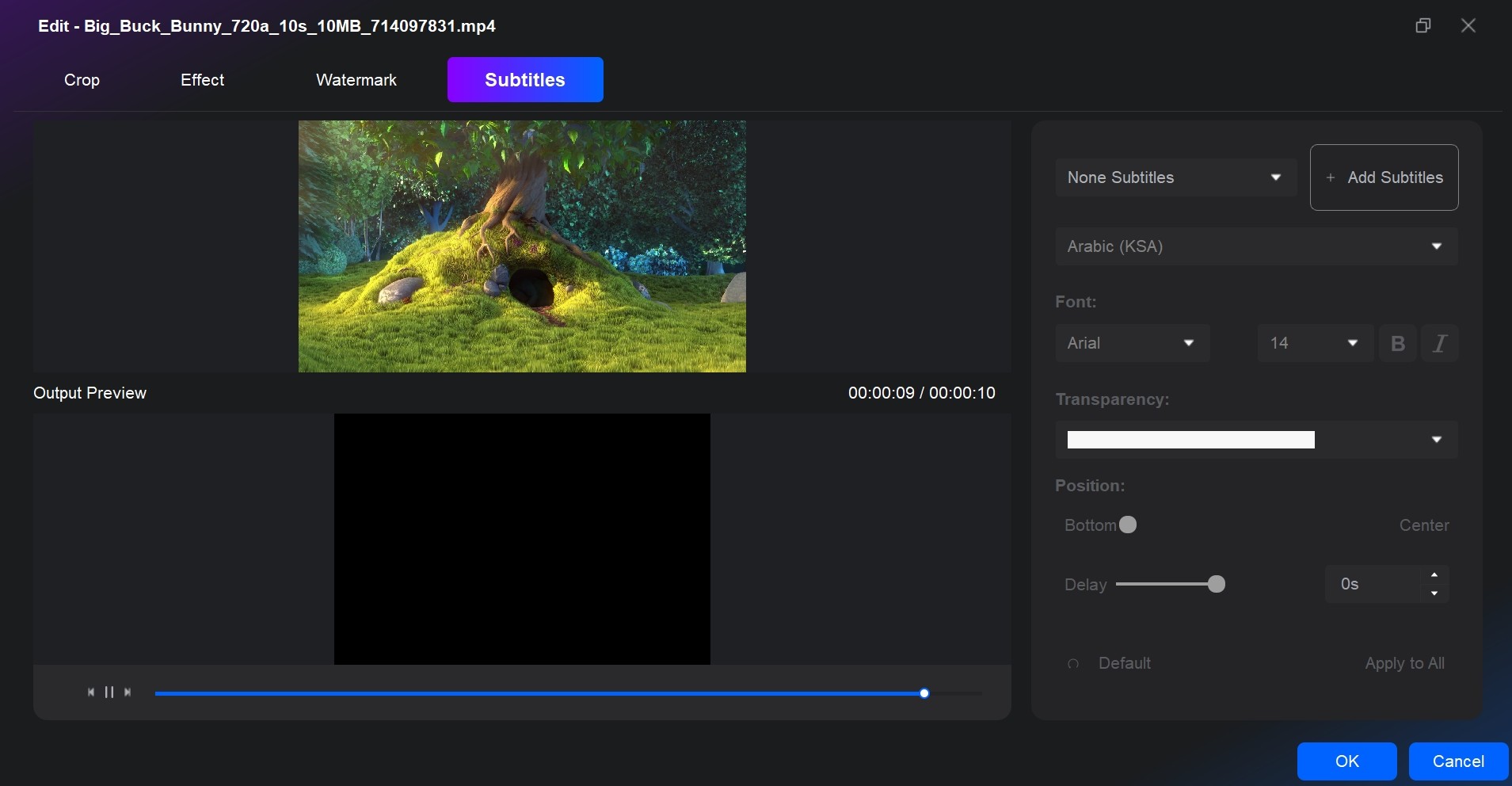
Step 3: Select a destination under Save to, such as your DVD burner for immediate writing or a folder/ISO for later burning. Click Start to begin the conversion and authoring process. DVDFab will display real-time progress and notify you when the disc is ready.
FAQs
Can I still buy a new DVD recorder with a hard drive in the US?
Mainstream new US DVD/HDD recorder supply has effectively ended. Most options are used or refurbished, so check the return terms, tuner type, included remote, HDD playback, DVD writing, and finalization before depending on a unit for preservation.
Will a Freeview DVD recorder work with an American antenna?
No. Freeview is designed for UK and Ireland broadcasts, while US over-the-air TV requires an ATSC-compatible tuner. A Freeview model can still be useful for compatible analog inputs, but it will not receive US antenna channels.
Can I copy recordings from the internal hard drive to a computer?
It depends on the recorder. A recording may need to be dubbed to DVD and finalized, exported through a documented USB or SD function, or played through analog output into a capture device. A USB port alone does not guarantee file export.
Is DVDFab DVD Creator a replacement for a live-TV recorder?
No. DVDFab DVD Creator makes DVDs from existing digital files. For live TV, VHS, or camcorder footage, first use a compatible tuner or capture device, then author the resulting video file to DVD.
Conclusion
Buy a legacy DVD recorder with a hard drive only when its tuner, inputs, condition, and exit path match the job. For VHS or camcorder preservation, a USB capture device plus DVD authoring software gives you a computer file before disc creation. For MP4, MKV, and other finished digital files, DVDFab DVD Creator can create DVD-5, DVD-9, ISO, or VIDEO_TS output with menus and chapters. I would not make an aging recorder the sole home for important footage: migrate authorized personal recordings where permitted by applicable law, and keep the resulting copies for personal use.

 How to Convert WMV to DVD: 3 Methods for Windows and MacBy Wenny Yan - Sep 16, 2026
 How to Convert MP4 to DVD Format for Free on Windows, Mac & OnlineBy Diana Smith - Sep 8, 2026
 How to Burn DVD with Subtitles: Add SRT/ASS or Hardcode CaptionsBy Diana Smith - Sep 3, 2026
![18 Best Free DVD Burner Software for Windows [2026 Review]](https://images.dvdfab.cn/media/Best_Free_DVD_Burner_Software_for_Windows_16sgci.png/public) 18 Best Free DVD Burner Software for Windows [2026 Review]By Diana Smith - Sep 3, 2026
18 Best Free DVD Burner Software for Windows [2026 Review]By Diana Smith - Sep 3, 2026