Does Wii Play Blu-ray? No—What Works on Wii and Wii U

Summary: No. Neither the Nintendo Wii nor Wii U can play Blu-ray movie discs. An original Wii can play Motion JPEG AVI or MOV files up to 848×480 through Photo Channel from an SD card, but Wii U has no equivalent official feature. For direct HD playback, use a Blu-ray player; convert the movie only if you specifically want to watch it on an original Wii.
Table of Contents
I already have a Wii connected to the television, so using it as a movie player seems more convenient than adding another device. But does Wii play Blu-ray, or can a system update add that function? Neither the Wii nor the Wii U can play Blu-ray movie discs. Their disc drives and system software do not provide Blu-ray movie playback.
To assess whether Wii can play Blu-ray by any supported method, I checked Nintendo’s compatibility information, the Photo Channel limits, and the WiiMC documentation. The options are narrow: use a separate player, or convert a movie you are allowed to copy into a low-resolution file for an original Wii.
Can Wii or Wii U Play Blu-ray Discs?
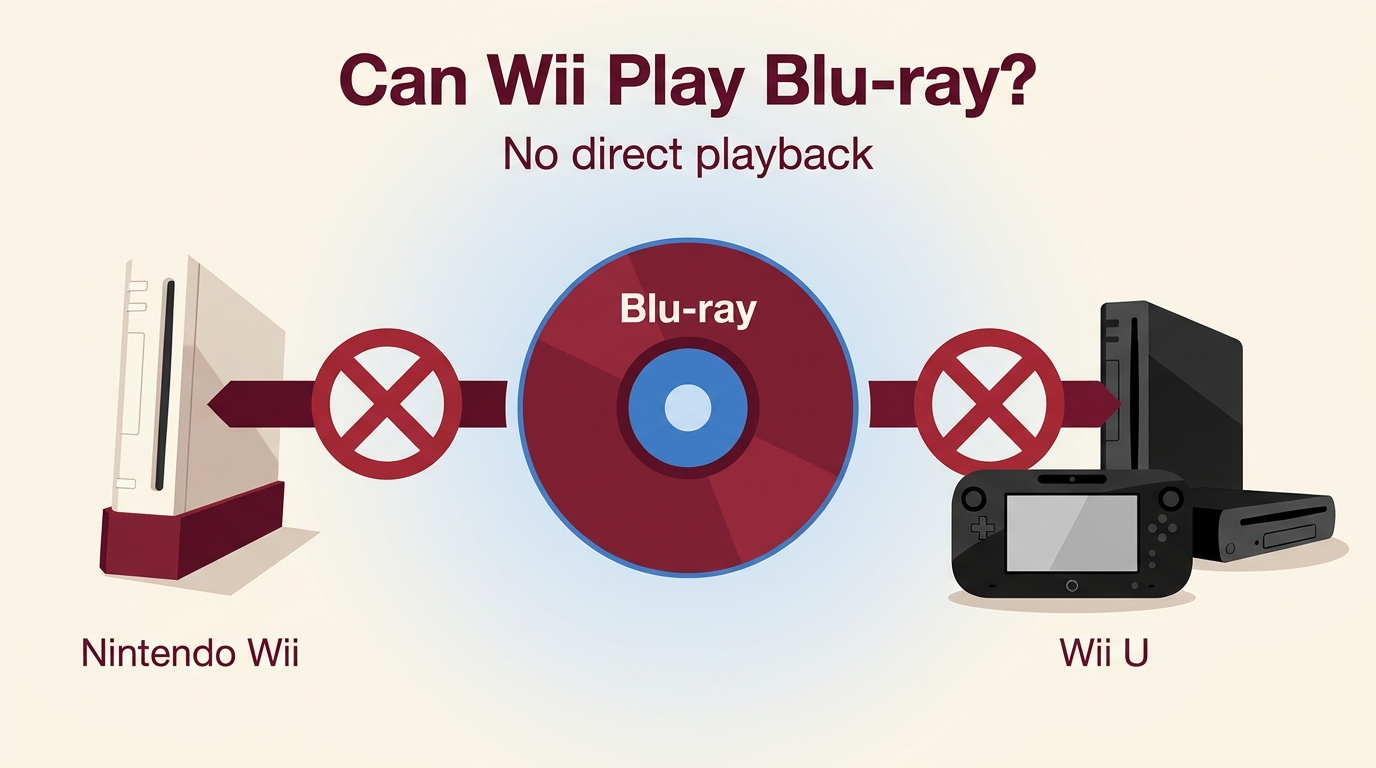
No. The original Wii cannot read or play Blu-ray movie discs. The Wii U cannot play them either, despite being a newer console.
| Playback Capability | Nintendo Wii | Nintendo Wii U |
| Blu-ray movie discs | No | No |
| DVD movie discs | No native support | No |
| CD music discs | No | No |
| Official local video option | Photo Channel from an SD card | No equivalent Photo Channel |
| Photo Channel video format | OpenDML-compliant Motion JPEG AVI or MOV | Not applicable |
A system update cannot add Blu-ray playback. The original Wii drive does not contain the hardware needed to read a Blu-ray movie disc, while neither console includes the movie-playback functions required to open a commercial Blu-ray.
Can Wii U Play Blu-ray?
The Wii U supports Wii U Game Discs and Wii Game Discs, but Nintendo specifically excludes Blu-ray, DVD, CD, and GameCube discs. Wii U Game Discs use a proprietary game format, so compatibility with them does not establish support for commercial Blu-ray movies. In June 2011, Nintendo explained that many households already had movie players and that adding DVD and Blu-ray movie playback would increase costs, including licensing fees.
The original Wii’s Photo Channel method also cannot be copied directly to Wii U. The virtual Wii environment on Wii U does not include Photo Channel, so converting a movie to Motion JPEG does not create an official Wii U playback option.
Which Option Should You Use to Watch a Blu-ray Movie?
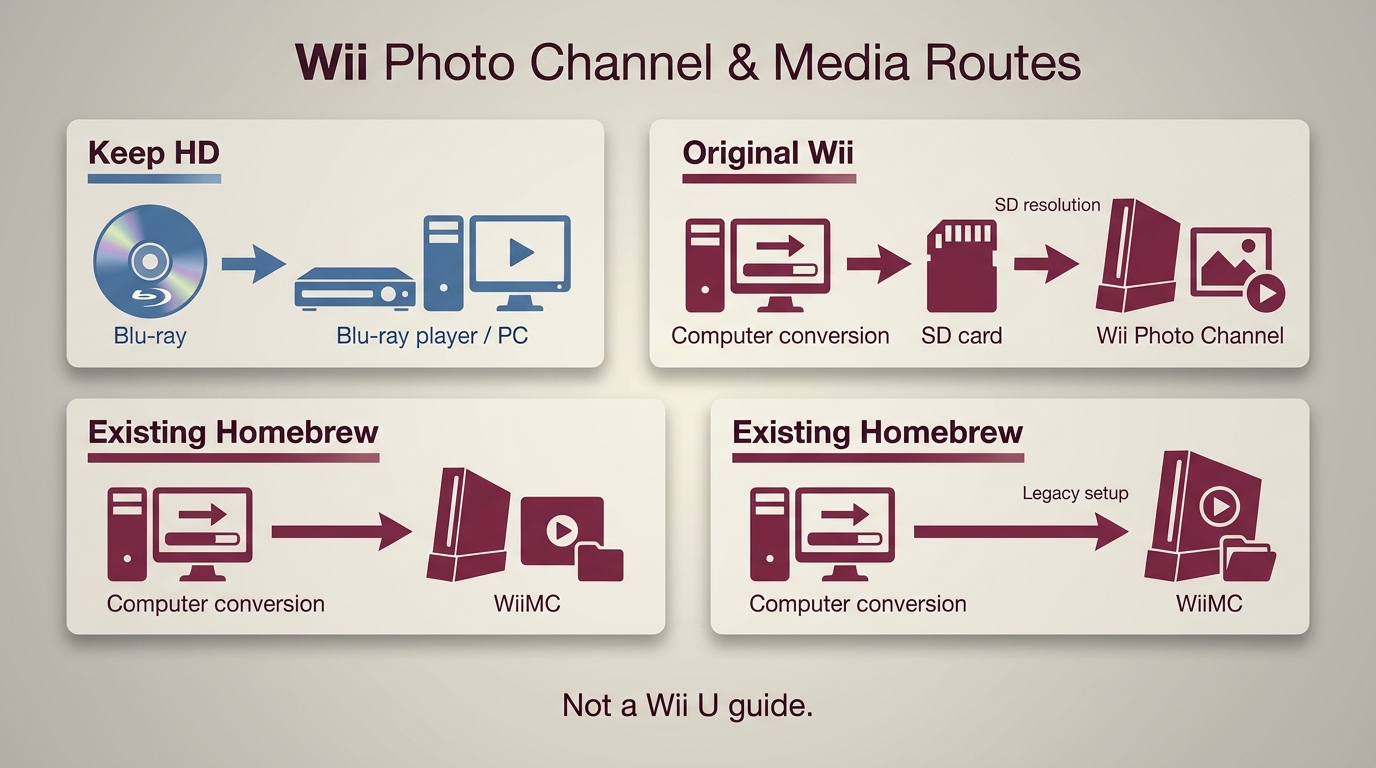
The right choice depends on whether you want to preserve Blu-ray quality or specifically use an old Wii.
- Use a Blu-ray player or compatible computer for direct playback. This keeps the original HD video, audio tracks, menus, and subtitles. It makes sense when the goal is simply to watch the disc.
- Convert the movie for an original Wii. Photo Channel can play OpenDML-compliant Motion JPEG AVI or MOV files from an SD card; the 16:9 conversion sample below uses 848×480. The result is standard definition, and Motion JPEG produces much larger files than modern formats such as H.264.
- Consider the original WiiMC as a legacy file player on an already modified original Wii. WiiMC reads media from SD, USB, SMB network shares, and FTP. It supports more video types than Photo Channel, but it still cannot make the Wii drive read a Blu-ray disc. The movie must first be converted on a computer.
I recommend a dedicated Blu-ray player for HD viewing because it avoids the extra conversion steps and loss of HD detail. Converting for Wii makes sense only when using that console is part of the goal.
Blu-ray Conversion for the Original Wii Photo Channel
This method applies to an original Wii with Photo Channel. It does not provide a playback method for Wii U. To prepare the movie, you first need to rip Blu-ray to a digital file and then convert that file to the limited format the Wii accepts.
Step 1: Check the Wii Playback Limits
Prepare the following before converting the movie:
- An original Wii with Photo Channel.
- An SD or SDHC card supported by the console.
- OpenDML-compliant Motion JPEG video saved as an AVI or MOV file.
- A sample resolution of 848×480 for 16:9 video or 640×480 for 4:3 video.
Photo Channel does not provide normal support for MP4, MKV, or H.264 video. Nintendo also notes that some otherwise compatible video files may have no playable audio, so convert a short sample before processing the complete movie.
Step 2: Rip the Blu-ray to a Digital File
FFmpeg can convert an existing video file, but it does not provide a complete method for opening a protected commercial Blu-ray. If the source is an unprotected video file or homemade Blu-ray folder that FFmpeg can already read, you may not need paid disc software.
Use this method only for content you are authorized to access and copy, where permitted by platform terms and applicable law.
For a personal Blu-ray backup on your computer, DVDFab Blu-ray Ripper can read the disc and save selected tracks in an intermediate MKV file for offline viewing and the next conversion step.
Free Download Windows 11/10 (64-bit)
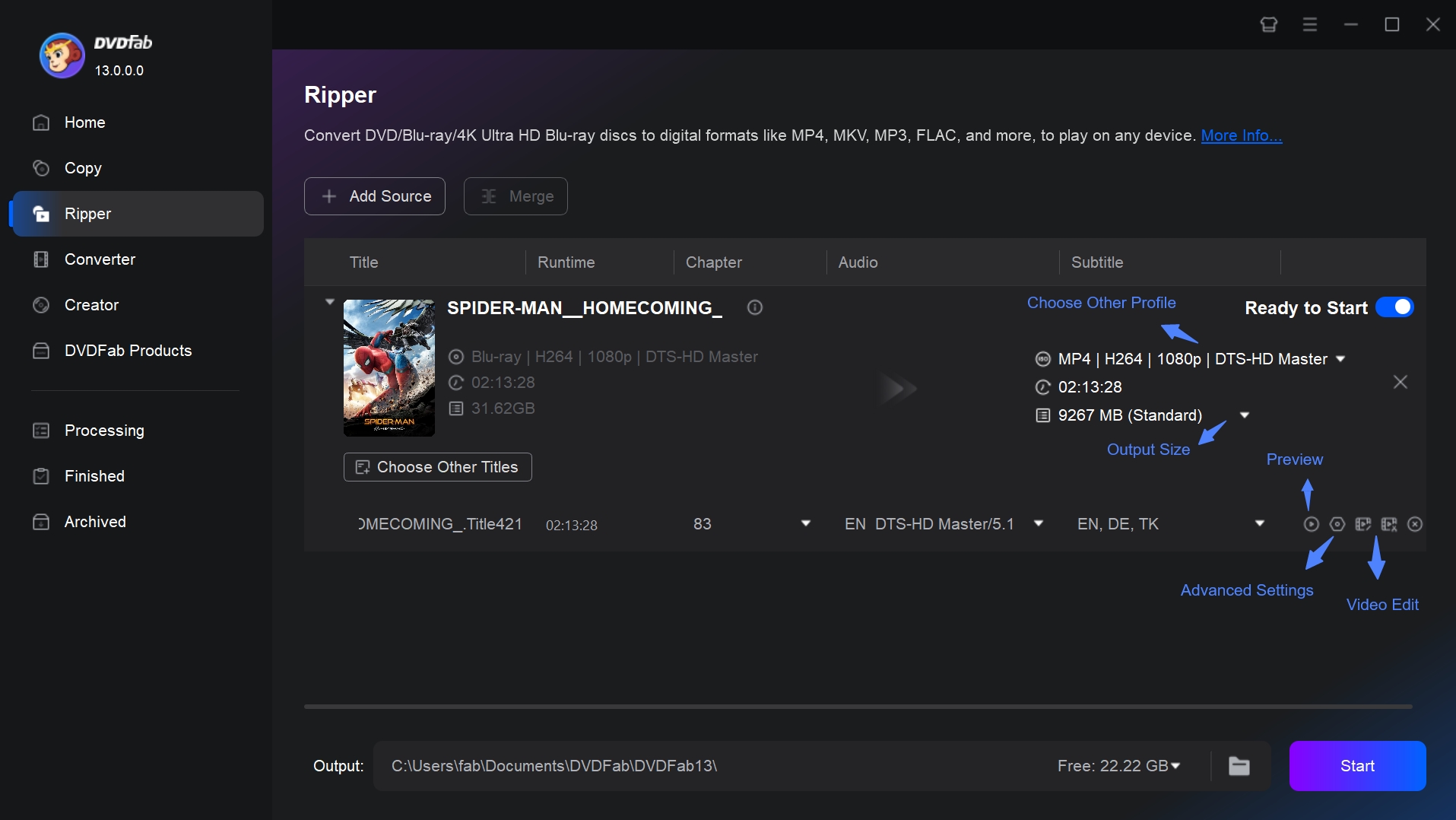
- Install DVDFab on Windows 11/10 (64-bit) or macOS 12+ and open the Ripper module.
- Insert the Blu-ray into a compatible computer drive, or load a Blu-ray ISO or folder.
- Select the main movie title and the audio track you want to keep.
- Open Choose Other Profile and select MKV.Passthrough.
- Choose an output folder and click Start.
MKV Passthrough keeps the selected source video and audio without compressing them during this first stage.
You can retain the passthrough MKV as a master for a capable player while FFmpeg creates a separate standard-definition copy for the Wii.
For the computer-stage MKV step, my July 2026 test of a 33.43 GB 2012.iso on Windows 10 with 16 GB RAM, an RTX 4060 Ti, and an i7-6700 took 7 minutes 4 seconds to 8 minutes 4 seconds for lossless MKV output of 28.7–31.4 GB, helping you budget that stage before creating the Wii copy.
Photo Channel cannot play the intermediate MKV file or select embedded Blu-ray subtitle tracks. If subtitles are required, render them into the picture during conversion.
Step 3: Convert the MKV File with FFmpeg
Install FFmpeg and confirm that it runs by entering ffmpeg -version in Terminal or Command Prompt.
For a 16:9 movie, this sample command uses 848×480 to create a two-minute test file:
ffmpeg -i input.MKV -t 120 \
-vf "scale=848:480:force_original_aspect_ratio=decrease,pad=848:480:(ow-iw)/2:(oh-ih)/2,fps=30" \
-c:v mjpeg -q:v 3 -pix_fmt yuvj422p \
-c:a pcm_s16le -ar 48000 -ac 2 wii_test_16x9.avi
For a 4:3 movie, this sample command uses 640×480:
ffmpeg -i input.MKV -t 120 \
-vf "scale=640:480:force_original_aspect_ratio=decrease,pad=640:480:(ow-iw)/2:(oh-ih)/2,fps=30" \
-c:v mjpeg -q:v 3 -pix_fmt yuvj422p \
-c:a pcm_s16le -ar 48000 -ac 2 wii_test_4x3.avi
The command writes Motion JPEG video with uncompressed stereo PCM audio. Nintendo does not guarantee that every audio stream inside a compatible video file will play, which is why the two-minute test matters.
If the sample plays with the correct picture, aspect ratio, and sound, remove -t 120 and change the output filename to convert the complete movie. Motion JPEG and PCM both use substantial storage, so check the estimated file size before starting a full-length conversion.
Step 4: Copy and Play the Video
Copy the finished AVI file to an SD or SDHC card. Do not use a USB drive for the Photo Channel method.
Insert the card into the Wii, open Photo Channel, select the SD card, and choose the converted video. If the file does not appear or the sound is missing, stop before converting other movies and check the troubleshooting section below.
Is Homebrew or WiiMC Worth Using?
The original WiiMC project lists version 1.3.4, released on November 23, 2013. It is a legacy local-file player for an original Wii already set up to run Homebrew; this version history does not describe separately maintained forks. It can load files from SD cards, USB storage, SMB network shares, and FTP servers, giving it more storage and format options than Photo Channel.
It does not add Blu-ray support to the Wii drive. A Blu-ray movie still needs to be read and converted on a computer before WiiMC can play the resulting file.
WiiMC also lists DVD playback, but that function depends on the Wii containing an older drive that still accepts DVD video commands. Some systems sold in 2009 and systems sold from 2010 onward do not support that DVD mode. This older-drive exception applies to DVD playback on the original Wii, not to Wii U or Blu-ray movie playback.
Installing Homebrew adds several setup steps and is not supported by Nintendo. If watching a Blu-ray movie is the only objective, use a Blu-ray player or compatible computer instead. WiiMC makes more sense when the console has already been modified and is already used for local media files.
Fix Common Wii Video Playback Problems
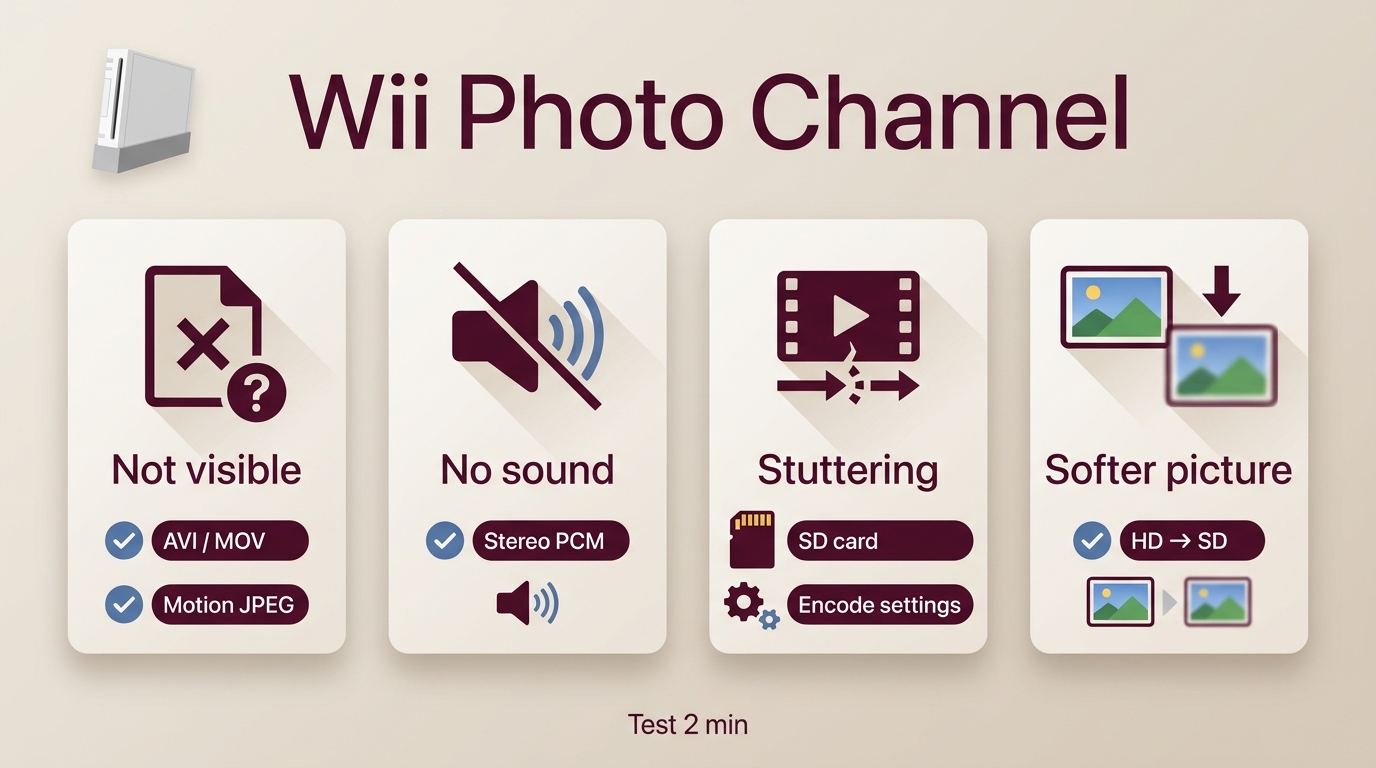
The Video Does Not Appear in Photo Channel
Check both the container and the video codec. Changing an MP4 filename to .avi does not convert the video to Motion JPEG.
Confirm that:
- The file is an AVI or MOV.
- The video is OpenDML-compliant Motion JPEG.
- If you used the sample command, the output has the intended resolution: 848×480 for 16:9 or 640×480 for 4:3.
- The file is stored on an SD or SDHC card rather than a USB drive.
The Video Plays Without Sound
Nintendo warns that the audio portion of some compatible video files may not play. Reconvert a two-minute segment with stereo PCM audio and check it before processing the full movie.
If the test still has no sound, use a different media player instead of repeatedly converting the complete movie. WiiMC may accept the file on a modified Wii, while a Blu-ray player or computer avoids the Photo Channel audio restriction.
The Video Stutters or Takes a Long Time to Load
Motion JPEG stores each frame as a separate compressed image, so a movie can become very large. A slow SD card may take longer to load the file or cause irregular playback.
In WiiMC, a supported container alone does not mean the Wii can decode the file’s video codec, resolution, and bitrate.
Check the test clip first. If it also stutters, try another supported SD card or reduce the frame rate and quality setting before converting the full movie.
The Converted Movie Looks Softer Than the Blu-ray
This is expected. The 848×480 sample used here sacrifices HD detail from the source movie, whose Blu-ray resolution is normally 1920×1080. Enlarging that SD picture on a television does not restore the discarded detail. MKV Passthrough protects the quality of the intermediate file, but the final Wii version is still standard definition.
FAQs
Can I Connect an External Blu-ray Drive to a Wii?
No, a standard Wii has no supported way to play Blu-ray movies through a USB optical drive. Use the external drive with a compatible computer for the disc-reading step instead.
Does Wii Play DVDs?
Wii cannot natively play DVD movie discs through its standard system software. WiiMC can play DVDs on Wii only with certain older drive revisions, and that does not add Blu-ray compatibility.
Can Wii Photo Channel Play MP4 Files?
No, Photo Channel uses OpenDML-compliant Motion JPEG video in AVI or MOV containers, not MP4 files. Renaming an MP4 file to .avi does not convert its video codec; use the Motion JPEG conversion step above.
Will a Converted Blu-ray Still Play in HD on Wii?
No. The standard-definition Photo Channel sample loses the source Blu-ray’s HD detail, and display scaling does not restore it. Keep the passthrough MKV master for HD viewing on a capable player.
Is It Legal to Convert a Blu-ray for Wii?
Use only content you are authorized to access and copy for the intended personal use; owning a disc does not itself grant every copying permission. Do not redistribute the copy, and follow applicable law and platform terms.
Conclusion
Wii and Wii U cannot play Blu-ray movie discs. Use a dedicated Blu-ray player or compatible computer when HD picture quality, menus, audio tracks, and subtitles matter. If the goal is specifically to watch a converted movie on an original Wii, create a short Motion JPEG AVI sample using the 848×480 widescreen or 640×480 4:3 settings above and confirm its picture and sound in Photo Channel before converting the full title.

 How to Convert 2D Blu-ray to 3D Video with DVDFab Blu-ray RipperBy Diana Smith - Nov 12, 2026
 How to Rip Blu-ray for Plex: 3 Workflows for Your LibraryBy Wenny Yan - Oct 19, 2026
 5 Tested Tools to Convert Blu-ray to MP4 on Windows & Mac [2026]By Wenny Yan - Oct 10, 2026
 How to Convert Blu-ray to Digital on Windows, Mac & MobileBy Wenny Yan - Oct 10, 2026