UHD Drive Firmware Downgrade: Supported Models and Safer Steps

Summary: Finding a UHD friendly drive and flashing it without bricking the hardware comes down to identity checks, not luck. This guide covers what makes a drive friendly, when a firmware downgrade makes sense, a supported model-and-firmware matrix (BU40N vs BU50N included), a safer DVDFab UHD Drive Tool workflow, and troubleshooting plus post-flash verification for authorized personal 4K backups.
Table of Contents
You bought a 4K Ultra HD disc, dropped it into a Blu-ray drive, and got nothing but a "no disc found" message. Most people searching for a UHD friendly drive or for the DVDFab UHD Drive Tool are stuck at the same wall: the hardware exists, but its current firmware will not read the disc, and the real fear is picking the wrong firmware and bricking a drive you just paid for.
I have checked and flashed several UHD drive variants for a home media library, and the pattern is consistent: success depends far more on identifying the exact model than on any single click. This guide walks through the compatibility checks that matter, a supported UHD drives matrix you can scan by model, the flashing workflow, and what to do when a write stalls.
What Makes a UHD Drive Friendly?
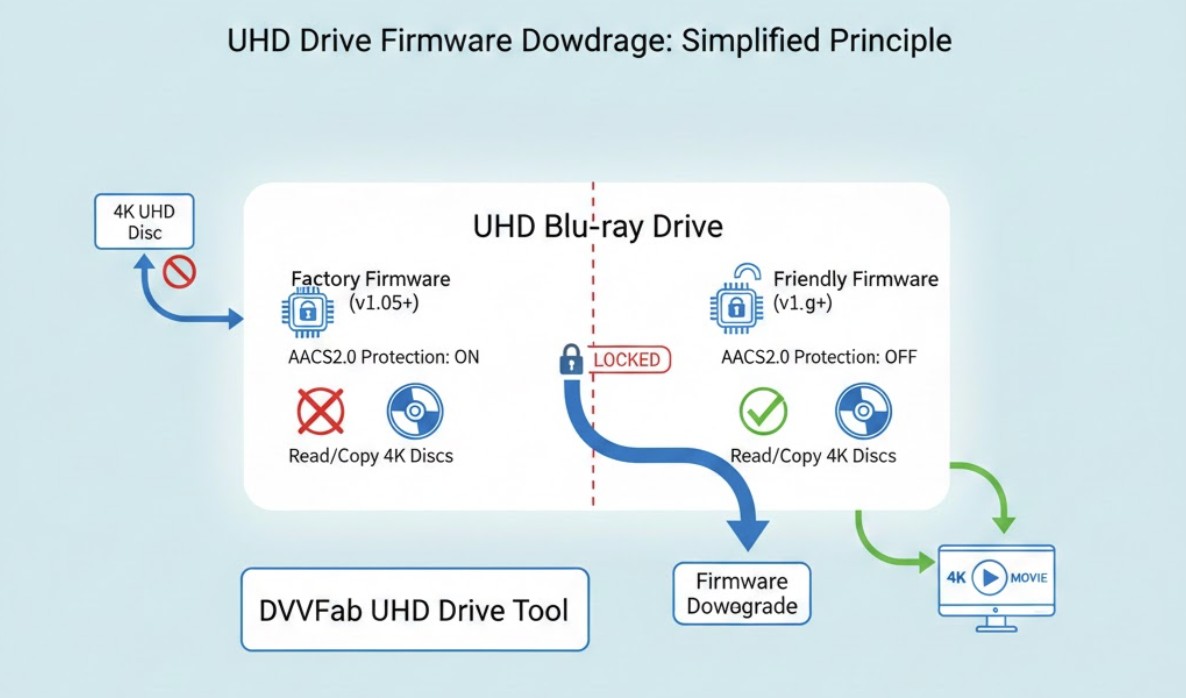
A UHD friendly drive is a Blu-ray drive whose firmware still allows supported software to read the data layers of a 4K Ultra HD disc. "Official" UHD drives are configured by manufacturers for stricter AACS 2.0 handling, while friendly builds keep the older read behavior that backup tools rely on. The distinction is about firmware state on a specific drive, not about a drive being special hardware.
Here is the part that trips people up: the family name on the box tells you very little. Two units with the same model number can ship with different OEM variants, SVC codes, and firmware, and only one of those combinations may be flashable. In my experience, exact model and hardware-platform data decide UHD drive compatibility far more than the family name, which is exactly why the next question is not "can I flash it" but "when does a downgrade actually make sense."
When a Firmware Downgrade or Cross-Flash Makes Sense
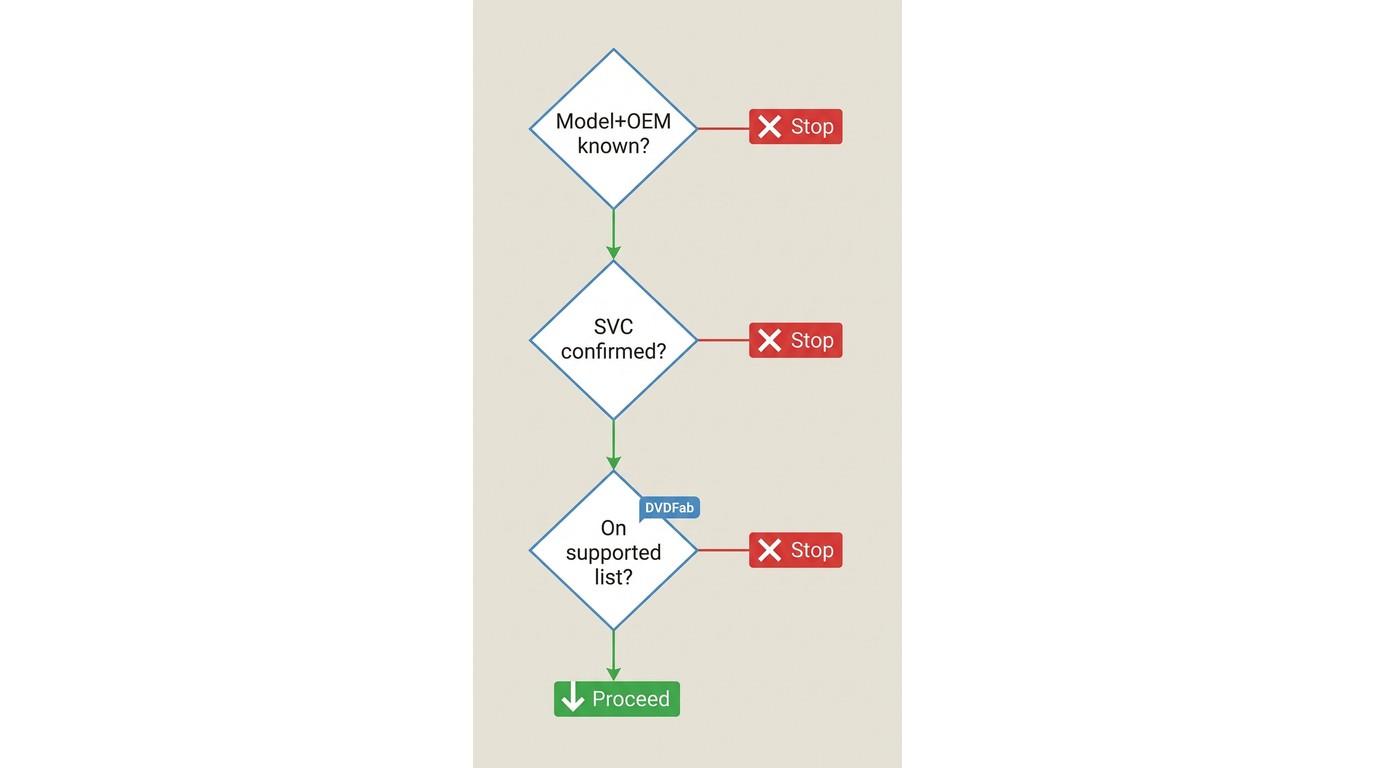
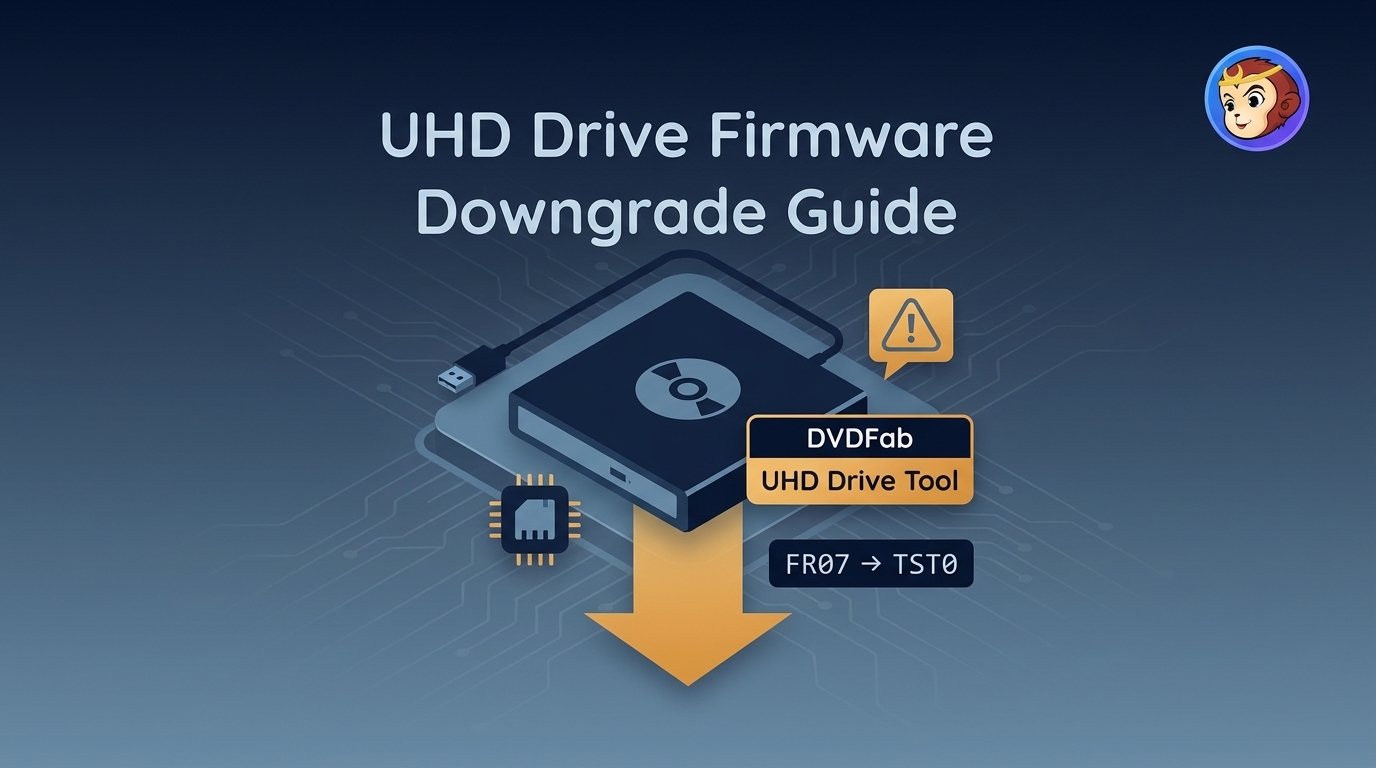
A firmware downgrade makes sense when a specific drive-and-platform combination is on the supported list and its current firmware no longer reads UHD discs. Some non-UHD Pioneer models use a verified cross-flash instead, which changes the firmware identity to a listed UHD-capable configuration. Neither action is a universal switch: confirm the full model, SVC or platform code, current firmware, target firmware, and listed method before you proceed. Done for the right unit, the change lets the drive work with tools like DVDFab UHD Copy and UHD Ripper for authorized personal backups.
The first time I flashed an LG BU40N, I moved before confirming the OEM sub-variant, and the suggested action did not match what I expected until I went back and read the SVC label. The current list assigns different targets to LG BU40N, HP HLDS BU40N, Buffalo BU40N, and the Archgon BU40N-based model, so these entries are not interchangeable. The identity check is the step that prevents most regret.

DVDFab UHD Drive Tool in the Workflow
The firmware installed on a UHD drive determines whether supported software can read the disc data needed for a personal backup.
DVDFab UHD Drive Tool checks a supported drive configuration against a compatible target and carries out the listed firmware downgrade or Pioneer cross-flash. The tool changes the drive firmware; UHD Copy or UHD Ripper is still required to copy or convert an authorized 4K Ultra HD Blu-ray backup.
Supported OS: Windows 11 / 10 (64-bit). The Windows version requires an Intel i3 or higher, 4 GB of RAM, 10 GB of free disk space, and a live Internet connection. UHD Drive Tool was added to DVDFab for Mac 13.0.6.3 for listed LG, ASUS, HP, Buffalo, and Archgon drives; the Mac release note does not list Pioneer support.
Key Features:
- Matches a supported model, platform, and current firmware to the target firmware listed for that configuration.
- Downgrades listed internal SATA and external USB drives from Pioneer, LG, ASUS, HP, Buffalo, and Archgon.
- Cross-flashes selected non-UHD Pioneer models to the compatible UHD-capable firmware named in the supported list.
- Prepares a successfully updated drive for use with the separate UHD Copy and UHD Ripper modules for authorized 4K Blu-ray movie backups.
A Safer UHD Firmware Downgrade Workflow
The setup still takes three short steps, while the actual firmware action starts with one click after a supported drive is detected and selected. The safety lives in what you check before and after the write. Run the pre-flash checklist first, keep the download handy, then move through the steps.
Check the Model, Platform, and Firmware
Start with drive firmware verification, not the software. Collect these before you flash anything: the exact model and OEM variant, the SVC or hardware-platform code, the manufacture date when it is printed, the current firmware identifier, and the connection type. Note a recovery path too. Stop if the variant is unknown, if the suggested action does not match the model, or if the drive is not detected at all. An SVC code check on the chassis label takes a minute and settles most of these questions.
Launch DVDFab UHD Drive Tool
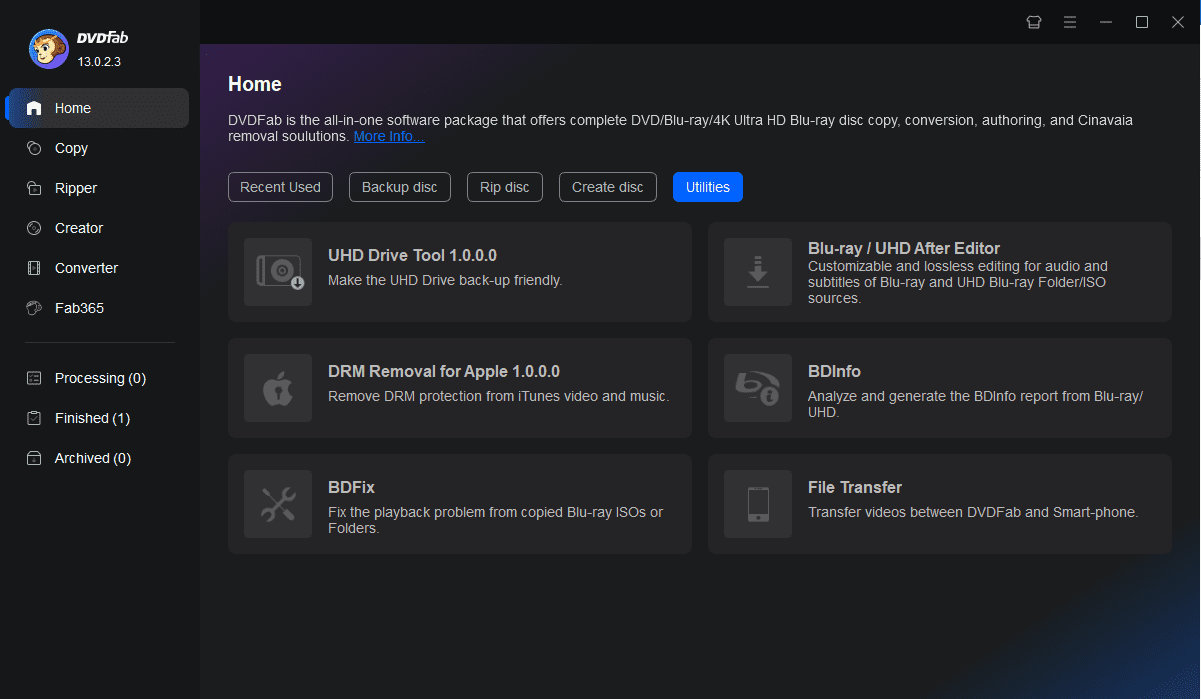
Install and open DVDFab, then choose "Utility" and "UHD Drive Tool." Connect the external UHD drive if you are using one, and take any UHD disc out of the tray before you continue. An empty tray keeps the tool focused on the drive rather than the media.
Confirm the Suggested Firmware Action
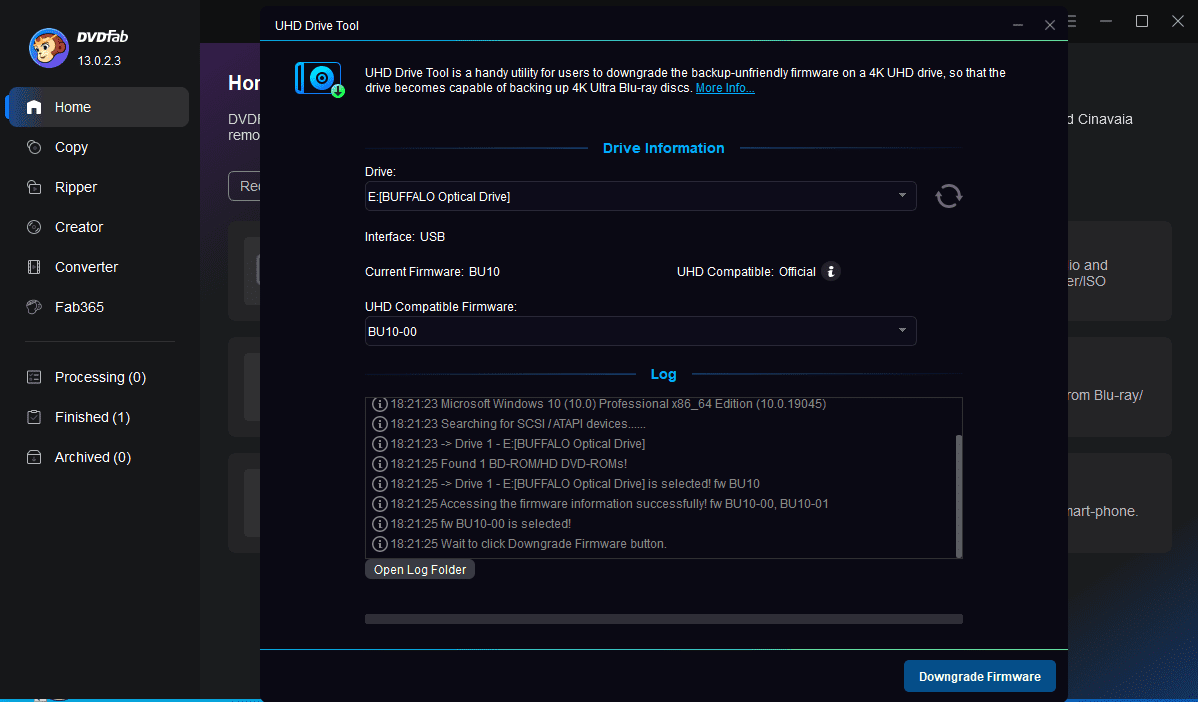
Select your drive from the menu and read the action the tool suggests for that exact unit. Confirm that the OEM variant, SVC or platform, and current firmware match what you recorded, and that the suggested downgrade or cross-flash is the method listed for your model. You can cross-check your unit against the published 4K UHD drives reference before you commit. If any field disagrees, stop here rather than force the write.
Complete the Firmware Action Without Interruptions
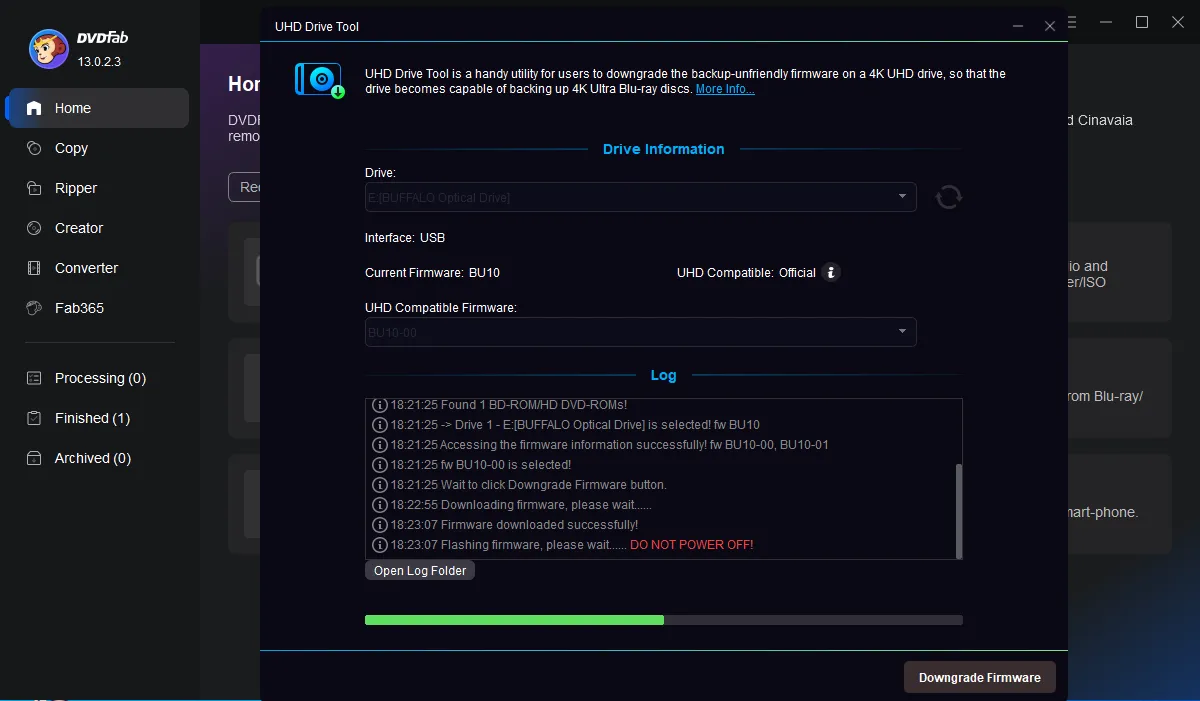
Follow the action shown for your model and let it finish. The write typically takes about two to three minutes; do not eject the drive, cut power, or run other tasks while it runs. When the tool reports success, reboot before you test anything. If the process stalls, do not immediately retry or power-cycle: wait until the tool has clearly stopped, then move to troubleshooting. In my sessions, the failures that were hardest to recover from all traced back to two things, a variant I had not confirmed or a write I let get interrupted.
Supported UHD Drive and Firmware Matrix
The list below is a decision matrix, not a shopping list: match your recorded identity data to a row before you flash. It separates current firmware from target firmware and preserves the listed method and status. "Tested" is shown only where the official list uses that label; an em dash means the model is listed without that test status. As of August 2026, the list still grows, so confirm your exact unit rather than assuming a whole family is covered.
Pioneer Downgrade and Cross-Flash Models
Pioneer support now covers both native UHD models that use a firmware downgrade and selected non-UHD models with a listed cross-flash. A family name such as XD07 or S12 is not enough on its own; the suffix, platform, and current firmware must match the row.
| Drive model | Type and platform | Current firmware | Target firmware | Method | Status |
| BDR-XD07UHD | External USB slim tray, RS8D30 | 1.04 | 1.00, 1.01, 1.02, 1.03 | Downgrade | Tested |
| BDR-XS07UHD/B-UHD/TUHD | External USB slim slot, RS8E21 | 1.02 | 1.00, 1.01 | Downgrade | Tested |
| BDR-S11 / BDR-S11JX | Internal 5.25-inch SATA, RS8800 | 1.54 | 1.53 | Downgrade | Tested |
| BDR-S12UHT | Internal 5.25-inch SATA, RS8F00 | 1.04 | 1.00, 1.01 | Downgrade | Tested |
| BDR-212UBK | Internal 5.25-inch SATA, RS8F00 | 1.05 | 1.00, 1.01, 1.02 | Downgrade | Tested |
| BDR-XD07TS | External USB, non-UHD, RS8D30 | 1.00, 1.01, 1.02, 1.03 | XD07TUHD 1.00, 1.01, 1.03 | Cross-flash | — |
| BDR-S12XLT | Internal 5.25-inch SATA, non-UHD, RS8F00 | 1.00, 1.01 | S12UHT 1.00, 1.01 | Cross-flash | — |
| BDR-212DBK | Internal 5.25-inch SATA, RS8F00 | 1.02 | S11 1.53 | Cross-flash | — |
| BDR-S09 | Internal 5.25-inch SATA | 1.50 | 211M 1.53 | Cross-flash | — |
| BDR-209DBK | Internal 5.25-inch SATA | 1.00 | 211M 1.53 | Cross-flash | — |
| BDR-209MBK | Internal 5.25-inch SATA | 1.00 | S11 1.53 | Cross-flash | — |
| BDR-S12JX | Internal 5.25-inch SATA | 1.03 | S11 1.53 | Cross-flash | — |
BU40N vs BU50N at a Glance
BU40N and BU50N labels appear under several brands, but the target firmware changes with the manufacturer and enclosure. Read the complete brand and model identity instead of treating every BU40N or BU50N as the same unit.
| Brand and drive model | Type | Current firmware | Target firmware | Method | Status |
| LG BU40N | Internal, UHD Official | — | CAT9 | Downgrade | — |
| LG BU50N | Internal, UHD Official | — | CC01 | Downgrade | — |
| HP HLDS BU40N | Internal, UHD Official | — | BW41 | Downgrade | — |
| HP HLDS BU50N | Internal, UHD Official | — | BW50 | Downgrade | — |
| Buffalo BU40N | External, UHD Official | BU13, BU14, BN12, BN13 | BU10 | Downgrade | Tested |
| Archgon MD-8107S-U3-UHD BU40N | External, UHD Official | — | 1.00 | Downgrade | Tested |
Other Listed LG and ASUS Models
The same rule applies to full-height internal drives, slim units, and external USB models. Keep each current-and-target pair together when you check the label and the action shown in the software.
| Brand | Drive model | Type | Current firmware | Target firmware | Method | Status |
| LG | UH12NS40 | Internal, BDXL, SVC code: NS40 | 1.01/1.02 | 1.00 | Downgrade | Tested |
| LG | BP55EB40 | External, BDXL, SVC code: NB50 | 1.02/1.03 | 1.00 | Downgrade | — |
| LG | WH14NS40 | Internal, UHD Friendly, SVC code: NS50 | 1.01-1.05 | 1.00 | Downgrade | Tested |
| LG | WH16NS40 | Internal, UHD Friendly, SVC code: NS50 | 1.03-1.05 | NS50_1.02 | Downgrade | Tested |
| LG | BH16NS40 | Internal, UHD Friendly, SVC code: NS50 | 1.03-1.05 | 1.02 | Downgrade | Tested |
| LG | BH16NS55 | Internal, UHD Friendly | 1.01-1.05 | 1.00 | Downgrade | Tested |
| LG | BH14NS58 | Internal, UHD Friendly | 1.01/1.02 | 1.00 | Downgrade | Tested |
| LG | BH16NS58 | Internal, UHD Friendly | 1.01/1.02 | 1.00 | Downgrade | Tested |
| LG | WH16NS58 | Internal, UHD Friendly | 1.V5-1.V9 | 1.00 | Downgrade | Tested |
| LG | BE16NU50 | External, UHD Friendly | 1.02-1.04 | 1.01 | Downgrade | Tested |
| LG | WH16NS60 | Internal, UHD Official | 1.02/1.03 | 1.00 | Downgrade | Tested |
| LG | BP60NB10 | External, UHD Official | 1.02 | 1.00/1.02 | Downgrade | Tested |
| ASUS | BC-12B1ST b | Internal, UHD Friendly, manufactured 2015+ | 3.01-3.11 | 3.00 | Downgrade | — |
| ASUS | BC-12D2HT | Internal, UHD Friendly, manufactured 2015+ | 3.01-3.11 | 3.00 | Downgrade | Tested |
| ASUS | BW-16D1HT | Internal, UHD Friendly, manufactured 2015+ | 3.01-3.10 | 3.00 | Downgrade | Tested |
| ASUS | BW-16D1H-U | External, UHD Friendly, manufactured 2015+ | A202/A203/A204 | A201 | Downgrade | — |
Read this as a starting point for supported UHD drives: support depends on the exact model, OEM variant, SVC or hardware platform, current firmware, target firmware, and the method listed for that combination, so the identity check always comes before the write.
Troubleshooting and Post-Flash Verification
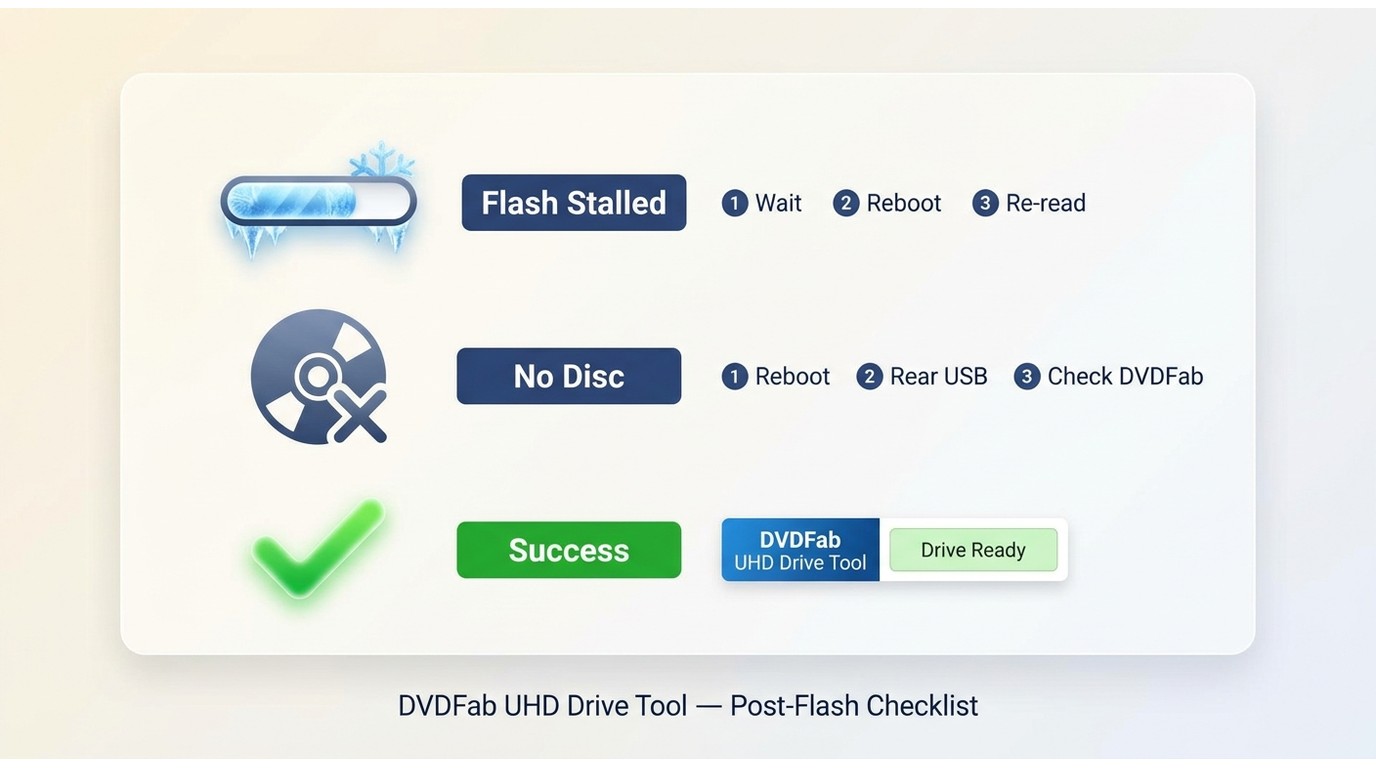
Most write problems fall into a few patterns, and the safe response is usually to slow down rather than retry. Community threads about downgrades that will not finish tend to describe the same root causes: an unconfirmed variant or an unstable connection. Here are firmware recovery steps for the common states, plus how to verify the result.
If the Downgrade Stalls
If the progress indicator freezes, do not eject or cut power while the tool may still be writing. Wait until the interface clearly reports that it has stopped, then reboot and re-read the drive before deciding anything. Do not run a second flash blindly. If the tool no longer detects the drive after a stalled write, treat that as a recovery boundary and seek model-specific guidance rather than trying arbitrary commands, which can make an external bridge or slim drive harder to recover.
If the Drive Shows No Disc
A "no disc" result right after flashing usually points at the firmware state or the connection, not the disc. Reboot first, since some drives only report the new firmware after a full system check. For an external UHD drive, reconnect it to a rear USB port on the motherboard with a good cable, and confirm the enclosure and bridge chip are ones the tool recognized. If it still shows no disc with a UHD title that another verified drive reads, the flash likely did not land as expected.
Verify the Result Before Using a Disc
Before you insert a UHD title, complete drive firmware verification: reopen the tool and confirm the firmware identifier now matches the target listed for your model. Only after the reported firmware matches should you test with a disc you are authorized to back up. This last check is what separates a confirmed flash from a hopeful one.
FAQs
Can I Use DVDFab UHD Drive Tool Without a Separate Product Key?
DVDFab offers UHD Drive Tool as a separate product, while access through an existing DVDFab package depends on the license attached to that account. Check License Info in DVDFab or the official product page before purchasing another license, and do not use an unofficial key or modified build.
Does DVDFab UHD Drive Tool Support Pioneer UHD Drives?
Yes, but only for the exact Pioneer model, platform, and current firmware combinations in the supported table. For example, BDR-XS07U is not the same listing as BDR-XS07UHD/B-UHD/TUHD, and the current table lists firmware 1.02 for that UHD entry. Pioneer support also includes selected non-UHD models with a specific cross-flash path; if the complete model and firmware do not match a row, treat the drive as unsupported for that action.
Is an External USB Enclosure Safe for a Firmware Downgrade?
It can be, but enclosure and bridge-chip behavior varies, so stable, direct power matters most. Use a rear motherboard USB port and a good cable, and confirm that the tool recognizes the exact enclosure and drive. If the model or connection is not clearly recognized, stop rather than run a firmware write over an uncertain connection.
What Information Should I Save Before Changing Drive Firmware?
Record the exact model and OEM variant, SVC or platform code, manufacture date, current firmware, connection type, and a recovery path for the drive. Match these details to the supported matrix before starting; if any field is uncertain, stop and confirm it before flashing.
Conclusion
The decision comes down to one line: proceed when the exact model, OEM variant, current firmware, target firmware, and listed method match, and stop to seek model-specific support when any of them does not. If your unit has a matching row in the matrix, DVDFab UHD Drive Tool can carry out the listed downgrade or cross-flash; if it does not, no amount of clicking makes an unlisted drive safe to flash. Once a drive reads UHD titles again, the rest is ordinary 4K Ultra HD Blu-ray basics for authorized personal backups.