How to Burn 4K Blu-ray Discs in 2026: Best Discs, Burners & Reliable Playback

Summary: Burning 4K Blu-rays takes more than just burning a video file; it requires proper authoring and compatible hardware. After testing several workflows, I found that software like DVDFab UHD Creator and 4K Blu-ray burners such as Pioneer BDR-XS07UHD work best together to preserve HDR and playback quality. This guide walks you through how to author, burn, and play 4K movies on your home theater setup.
Table of Contents
To Burn 4K Blu-ray discs, you need an authored UHD project, a 4K disc burner that supports your blank media, and a player that accepts the resulting disc. Check those conditions before buying supplies: successful writing does not guarantee playback on your intended device.
I recommend authoring MP4 or MKV videos for disc-style playback, writing an already-authored UHD ISO or folder, or using a data disc only if the device supports the file and codec. The preparation checks and four-step tutorial below cover these choices on Windows and Mac.
Preparation for Burning 4K Blu-ray
Before you author and Burn a 4K Blu-ray, confirm the writer's media support and the total authored project size. Use the Player Compatibility checklist below for the final media decision.
File Preparation
For disc-style playback, MP4 files need UHD authoring. To Burn MKV videos to Blu-ray with UHD menus and playback, author them into a UHD project first; an already-authored UHD ISO or folder can proceed to writing. Copying video files to a data disc is different and requires a player that supports those files.
- 4K video files: Make sure the video resolution is native 3840 × 2160 (4K).
- Audio tracks: Select the language and audio tracks you want to include, and check their compatibility with the UHD project settings.
- Subtitles: Prepare SRT or ASS files for external subtitle import.
Hardware Specifications: Your 4K Disc Burner
- 4K-compatible Blu-ray burner: Choose a Blu-ray writer whose exact model supports the recordable medium you intend to use, including BDXL support for a 100 GB blank. Writing an authored video project does not require the protected-UHD reading capabilities described as UHD-friendly.
- External drive compatibility: Make sure the external burner is compatible with your operating system; a Blu-ray burner for Mac also needs a compatible connection and enclosure.
- Blank discs with large capacity: Choose a BD-50 or BD-100 blank that fits the authored project and is supported by both the writer and the intended player. See the blank-disc section below for a capacity and compatibility breakdown.
Settings and Optimization
The encoding settings you choose during authoring affect HDR preservation, project size, and playback compatibility.
- Bitrate management: Aim for 40–60 Mbps when compressing HEVC video to balance quality and disc capacity.
- Codec choice: Use HEVC (H.265) for 4K UHD Blu-ray authoring. It delivers the compression efficiency required for high-resolution content.
- HDR preservation: For HDR10 or Dolby Vision content, use a supported source and project settings that preserve its HDR metadata, the information used to display brightness and color. Preview a short authored output before burning.
- Burn speed: Select a writing speed supported by both the exact drive model and the particular blank disc; a lower speed alone does not establish player compatibility.
How to Burn 4K Blu-ray Discs with DVDFab UHD Creator
DVDFab UHD Creator is a Windows and macOS authoring tool that converts more than 200 video formats, including MP4, MKV, MOV, and AVI, into 4K Ultra HD Blu-ray discs, ISO files, or folders. It can preserve HDR10, Dolby Vision, and high-resolution audio formats, while also providing customizable static or animated menus, chapter settings, trimming, cropping, subtitle import, and basic image adjustments. GPU acceleration helps shorten processing time, and Windows users can optionally use AI enhancement for compatible SDR sources. Its main strength is combining UHD authoring, menu creation, and simple editing in one workflow.
Supported OS:
Free Download Windows 11/10 (64-bit)
Key Features:
- Burn 4K Blu-rays from 200+ video formats, including MP4, MKV, and AVI.
- Retain HDR10 and Dolby Vision effects for 4K videos.
- GPU acceleration for faster encoding and burning.
- Create a user-friendly .nfo file for your media server.
- Burn 4K videos to blank BD-100, BD-66, BD-50, or save as ISO/folder.
- Output 2160p Ultra HD video with DTS-HD, DTS:X, TrueHD, and TrueHD Atmos audio.
Before you start, install DVDFab 13 for Windows 11/10 (64-bit) or macOS 12 or later using the official download buttons above. Windows requires an NVIDIA Pascal/GeForce GTX 10-series GPU or newer.
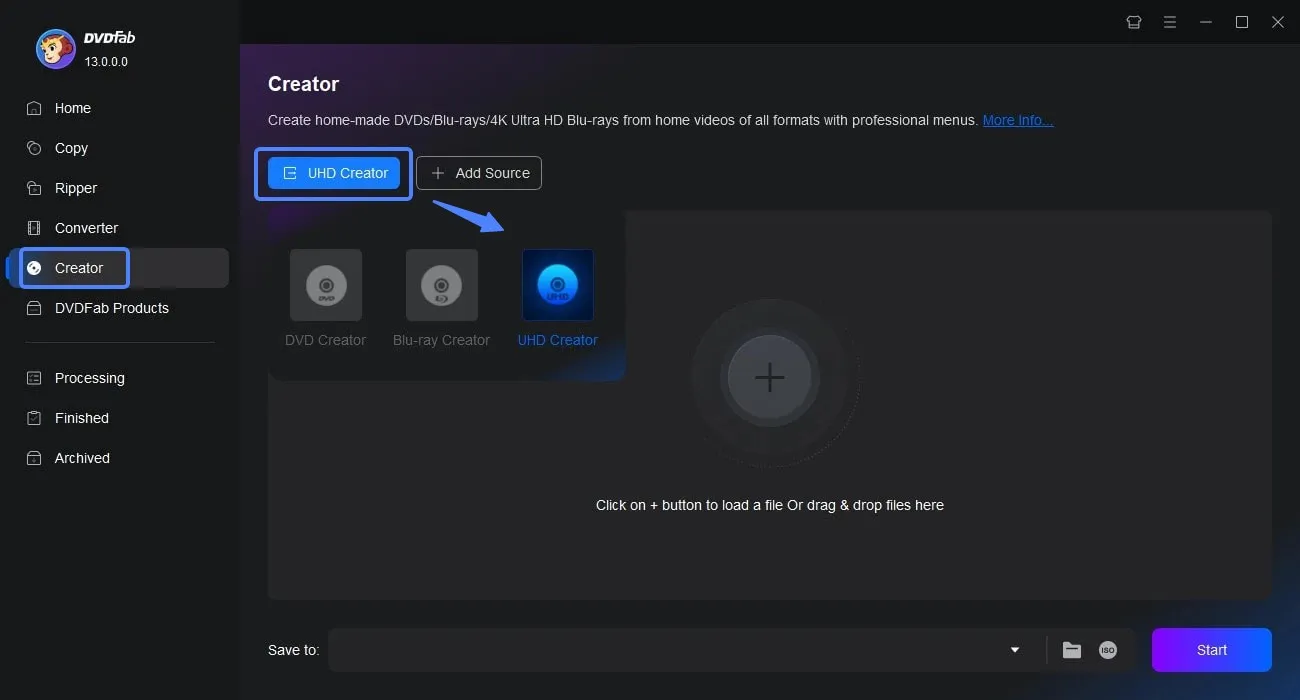
Step 1. Open DVDFab and Load Your 4K Source
Open DVDFab and select UHD Creator from the main interface.
Drag and drop your 4K video file into the window, or click the plus icon to import it manually. DVDFab supports a wide range of input formats with HEVC 10-bit encoding.
Step 2. Customize the Output Settings
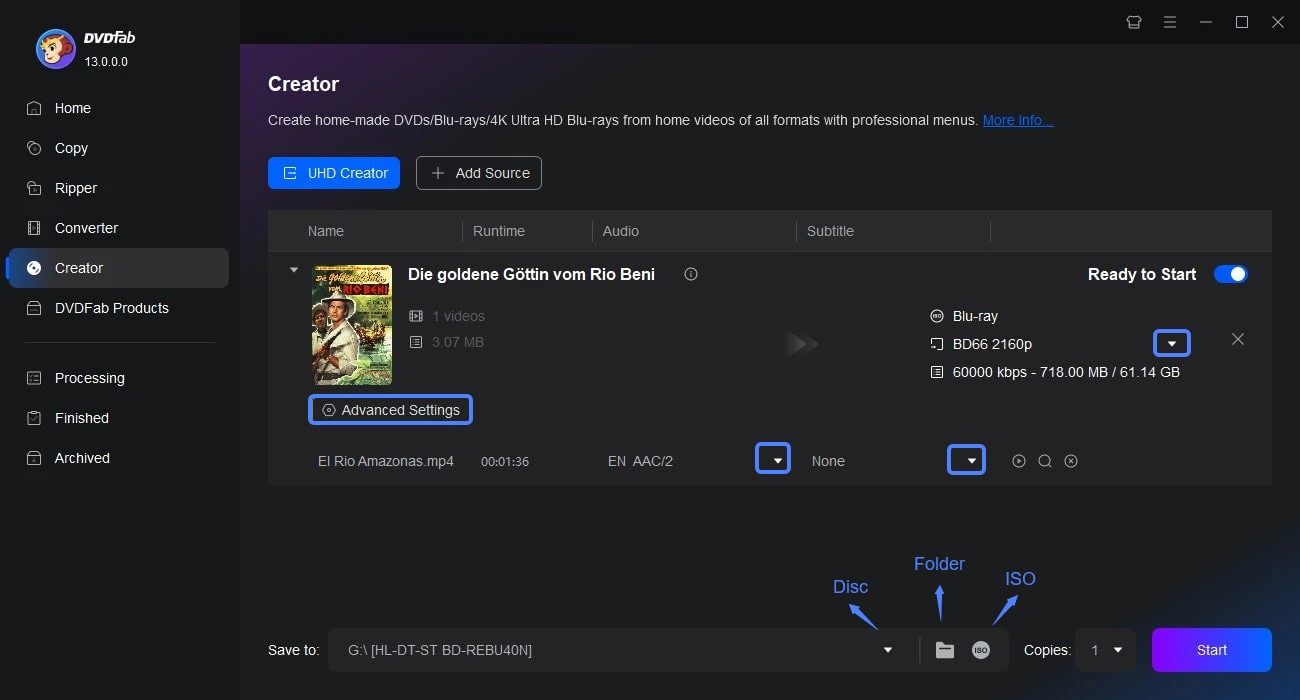
Before burning, personalize your 4K Blu-ray content. Use the Subtitles and Audio drop-downs to select your preferred tracks, or import external SRT/ASS subtitles if needed.
For further control, click Advanced Settings:
- Video quality: Choose from Fast Speed, Standard, or High Quality. HEVC H.265 is recommended for efficiency.
- Output type: The UHD Creator output profile sets a project size target; encoding depends on the source and authoring settings. Choose settings that preserve HDR10 or Dolby Vision for supported sources, confirm that the completed project fits the intended blank, and check that your target player supports that recordable medium.
Step 3. Design the UHD Menu and Edit the Video
Click the Menu Settings icon to design your 4K Blu-ray interface. Choose from built-in templates, replace the background image, and adjust fonts or playback buttons.
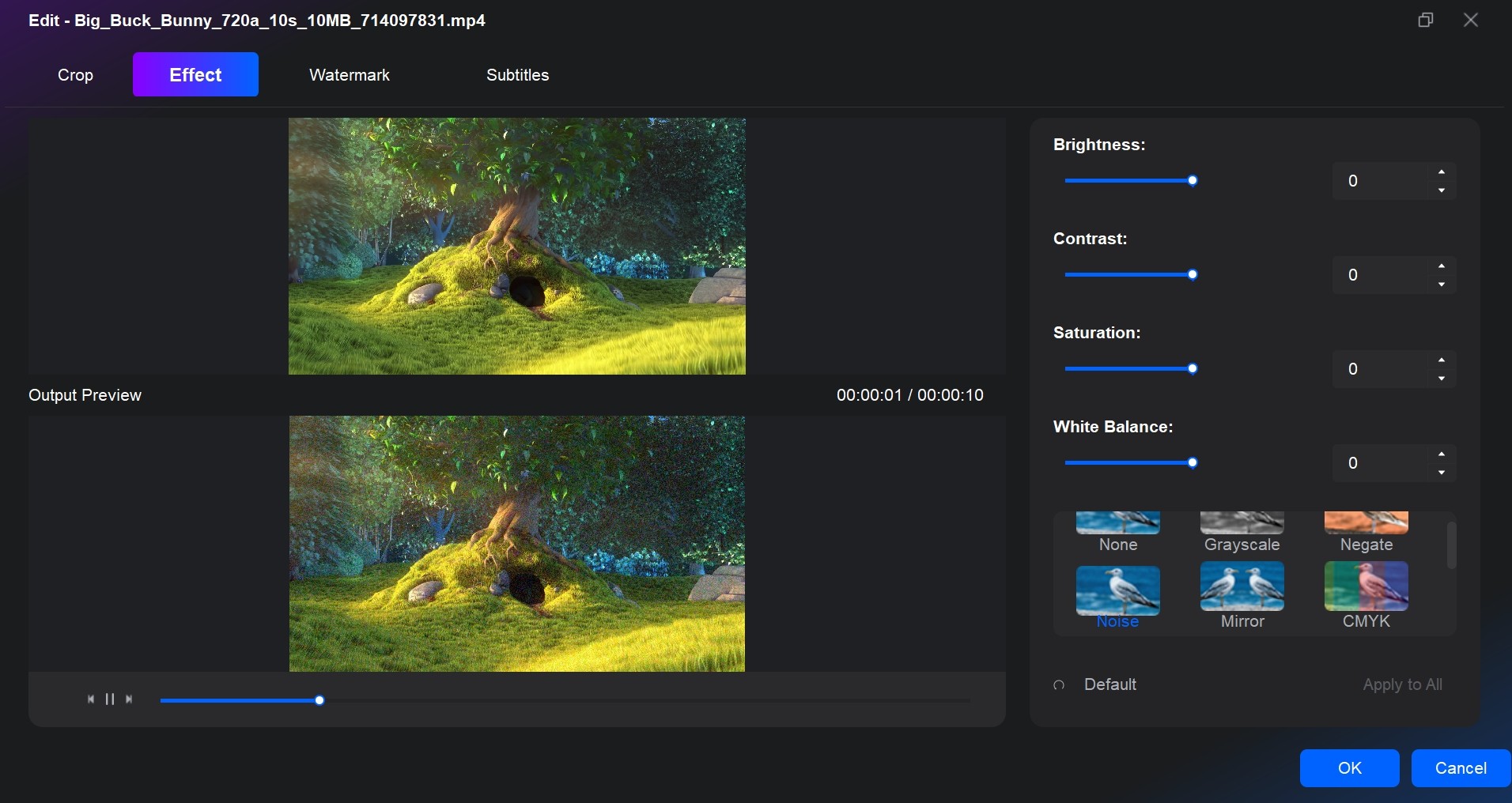
For further customization, open the Video Editor to crop, trim, or enhance visuals, adjust brightness or contrast, and import external subtitles. DVDFab UHD Creator supports static or animated UHD menus, with customizable navigation and chapter settings for the project.
Step 4. Choose Output Type and Start Burning
The last step is to decide whether to save the 4K movie locally as an ISO image or movie folder, or to Burn it straight to a blank disc.
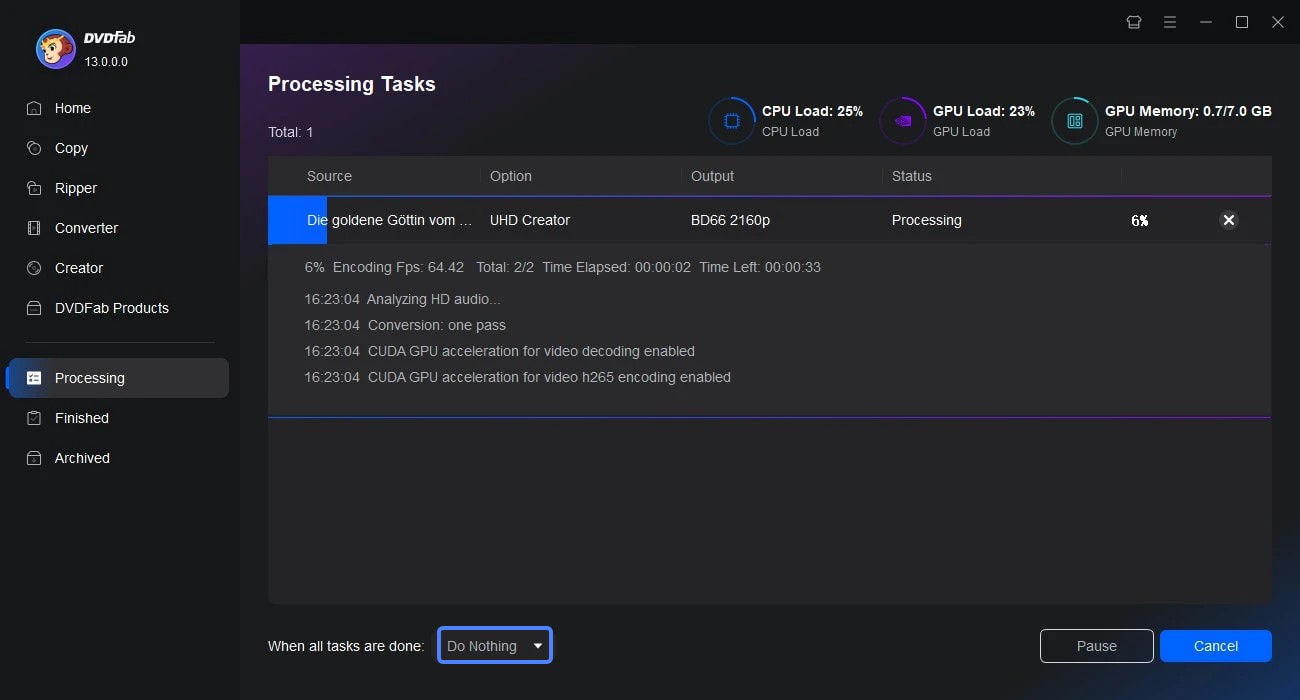
BD-50, BD-66, and BD-100 are project capacity profiles, not blank-disc specifications. Choose from the disc, ISO, or folder outputs available for the selected profile; encoding depends on the source and project settings. Once all settings are confirmed, click Start. The progress bar will display real-time speed, elapsed time, and GPU load.
Before writing: DVDFab UHD Creator authors video into UHD disc, ISO, or folder output. Physical recording requires a writer that supports the selected recordable medium, not firmware modification with UHD Drive Tool. Use this authoring process for personal offline viewing, for content you are authorized to access, where permitted by platform terms and applicable law. Use only content you own or have permission to use, do not redistribute it without authorization, and follow any requirements specific to your use case.
Best Blank Discs for Reliable 4K Blu-ray Playback
Choosing the right blank media is just as important as choosing the right burner. Choose a blank that fits the complete authored project and is supported by both the writer and the intended player; capacity alone does not establish playback compatibility.
BD-50 vs BD-66 vs BD-100: Capacity, Runtime and Media Brands
Commercial 66 GB UHD Blu-ray discs are dual-layer. A BD66 software output profile is not a recordable blank-media SKU. BD-50 recordable media and BD-100 BDXL recordable media are separate blank formats; match the software output target to an actual blank supported by your writer and player.
| Capacity label | Nominal capacity | Layers | Format distinction |
| BD-50 | 50 GB | Dual-layer | BD-R DL or BD-RE DL blanks; software output target |
| BD-66 | 66 GB | Dual-layer commercial UHD | Pressed UHD format; BD66 profile does not identify a blank |
| BD-100 | 100 GB | Triple-layer | BDXL recordable blanks; commercial UHD format; software output target |
BD-50 is an option when the complete authored project fits its capacity and both the writer and player support the chosen blank. Estimate video size in decimal GB with Mbps × seconds ÷ 8 ÷ 1000; then add the selected audio tracks, subtitles, menus, and disc-structure overhead to calculate the total project size. At a video bitrate of 50 Mbps, 90 minutes contains 33.75 decimal GB of video before audio, menus, and disc-structure overhead. Its total size must fit the selected blank; a 100 GB label does not imply a fixed 66 GB usable capacity. BD-RE 50GB rewritable discs are useful for test burns while you dial in settings.
For Verbatim, Panasonic, or another media brand, select the exact blank format and write-speed rating supported by your drive.
Will Your Burned Disc Play? Player Compatibility
This is the most common pain point for newcomers. A burned 4K Blu-ray that plays on one device may be rejected by another; compatibility depends on the exact player, recordable medium, and authored project.
- Check the exact player: For a Sony UHD player, Panasonic UB9000, Microsoft Xbox Series X, Sony PlayStation 5, or PC drive, identify the supported BD-R, BD-RE, or BDXL formats. Commercial UHD disc playback does not establish support for an authored recordable disc.
- Check the project: Use an authored UHD Blu-ray structure, not an MP4 or MKV copied onto a data disc, when you need disc-style menus and playback.
- Check the blank: Match its format and capacity to both the writer and player, and inspect the surface for dust, fingerprints, or damage.
- Check a small project: Read back the written disc on the computer and try its menus, chapters, audio, and subtitles on the intended player before writing a larger batch.
Questions about assembling a burner, blank-media, and software setup also appear in community discussions.
4K Blu-ray Burners: Writing Specs and Legacy Models
When I plan my own authorized video project, I first identify the target player's accepted recordable format, then set the menu needs and project capacity, and only then select or check a Blu-ray writer that supports the chosen blank. For an existing drive, match the exact model's supported media and connection to the project; for a purchase, use those requirements to select a writer.
Writing Support Versus UHD Reading Support
The ASUS BW-16D1HT specifies recordable-media writing support separately from protected UHD-disc reading. These drives use a 405 nm laser to write supported recordable media; firmware manages writing, but does not establish playback compatibility with a particular UHD player. Select a writing speed supported by both the exact drive and blank; the BW-16D1HT maximums are not universal Burn-speed recommendations.
For an existing ASUS BW-16D1X-U external USB 3.0 drive, use that model's supported-media specifications. The BW-16D1HT speed ratings do not apply to the BW-16D1X-U or BW-16D1H-U.
Pioneer BDR-XS07UHD, BDR-S13 and BDR-X13U: Existing-Drive Considerations
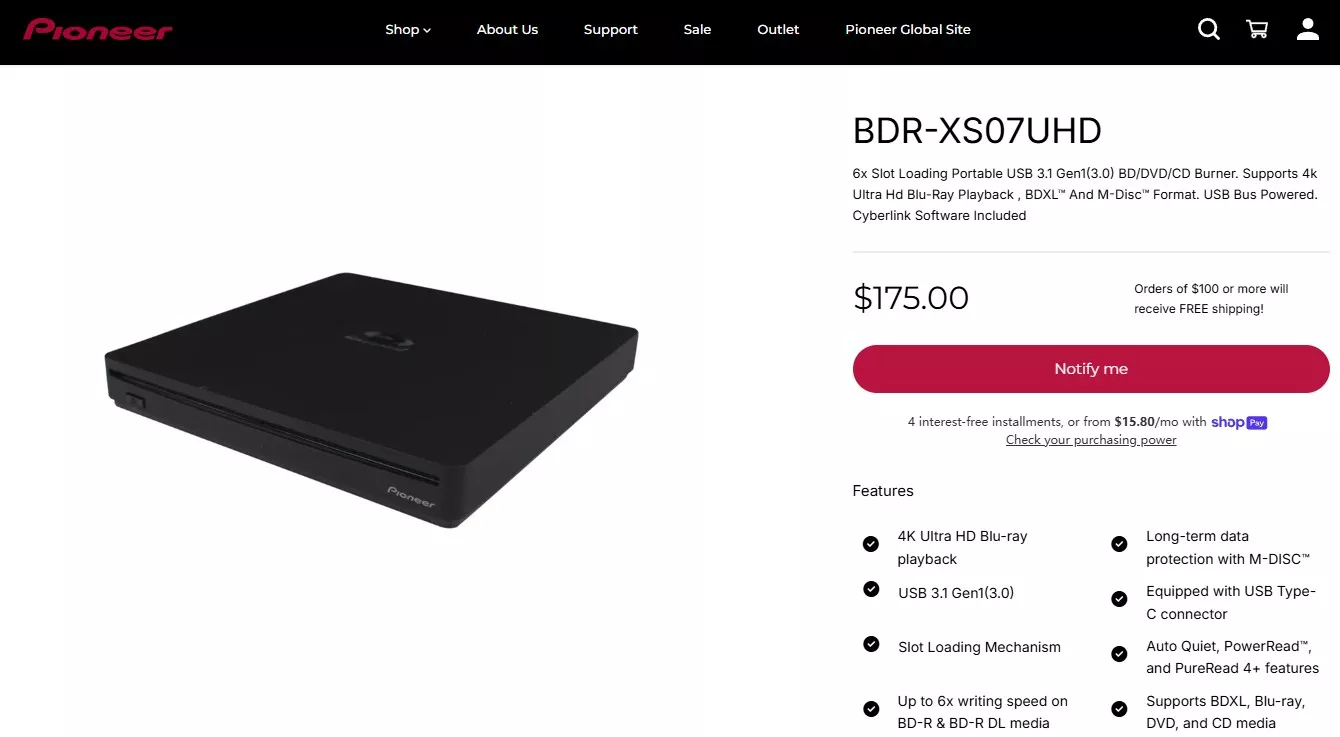
The Pioneer BDR-XS07UHD is a compact external drive with BD-XL support; match the intended blank to the exact model and suffix. The BDR-S13 uses an internal SATA connection, while the BDR-X13U is an external USB 3.0 model. For BD-100 projects, match the drive's BD-XL writing support to the particular 100 GB blank and its rated write speeds. For an external setup, also consider enclosure noise and allow time for disc verification.
LG WH16NS60 and BU40N: Discontinued Models
The LG WH16NS60 is an internal SATA drive with BD-XL writing support; select a blank and writing speed supported by that exact model. As of November 2026, LG USA lists both the WH16NS60 and BU40N as discontinued. Treat it as a legacy option rather than a current recommendation.
For an existing LG BU40N, a slim internal SATA model, match the intended blank to its supported recordable media. The ASUS BW-16D1HT provides a specific example of a writer with separate DL, TL, and QL writing specifications.
If you already own either LG drive, its discontinued status does not by itself determine whether it can write your project. Check the supported blank format and connection for that model.
ASUS BW-16D1HT: Media-Specific Writing Support
The ASUS BW-16D1HT specifies maximum BD-R write speeds of 12× for dual-layer (DL), 8× for triple-layer (TL), and 6× for quad-layer (QL) media. These are format-specific maximums, not recommended speeds for every blank. Select a writing speed supported by both the drive and the particular disc.
I would consider the BW-16D1HT for a project that needs its documented recordable-media support. For an existing external ASUS BW-16D1H-U or BW-16D1X-U, use that exact model's documentation; the BW-16D1HT specifications do not establish its capabilities.
How 4K Blu-ray Creator and Hardware Burners Work Together
Authoring software and hardware burners are two linked stages. For my own authorized video project, I choose the target player's recordable format, menu requirements, and project capacity before selecting the blank and writer, then make a small test burn before a larger run.
The Authoring Stage: Building the Logical Disc Structure
For UHD projects, Blu-ray authoring software such as DVDFab UHD Creator builds the logical disc structure. That structure includes menu navigation, subtitles, and HDR metadata. During authoring, the software encodes the video in HEVC (H.265) format, organizes files into the BDMV and CERTIFICATE folders, and outputs either a Blu-ray folder or an ISO image. These outputs are ready to Burn but are still digital data.
The Burning Stage: Writing Data onto Physical Media
Physical writing requires a Blu-ray burner that supports the selected recordable disc format; protected UHD-disc reading is a separate capability. This hardware writes the authored files to BD-R, BD-RE, or BD-XL media using a 405 nm laser. The burner's firmware manages writing to the supported media layers and the available write speeds.
FAQs About Burning 4K Blu-ray
Why won't my burned 4K Blu-ray play on my UHD player?
If the disc reads on a computer but not on your UHD player, check the player's supported recordable formats and firmware against the blank and authored UHD structure. Computer readback only confirms that files can be read; use the Player Compatibility checklist above for the detailed checks.
Can a 4K DVD burner make UHD Blu-ray discs?
No. A DVD-only burner cannot write Blu-ray media. Physical recording requires a Blu-ray writer that supports the selected recordable disc format. A BD-50, BD-66, or BD-100 software profile sets the UHD project's capacity target; it does not identify a retail blank. In particular, a BD-66 profile is not a recommendation to buy a 66 GB recordable disc.
Why does my 4K Blu-ray Burn fail or stop midway?
Identify whether the failure occurs while creating the authored project or while writing the physical disc. Those stages require different checks. Authoring or ISO creation: Check available working space and project settings. Try saving the project as an ISO to separate authoring from physical writing. Physical writing: Confirm that the completed project fits the blank and that the writer supports its recordable format. Select a write speed supported by both the drive and that blank. Drive connection: Check the cable, power supply, and connection before retrying. If either stage keeps failing, contact DVDFab support with the failure stage, project settings, writer model, and blank type.
Why does my burned 4K video have green bars or distorted colors?
Inspect the source video and the project's HDR and color settings first. Export a short sample with hardware acceleration disabled and compare it with the accelerated output. If the artifacts disappear, the accelerated encoding settings may be involved; if they remain, inspect the source and authored output before burning another disc, and contact DVDFab support if the problem persists.
Conclusion
Burning 4K movies onto Blu-ray discs becomes more manageable when the player, authoring plan, blank media, and hardware burner are chosen in that order.
For my own authorized video project, I start with the device that must play the disc, decide whether the project needs menus and basic editing, calculate the complete project size, and make a small test burn before buying blanks for a larger run. Write an already-authored UHD ISO or folder with a compatible writer, or use DVDFab UHD Creator when video files need UHD authoring, menus, and basic editing. Start with the small-project check in the Player Compatibility section, using the official download buttons above to prepare your project.