Vudu Error Code 28: 8 Fixes for Operation Timeout

Summary: Vudu Error Code 28 in Fandango at Home indicates a network or operation timeout. First test another device and network to separate a service outage from an app, device, or router problem. Then restart the app and device, power-cycle the router, install updates, clear app data, and reinstall if needed. Check current device support before changing DNS or firewall settings, and treat advanced network changes as reversible last steps.
Table of Contents
Vudu Error Code 28 means Vudu (now Fandango at Home) failed to connect before an operation timed out. The quickest route is to determine whether the service, your home network, the app, or one device is responsible before changing DNS or firewall settings.
If you searched for "error code 28 operation timeout" or "Vudu failed to connect," start by testing the same account on another supported device. That single comparison tells you more than immediately editing router settings, and it sets up the eight-step path below.
What Vudu Error Code 28 Means
Vudu Error Code 28 is a connection or operation timeout. The app sent a request but did not receive a usable response in time, so the fault may sit with the service, the network path, the app installation, or the device. The message can appear during sign-in, browsing, playback, or a Vudu Disc to Digital request.
Vudu Is Now Fandango at Home
Vudu was renamed Fandango at Home in 2024. The legacy wording remains common in searches and device messages, so "Fandango Error Code 28" and Vudu Error Code 28 generally refer to the same timeout in the current service.
Code 28 vs. Prime Video Error 0.28
Vudu or Fandango Code 28 is not Prime Video Error 0.28. The similar numbers belong to different services, and the checks in this article address the Vudu network timeout rather than an Amazon playback error.
Why Vudu Error Code 28 Happens
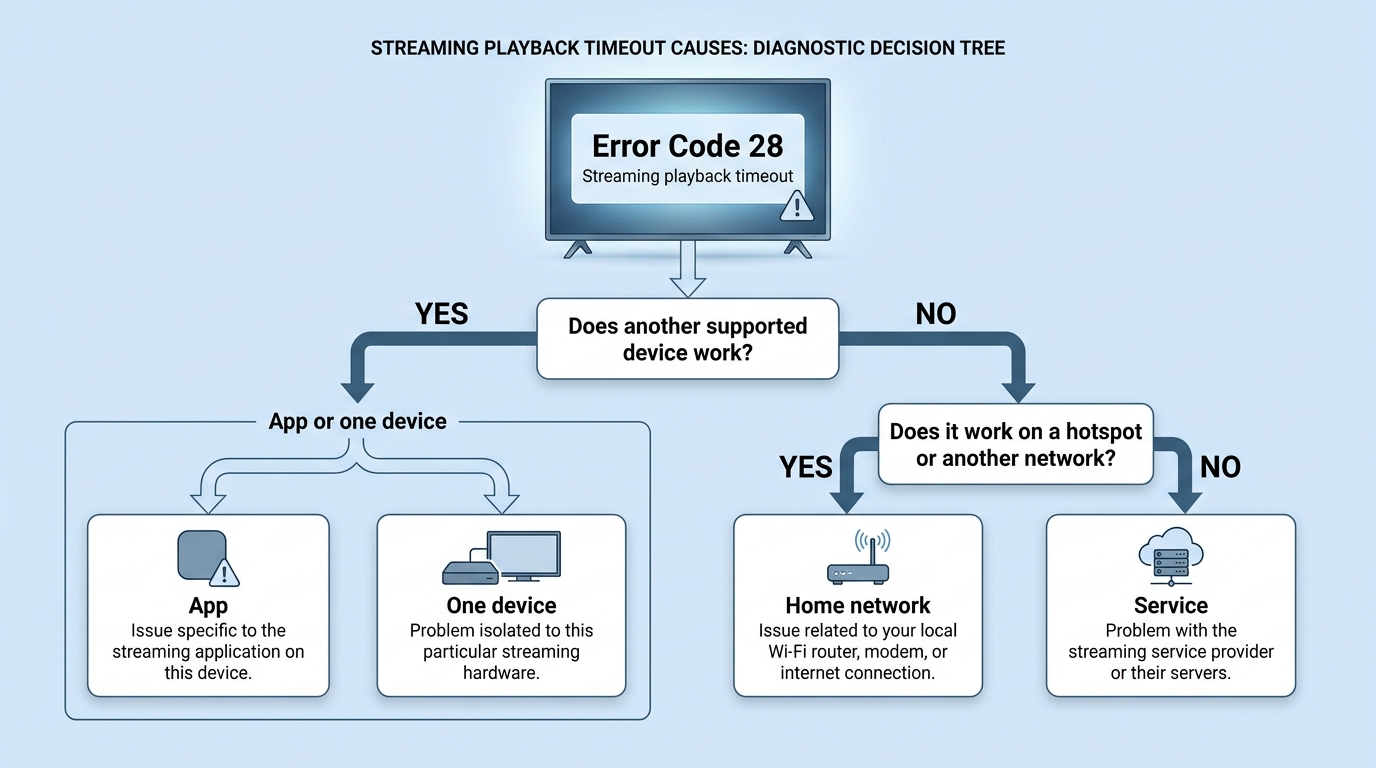
Most cases fit one of four branches: a service-wide interruption, a whole-home network problem, an app problem, or a failure isolated to one device. Identifying the branch first prevents unnecessary resets and configuration changes.
Service, Network, or Device?
My troubleshooting rule is to compare devices before changing settings. If the same title works on a phone or another streamer, the account and service are probably reachable; focus on the failing TV, player, or app instead of assuming registry corruption or malware.
| Scenario | Symptom Pattern | Most Likely Branch | First Action | When to Escalate |
| Fandango at Home unavailable on every device | Multiple networks or devices fail at the same time | Service availability or account-side issue | Check service notices and retry on another connection | Contact Fandango at Home if the failure continues across networks |
| Only one TV or player fails | Other devices stream normally | App, device software, or ended device support | Restart the app and check current device support | Use a supported streamer or casting if the model is no longer supported |
| Every device fails on the home network | The account works on cellular data or another network | Router, ISP, VPN, filtering, or DNS path | Power-cycle the router and disable VPN or proxy routing | Ask the network provider to check the connection path |
| App opens but repeatedly times out | Menus load slowly or playback requests fail | App data, outdated software, or unstable connection | Force-stop, update, and clear app data where supported | Reinstall after the lower-risk recovery steps fail |
| Older device may no longer be supported | An app icon remains, but sign-in or playback no longer completes | Compatibility rather than a router fault | Compare the exact model with the supported-device list | Move playback to a supported external streamer or cast target |
The practical takeaway is simple: a one-device failure points toward compatibility or app recovery, while an all-device failure points toward the service or network. This distinction should determine your next action.
8 Fixes for Vudu Error Code 28
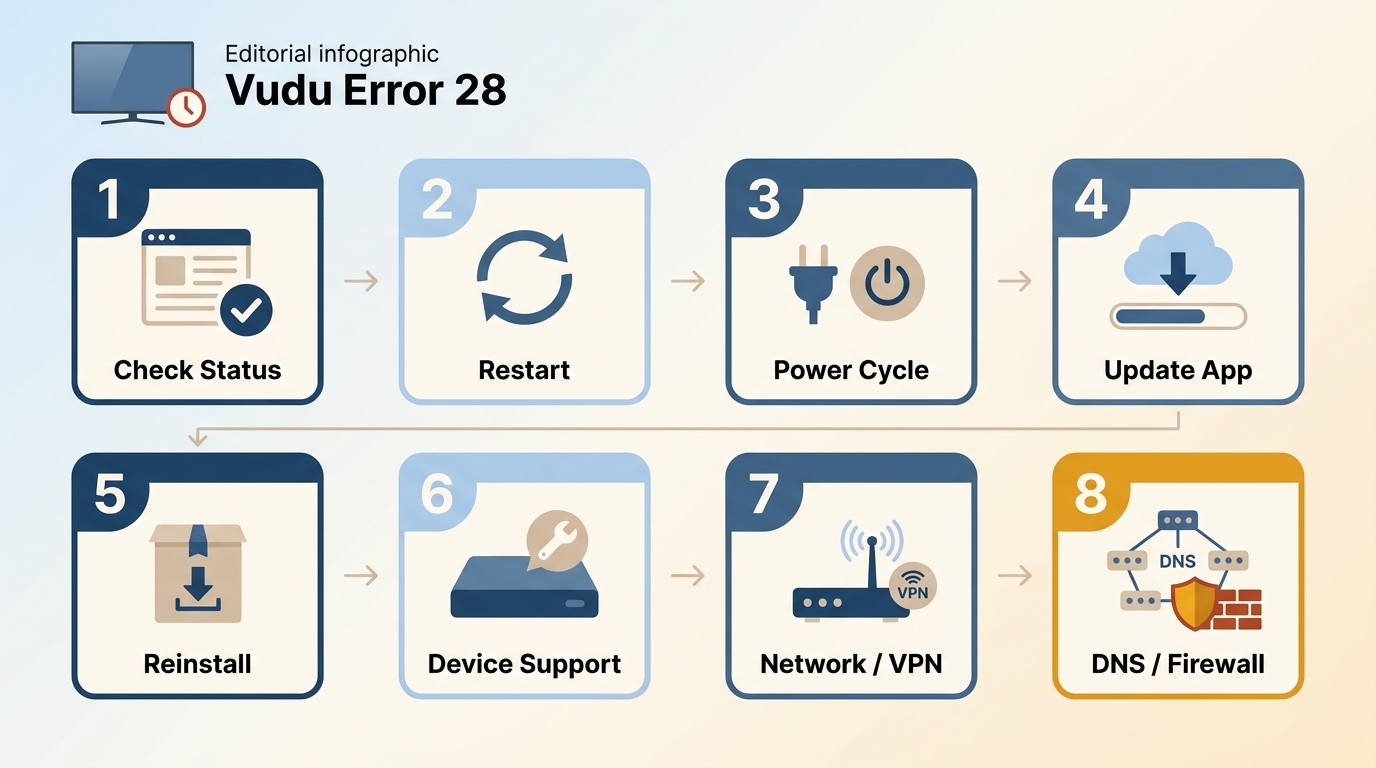
Use these fixes in order and retest after each one. This Fandango app troubleshooting sequence starts with reversible checks and leaves DNS, firewall, and legacy port advice until the end.
Check Service Status and Another Device
First, try Fandango at Home on another supported device and, if available, another network. If several devices fail together, Fandango at Home not working may reflect a broader service or account issue rather than a fault in one TV.
- Open the same account on a second supported phone, browser, TV, or streaming player.
- Try a different title to separate a title-specific playback issue from an app-wide timeout.
- If possible, test briefly on cellular data or another trusted network.
If the second device works, continue with the failing device. If every device fails across more than one network, skip to the escalation section and contact Fandango at Home.
Restart the App and Streaming Device
Close the app completely, not just the playback screen, then restart the streaming device. A clean relaunch clears a stuck session without deleting account data or changing network settings.
- Exit Fandango at Home and remove it from the recent-app list where the device offers one.
- Restart the TV, Roku, Fire TV, Android TV device, console, or Windows computer.
- Open the app, sign in if required, and retest the same title.
If playback resumes, no deeper change is needed. If Vudu failed to connect again, the next test is a full power cycle of the device and router.
Power-Cycle the Router and Retest
A power cycle is the lowest-risk response to a Vudu network timeout. It rebuilds the local connection before you edit DNS, firewall, or router rules.
- Turn off the streaming device and unplug it from power.
- Unplug the router and modem, wait about one minute, then reconnect the modem and router.
- Wait until the network lights stabilize, reconnect the streaming device, and retest Fandango at Home.
I would take this step before any DNS edit because the result is easy to interpret and easy to reverse. If every home device still fails but another network works, continue to the network-isolation step.
Update, Force-Stop, or Clear App Data
Recover the app in stages: update it, force-stop it, then clear its cache or app data where the device supports those controls. Clearing app data may require signing in again, but it is not the same as factory-resetting an entire TV.
- Roku: Check for a system update, restart Roku, and relaunch the channel.
- Fire TV or Android TV: Open app settings, force-stop Fandango at Home, clear cache, then clear app data only if needed.
- Smart TVs: Install available TV firmware and app updates; use the TV's app reset control if the manufacturer provides one.
- Windows: Update the app or browser, close background sessions, and relaunch.
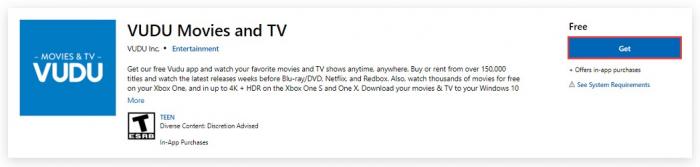
If a clean app-data reset works, stop here. If the app remains damaged or will not update correctly, reinstall it next.
Reinstall Fandango at Home
Reinstall only after restart, updates, and app-data recovery fail. Reinstallation replaces the local app package, but it will not correct an unsupported device or a network path that blocks the service.
- Remove the Fandango at Home app or channel using the device's normal app-management screen.
- Restart the device before downloading the app again.
- Install it from the official app store, sign in, and test the same title.
If Code 28 returns immediately after a clean installation, check compatibility before repeating network changes.
Check Device Support and Compatibility
An unsupported Vudu device can keep an old app icon even when the service no longer functions on that model. Some older devices stopped receiving Vudu or Fandango at Home support on December 10, 2024.
Compare the exact model and operating-system version with the current supported-device list. If Vudu is not working on a TV while the same account works elsewhere, this check is more useful than repeatedly reinstalling the app.
A supported external streamer or casting route can restore access on an older display, although it is a fallback rather than a guarantee for every setup. If the device is supported and updated, continue by isolating the network.
Test Another Network and Disable VPNs
Use another network to determine whether the timeout follows the device or stays with the home connection. VPNs, proxies, filtering services, guest-network isolation, or a mesh node can change the path used by the app.
- Turn off any VPN or proxy on the device or router.
- Connect the device to another trusted network or a temporary mobile hotspot.
- On a mesh network, test near the main router or on the primary access point.
- Retest the same title and note whether the error follows the device.
If another network works, focus on the router or ISP rather than reinstalling again. If the error follows one supported device across networks, contact the device maker or Fandango at Home with the model and software version.
Change DNS or Firewall Settings Last
DNS and firewall changes are late-stage diagnostics, not standard first fixes. Record the existing values, change one item at a time, retest, and restore the original setting if the result does not improve.
For a reversible DNS test on Windows or a router, Google Public DNS uses 8.8.8.8 as the preferred IPv4 address and 8.8.4.4 as the alternate. Save the current addresses before replacing them.
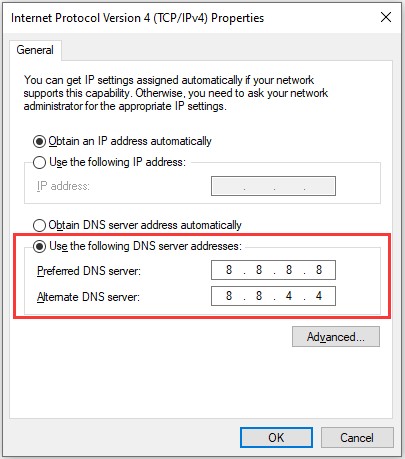
On Windows, allow Fandango at Home or the browser through the firewall rather than switching firewall protection off. If you temporarily disable a security control for a short test, turn it back on immediately afterward.
Older forum advice sometimes mentions opening router ports. Treat that as historical, device-specific guidance, not a guaranteed fix. Do not add port-forwarding rules unless current support instructions for your exact setup require them, and remove the rule if it makes no difference.
Device Notes for TVs, Roku, and Consoles
The eight fixes are shared across platforms; the menu names differ. Use this compact reference after you identify the failing branch.
| Device | Start Here | Device-Specific Note |
| Roku | Restart the channel and Roku, check updates, then reinstall | Restart the player after removing the channel and before adding it again |
| Samsung, LG, or Vizio TV | Power-cycle the TV, update firmware and the app, then check model support | Do not use a full factory reset as the default app-recovery step |
| Fire TV or Android TV | Force-stop, clear cache, update, and then reinstall | Clear app data only when you are ready to sign in again |
| PlayStation or Xbox | Close the app fully, restart the console, and relaunch | If playback fails between titles or episodes, make sure the app was closed rather than suspended |
| Windows | Update the app or browser, restart, and test another network | Leave DNS and firewall changes until app and network isolation are complete |
When Vudu is not working on a TV but works on another device, the device row should guide the next check. When every row fails on the same home network, return to the router and ISP branch.
A Local Playback Alternative When Vudu Error Code 28 Persists
If your goal changes from fixing a streaming app to creating a local video file from a personally owned DVD, a dedicated disc-ripping tool like DVDFab may help.
Where DVDFab DVD Ripper Fits
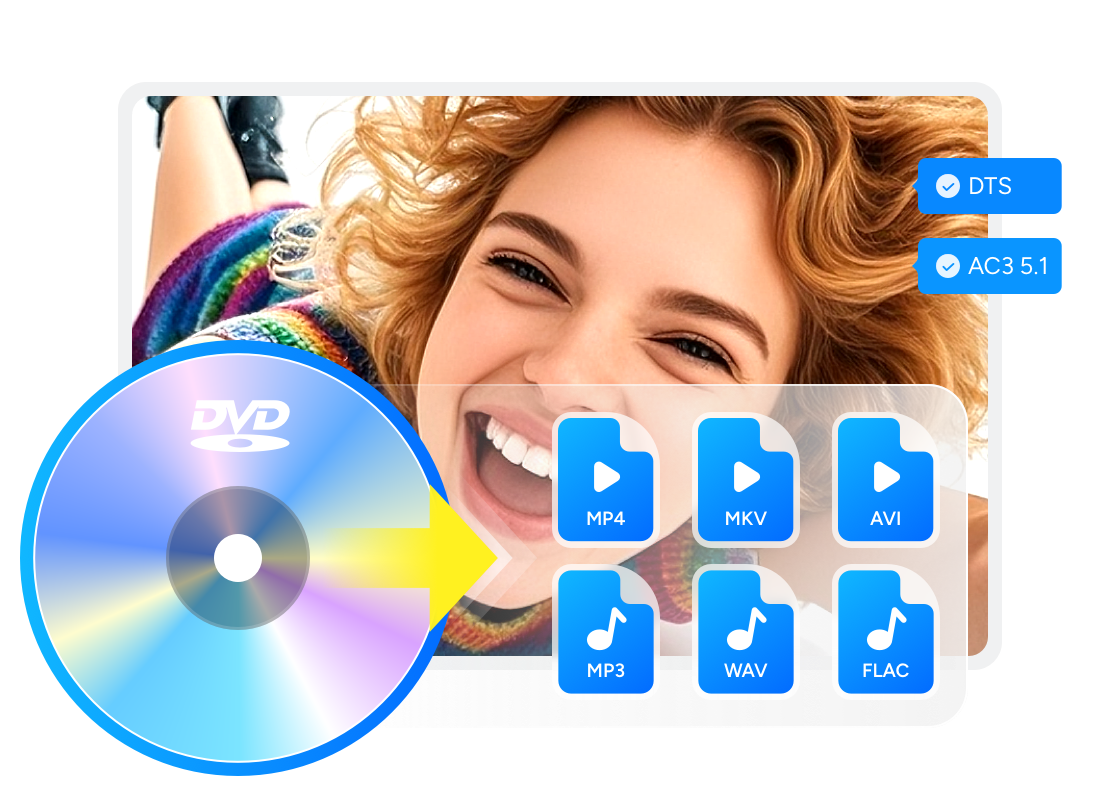
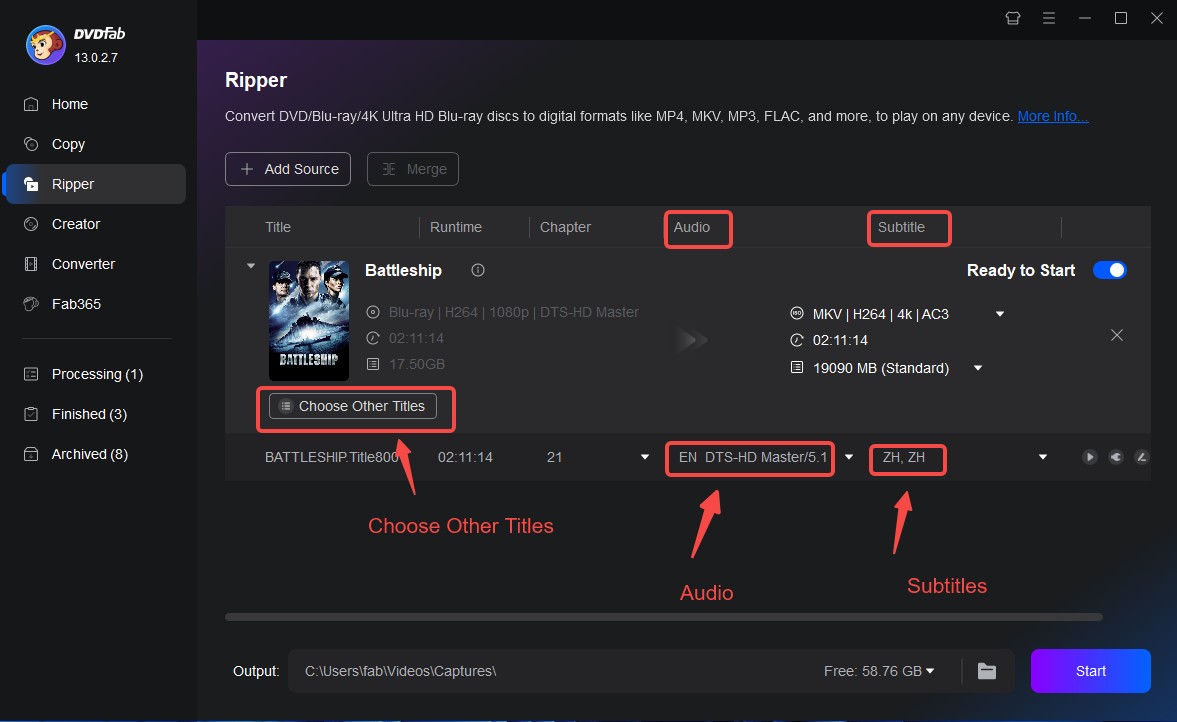
DVDFab DVD Ripper is desktop software for Windows and macOS that converts supported protected DVDs into local files such as MP4 or MKV. It is useful when you own the disc and want an offline copy with selected audio tracks, subtitles, or a device-specific output profile. The built-in video editor also lets you trim, crop, and adjust the video before conversion.
Supported OS:
Free Download Windows 11/10/8.1/8/7
Free Download macOS 10.13 - 15.x
- Converts copy-protected DVDs to common video and audio formats
- Includes device-oriented output profiles
- Lets you select audio tracks, subtitles, and output settings
- Supports queued tasks and GPU acceleration on compatible hardware
- Works with an optional AI upscaling module for supported workflows
Create a Local Copy in Three Steps
The workflow stays at three decisions so the article remains a troubleshooting guide: load the owned disc, choose the output and tracks, then save to local storage. Performance and output size depend on the selected profile and system.
- Load the DVD. Install the Windows or Mac version, open the Ripper module, and insert a personally owned DVD or load its DVD folder or ISO source.
- Choose the output and tracks. Select MP4 for broad device compatibility or MKV when retaining multiple tracks is more important, then choose the needed audio and subtitles.
- Choose local storage and start. Confirm the destination folder, review the profile, and begin the task. Test the finished file on the device you plan to use before archiving the disc.
FAQs
Is Vudu down when Error Code 28 appears?
Not necessarily. A service interruption is one possibility, but compare another supported device and another network first. If all combinations fail together, a Fandango at Home service or account issue becomes more likely.
Why does Vudu work on other devices but not my TV?
The TV may have stale app data, outdated software, a different active network path, or ended support for that model. Check the exact model's support status before changing router settings.
Can an unsupported device show Vudu Error Code 28?
Yes. An app icon can remain after support ends, even though sign-in or playback no longer completes. A supported external streamer or casting device is the practical fallback for that display.
Should I change DNS or open router ports for Error 28?
Use DNS only after app, device, compatibility, and network-isolation checks. Record the old values and roll back if nothing changes. Port changes are not a routine or guaranteed fix and should follow current instructions for the exact setup.
Is Vudu Error Code 28 the same as Prime Video Error 0.28?
No. Prime Video Error 0.28 belongs to Amazon's service. This guide covers the connection timeout known as Vudu or Fandango Error Code 28.
Conclusion
The fastest way to resolve Vudu Error Code 28 is to identify where the timeout occurs before changing advanced settings. If Fandango at Home works on another device, focus on the affected app, device software, and current model support. If every device fails only on the home network, restart the router, disable VPN or proxy routing, and test another connection. A failure that continues across devices and networks is more likely to require help from Fandango at Home.
I would work through the fixes in their current order: begin with service and device checks, continue with restarts, updates, app-data recovery, and reinstallation, and leave DNS or firewall changes until last. Record and reverse any advanced setting that does not help. If an older device is no longer supported, moving playback to a current streaming device is more practical than repeatedly resetting the TV. Creating a local file from a personally owned DVD can provide a separate offline option, but it does not repair the Vudu service or restore an unsupported app.

 Free DVD Decoder for Windows XP and Windows 11: 3 Ways to Play DVDsBy Diana Smith - Sep 23, 2026
 How to Compress ISO Files: 4 Methods for Storage, Playback, and ArchivesBy Diana Smith - Sep 16, 2026
 How to Rip DVD to Facebook and Upload the Video in 2026By Diana Smith - Sep 15, 2026
![How to Rip DVDs for Plex: Guide to Formats, Tools, and Library Setup [2026]](https://images.dvdfab.cn/media/Screenshot_2026-09-08_at_18.53.34_j36v3l.png/public) How to Rip DVDs for Plex: Guide to Formats, Tools, and Library Setup [2026]By Diana Smith - Sep 8, 2026
How to Rip DVDs for Plex: Guide to Formats, Tools, and Library Setup [2026]By Diana Smith - Sep 8, 2026