2026 Tested Ways to Rip Blu-ray to ISO on Mac & Windows: 1:1 Backup & Decryption

Summary: To rip a Blu-ray to ISO with the original menus and structure intact, you need software such as DVDFab Blu-ray Copy that can handle disc protections like AACS, BD+, and BD-J while creating a full disc image. A free MakeMKV + ImgBurn workflow can also work on Windows, but it requires two separate steps and is better suited to unprotected or homemade discs. It also cannot compress BD50 to BD25, so DVDFab is the more complete choice when you need a direct 1:1 ISO backup or disc compression.
Table of Contents
I often see the same problem in archiving forums: users try to clone a Blu-ray with standard tools such as macOS Disk Utility, but the final ISO will not play correctly. An ISO image is different from an MKV or MP4 file. It is meant to preserve the full disc structure, including BD-J menus, playlists, chapters, and original folders. If the disc protection is not handled during the backup process, the copied ISO may keep the structure but still fail to open or play as expected.
To create a usable 1:1 Blu-ray ISO backup for personal use, the software needs to read the disc correctly and handle the protection during copying. In this guide, I will show the workflow with DVDFab Blu-ray Copy to rip Blu-ray to ISO, then compare it with the manual MakeMKV alternative. I will also explain how to mount and play the finished ISO with the original menu structure intact.
How to Rip Blu-ray to ISO with DVDFab Blu-ray Copy
DVDFab Blu-ray Copy provides a streamlined way to rip Blu-ray to ISO on Windows and macOS. Beyond creating ISO images or folder for compatible playback and digital backups, it can also physically clone discs—either as a 1:1 duplicate or as a compressed copy written to blank media.
The most important reason to use DVDFab Blu-ray Copy is that it handles the disc's copy protection layers (AACS, BD+, BD-J, region codes) in the same pass as it builds the ISO, so you get a mountable image with menus intact — something free image-building tools like ImgBurn cannot do on their own.
- Bypasses even the newest Blu-ray copy protections with DVDFab CDS technology
- 1:1 clone Blu-rays or compress Blu-ray disc, ISO, or folder to BD-50/BD-25
- Offers 5 copy modes: Full Disc, Main Movie, Customize, Clone/Burn, Merge
- Supports high-speed Blu-ray to ISO copying with GPU acceleration
- Works with Blu-ray Cinavia Removal to eliminate Cinavia protection
Step 1: Launch DVDFab Blu-ray Copy and Choose a Copy Mode
To rip a Blu-ray to an ISO, download and run DVDFab Blu-ray Copy.
Free Download Windows 11/10/8.1/8/7
Free Download macOS 10.13 - 15.x
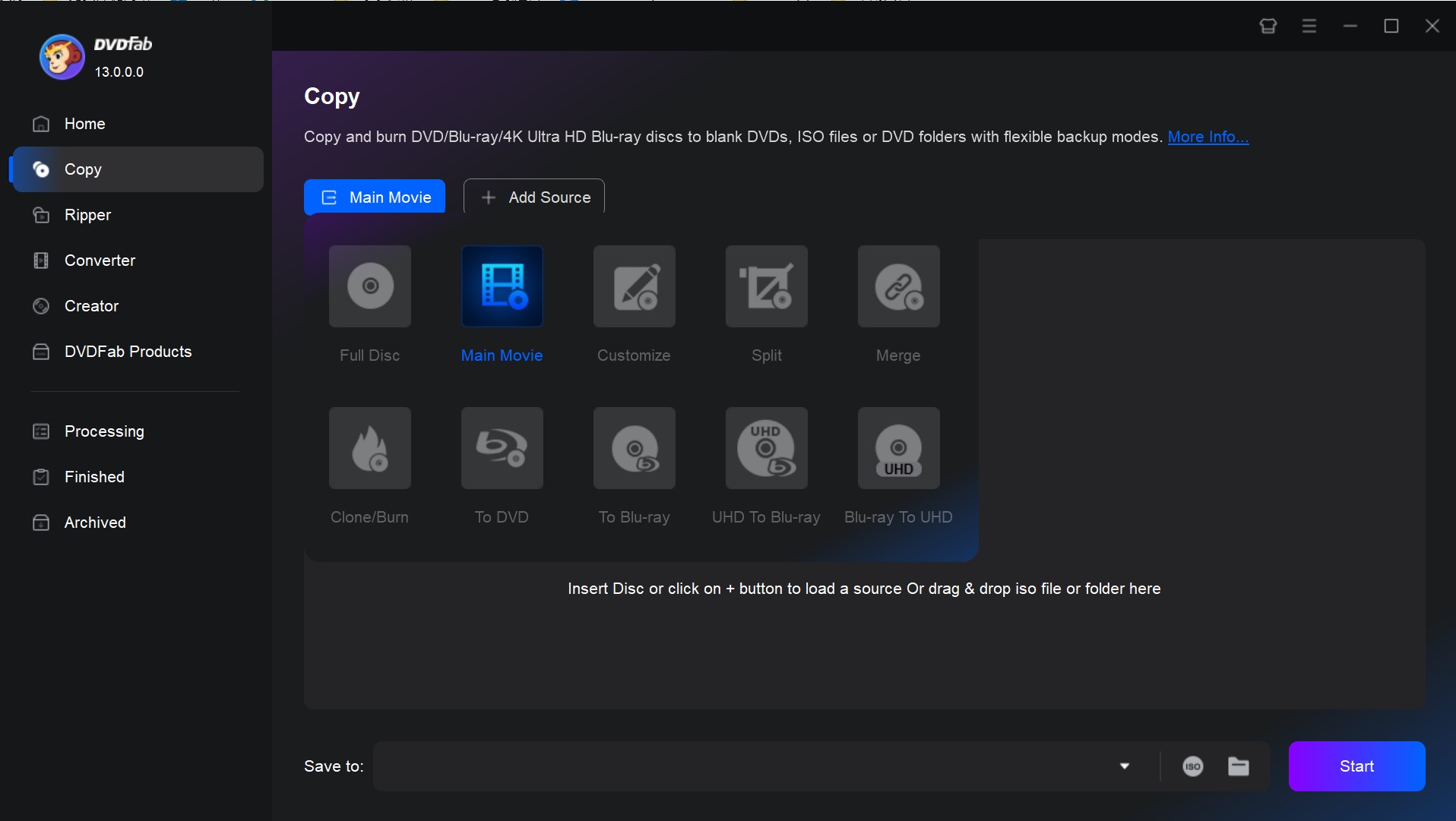
Choose the Copy module, then use the mode switcher to pick one of the following: Full Disc, Main Movie, Merge, Customize and Clone/Burn. In this section, I'll use Main Movie mode to display the whole Blu-ray to ISO conversion process.
Step 2: Load Your Blu-ray Disc
Insert your Blu-ray disc into the optical drive, and DVDFab will detect and load it automatically. If your source is a Blu-ray ISO file or a BDMV folder stored on your hard drive, click Add Source or drag and drop it directly into the main interface. After the upload, the program takes a few seconds to parse the file, and then your resource will appear on the panel.
Step 3: Customize the Blu-ray ISO File
To choose the titles and chapters you want to keep, click Choose Other Titles and Chapter drop-down box. In Main Movie mode, the longest title is automatically selected.
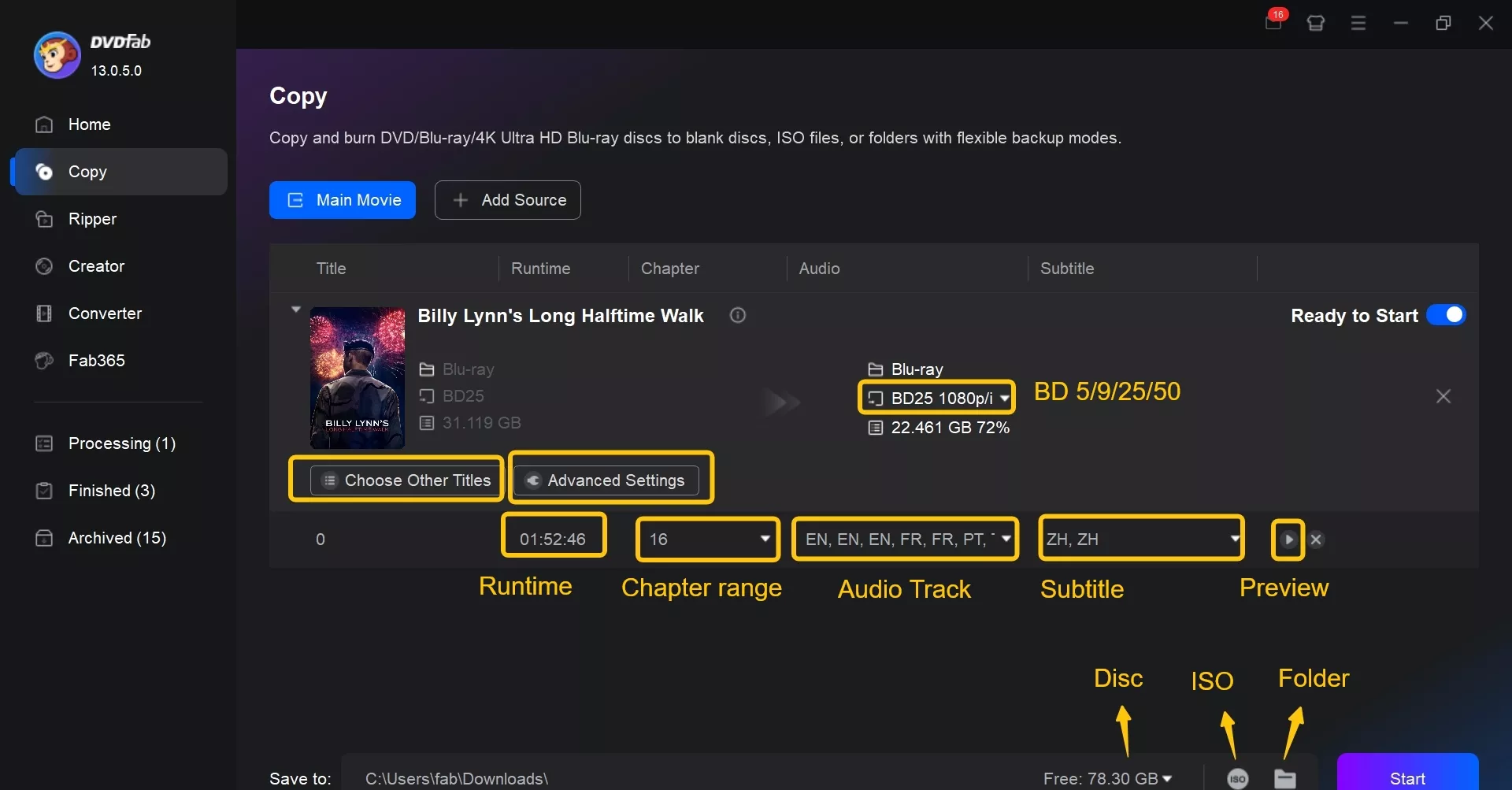
To select the audio tracks and subtitles, open Audio Track and Subtitle drop-down boxes. If you want to import external subtitle files, open the Subtitle menu, click Add External Subtitles, and upload your .SRT files as the instructions.
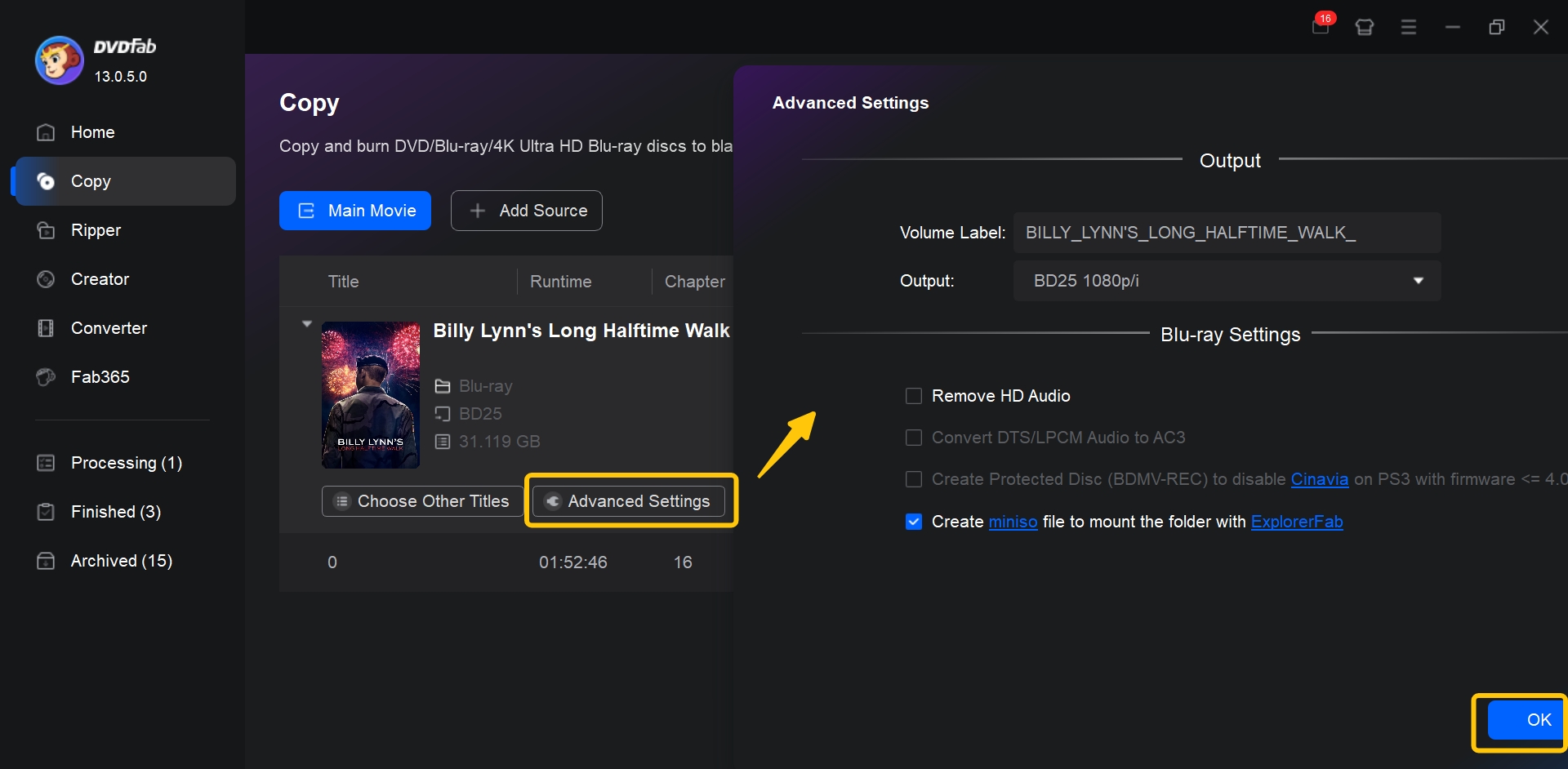
To fine-tune the Blu-ray to ISO conversion, open Advanced Settings, then customize the volume label, choose the output disc type and resolution (to control the final file size), and decide whether to remove HD audio, etc. Then, click OK to confirm.
Step 4: Select ISO as Output and Start Ripping
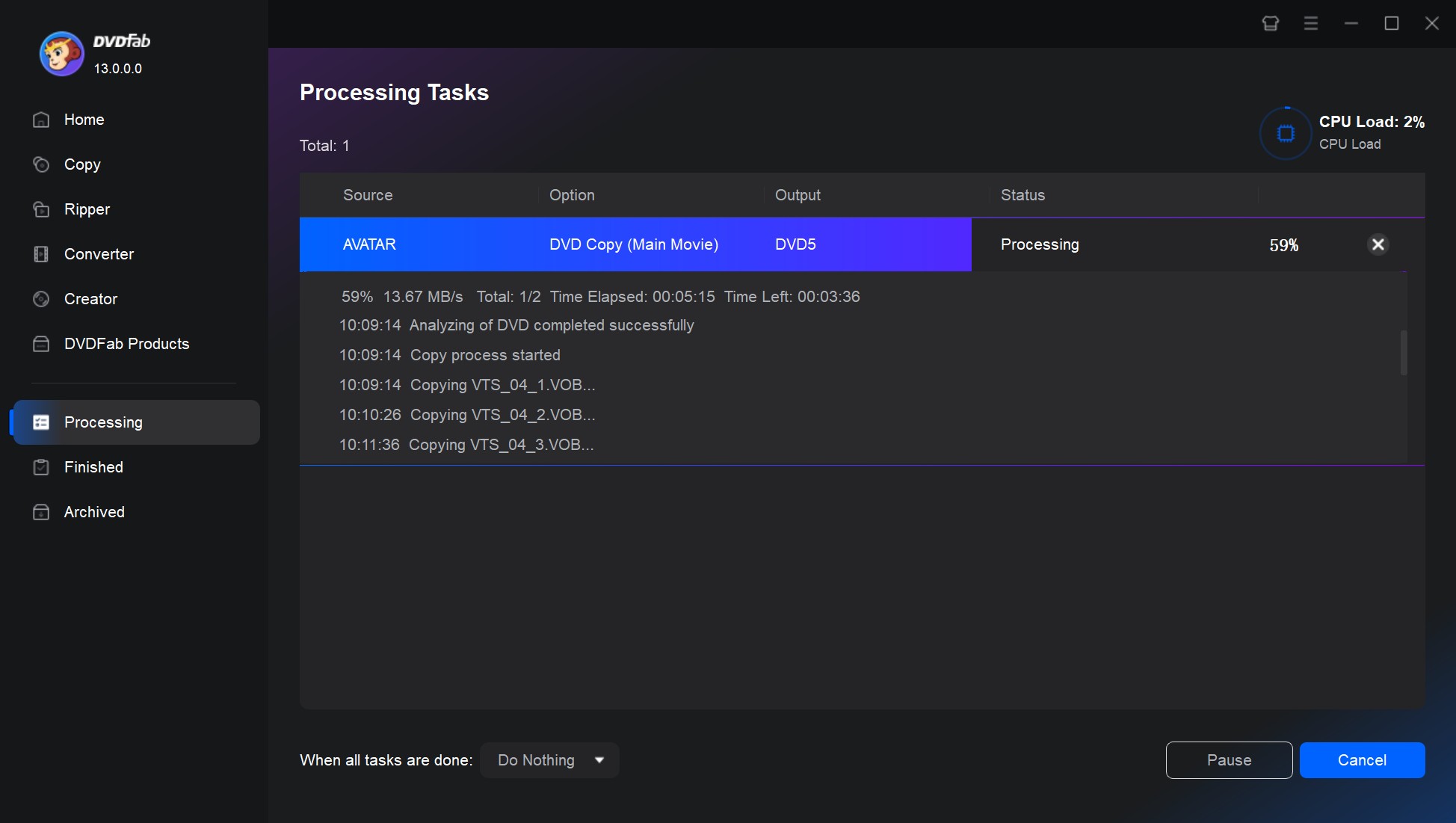
Click the ISO icon to set the output directory and file name. When everything is ready, click Start to copy Blu-ray disc to image files.
Free Way to Create Blu-ray ISO with MakeMKV and ImgBurn
For users on a strict budget or those who only need to archive discs occasionally, a professional license may not be necessary. In technical communities like Reddit's r/DataHoarder, the standard advice for a zero-cost workaround is combining two specific utilities.
You need to combine MakeMKV and ImgBurn. This method relies on a split workflow. MakeMKV is used solely to bypass the copy protection, while ImgBurn is required to package the resulting files into an image. Since MakeMKV cannot export a Blu-ray to ISO file natively, ImgBurn acts as the necessary bridge to create a standard, mountable disc image from the raw folders.
One honest caveat on ImgBurn: its last release (2.5.8.0) dates to 2013 and it is Windows-only, so it cannot handle newer disc encryption on its own and is best treated as a legacy image-builder for the already-decrypted folder MakeMKV hands it. That's fine for this workflow, but it's not a modern peer of a maintained tool.
At-a-glance: paid vs free method
| Capability | DVDFab Blu-ray Copy | MakeMKV + ImgBurn (free) |
|---|---|---|
| Decryption (AACS / BD+ / BD-J) | Yes, in the same pass | Partial — MakeMKV decrypts, ImgBurn only builds the image |
| Compress BD50 to BD25 | Yes | No |
| Native macOS | Yes (10.13–15.x) | No — ImgBurn is Windows-only |
| Single-pass decrypt + ISO | Yes | No — two tools, two steps |
| Speed on our test disc* | ~15 minutes | ~40 minutes |
*Test rig: Windows 11, Buffalo BRUHD-PU3 external drive, GPU acceleration on, ~3-hour Blu-ray title.
Step 1: Decrypt Disc to BDMV Folder with MakeMKV
The objective here is to rip the raw file structure, not to convert video streams.
- Insert the disc and launch MakeMKV. Wait for the drive to authenticate.
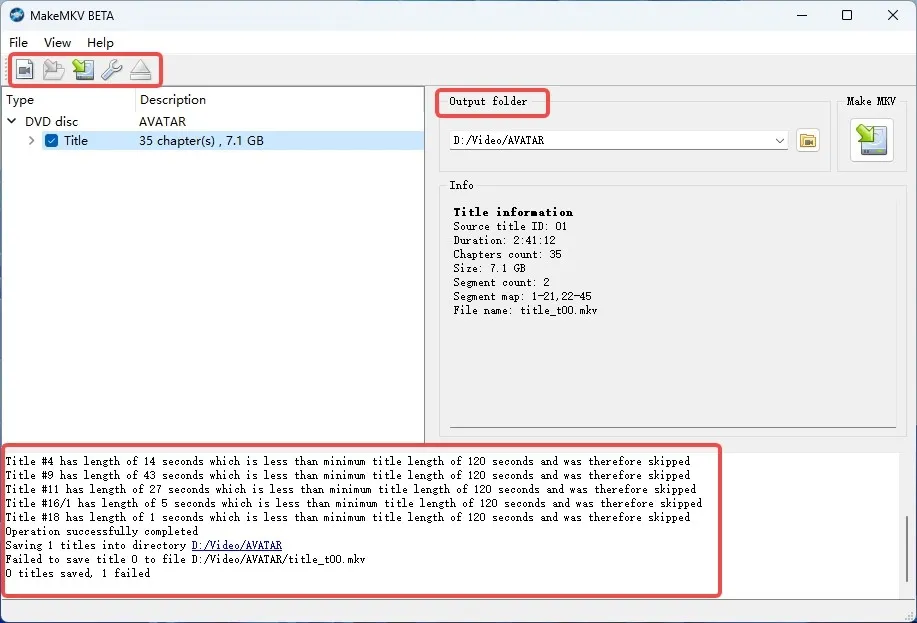
- Ignore the large "Save to MKV" button. Instead, click the "Backup" icon in the toolbar.
- In the backup window, check the box for "Decrypt video files." If you skip this, the resulting data will remain encrypted and unplayable.
- Set an output directory and click OK. This process copies the raw BDMV and CERTIFICATE folders to your drive.
Step 2: Build the ISO Image with ImgBurn
Now that you have the raw folders, you need to package them into an ISO that a player can recognize.
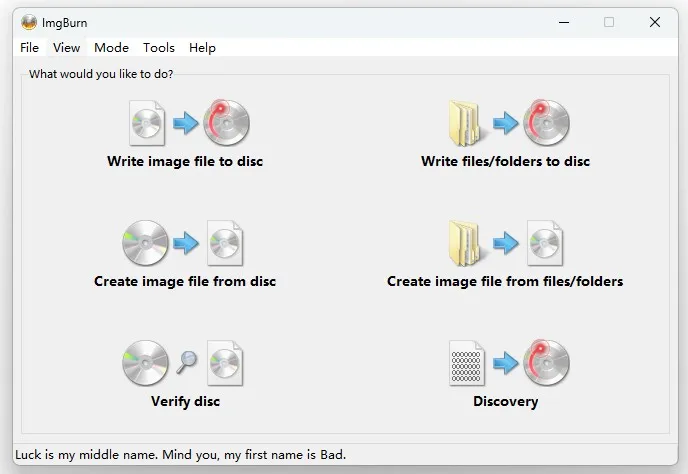
- Open ImgBurn and select "Create image file from files/folders."
- Click the "Folder" icon to browse and source the backup folder you created in Step 1.
- Click the Options tab on the right panel. Change the File System to UDF 2.50.
Note: Standard ISO9660 or UDF 1.02 will not work for Blu-ray. - Select a destination for your ISO file and click the large Build button.
Play and Mount Your Blu-ray ISO with Menus Intact
Ripping is only half the job. Once you have a 25–50 GB ISO sitting on your drive (BD25 discs land closer to 25 GB, BD50 discs closer to 50 GB — free up space accordingly), the next question is how to actually watch it with the menus you went to the trouble of preserving.
Mount the ISO on Windows 11
Windows 10 and 11 have a built-in virtual drive: right-click the ISO and choose Mount. The image shows up as a new drive letter, and any Blu-ray-aware player pointed at that drive will treat it like the original disc. To eject, right-click the mounted drive and choose Eject. On macOS, double-clicking the ISO mounts it in Finder the same way.
Which players actually show the menus?
This is where readers usually get burned. VLC will play the video streams inside the ISO, but it does not render full BD-J menus — you'll see the movie, not the animated menu the disc shipped with. For the full menu experience, use a menu-capable player such as CyberLink PowerDVD or Leawo Blu-ray Player. If the ISO came from a commercial disc, the player still has to be able to handle its decryption at playback time — a plain player pointed at a still-encrypted image will fail.
A note on media servers (Plex, Jellyfin, etc.)
Popular home-media servers do not play Blu-ray ISOs directly with menus. Plex, in particular, does not support ISO playback natively; the common workaround is to convert the ISO to MKV or MP4 for streaming and keep the ISO purely as an archive master. If streaming to a TV or phone is your real goal, ripping to MKV with DVDFab Blu-ray Ripper is a better fit than fighting the ISO through a server.
Best for keeping the ISO route: you want the disc experience — menus, extras, chapter structure — on a PC or Mac with a menu-capable player, and you're happy to convert a copy to MKV separately for the living-room server.
Frequently Asked Questions
Is ripping Blu-ray to ISO legal?
Laws regarding Blu-ray ripping and backup vary by country and region. In some places, making a personal backup may be permitted under limited conditions, while commercial use, redistribution, uploading, or sharing copied content is generally prohibited. Before ripping or backing up any Blu-ray disc, make sure you own the disc or have permission to use it, check your local copyright laws, and keep the copy strictly for personal, non-infringing use.
How to rip a Blu-ray to ISO for free?
There is no all-in-one free tool that decrypts and creates an ISO in a single pass. The most reliable free method is a two-step workaround: use MakeMKV to decrypt the disc to a BDMV folder, then use ImgBurn to build that folder into an ISO. Two caveats to keep in mind: ImgBurn is a legacy Windows-only tool (last updated in 2013), so Mac users cannot use it and are better served by a maintained cross-platform option; and you have to manually set the file system to UDF 2.50, or the resulting image will not read as Blu-ray.
Can I play ISO files directly on my computer?
Yes — mount the ISO with your OS's built-in virtual drive (right-click → Mount on Windows 10/11; double-click on macOS) or open it in a compatible player. Two gotchas: VLC plays the video but does not render full BD-J menus, and an ISO from a commercial disc still needs a player able to handle its decryption at playback. For streaming to a TV, convert a copy to MKV with DVDFab Blu-ray Ripper. See the "Play and Mount Your Blu-ray ISO" section above for player picks and the Plex caveat.
How long does it take to rip a Blu-ray to ISO?
The ripping time varies depending on disc size, optical drive speed, computer performance, and software settings. In our tests on Windows 11, using Buffalo BRUHD-PU3 external drive with GPU acceleration enabled, a 3-hour Blu-ray movie were ripped to an ISO in about 15 minutes with tools like DVDFab Blu-ray Copy. Using the MakeMKV + ImgBurn method took about 40 minutes.
Can MakeMKV create an ISO file directly?
No. As the name implies, MakeMKV is engineered to output MKV container files or decrypt disc data into a loose folder structure (BDMV) on your hard drive. It does not have a built-in ISO muxing engine.
If you use MakeMKV's Backup feature, you will end up with a folder containing .m2ts files. To turn that folder into a mountable ISO, you are forced to use a secondary tool to manually build the image file.
Can you rip a 4K UHD Blu-ray to ISO?
Yes, with the right combination of software and hardware. 4K UHD Blu-ray uses AACS 2.x, which is stricter than standard Blu-ray, and the ripping pass typically requires a compatible ("friendly") UHD-capable optical drive. DVDFab supports UHD ripping to ISO within that hardware scope — check the current drive compatibility list before you buy a drive specifically for this.
Conclusion
A good Blu-ray to ISO workflow keeps the disc's menus and structure intact instead of leaving you with a folder of .m2ts fragments. While the free MakeMKV method serves as a functional workaround for budget users, it lacks the ability to compress BD50 data or handle decryption in a single pass. For Mac users or those needing a streamlined 1:1 clone without quality loss, DVDFab Blu-ray Copy remains the most efficient, error-free solution.

![6 Best Blu-ray Copy Software for Windows & Mac [2026 Tested & Ranked]](https://r5.dvdfab.cn/upload/resource/top-blu-ray-copy-software-programs-yuzM.jpeg) 6 Best Blu-ray Copy Software for Windows & Mac [2026 Tested & Ranked]By Diana Smith - Sep 3, 2026
6 Best Blu-ray Copy Software for Windows & Mac [2026 Tested & Ranked]By Diana Smith - Sep 3, 2026![How to Copy Blu-ray Discs to Hard Drive, PC, and DVD [2026, Tested]](https://r5.dvdfab.cn/upload/resource/en/how-to-copy-blu-ray-discs-LDqW.jpg) How to Copy Blu-ray Discs to Hard Drive, PC, and DVD [2026, Tested]By Diana Smith - Jul 15, 2026
How to Copy Blu-ray Discs to Hard Drive, PC, and DVD [2026, Tested]By Diana Smith - Jul 15, 2026