How to Rip and Extract Hi-Fi Audio from Blu-rays? [2026 Update]

Summary: To rip audio from Blu-ray, you need a Blu-ray reader connected to your computer and software that can read the encrypted Blu-ray disc. The most direct method is to use a Blu-ray audio ripper such as DVDFab Blu-ray Ripper to choose the title, chapter range, and audio stream, then export the audio as FLAC, WAV, MP3, AAC, or another format. For Blu-ray Audio or concert discs, DVD Audio Extractor can also save the audio separately, while MakeMKV with MKVToolNix is better when you want to keep the original Blu-ray audio stream in an MKV first and extract it later.
Table of Contents
I often extract audio from Blu-ray movies and concert discs because I do not always want to load the disc just to hear the soundtrack, a live performance, or a favorite chapter again. Once the audio is saved as a separate file, I can play it on my phone, in the car, or on a media server without keeping the Blu-ray disc in the player.
Many people start by converting the disc to a video file first, but that is not always the most direct way to get the audio you want. In this guide, I will show you how to rip audio from Blu-ray discs, ISO files, and Blu-ray folders, how to choose the right output format such as FLAC, WAV or MP3, and what to check when you want to keep stereo or surround sound.

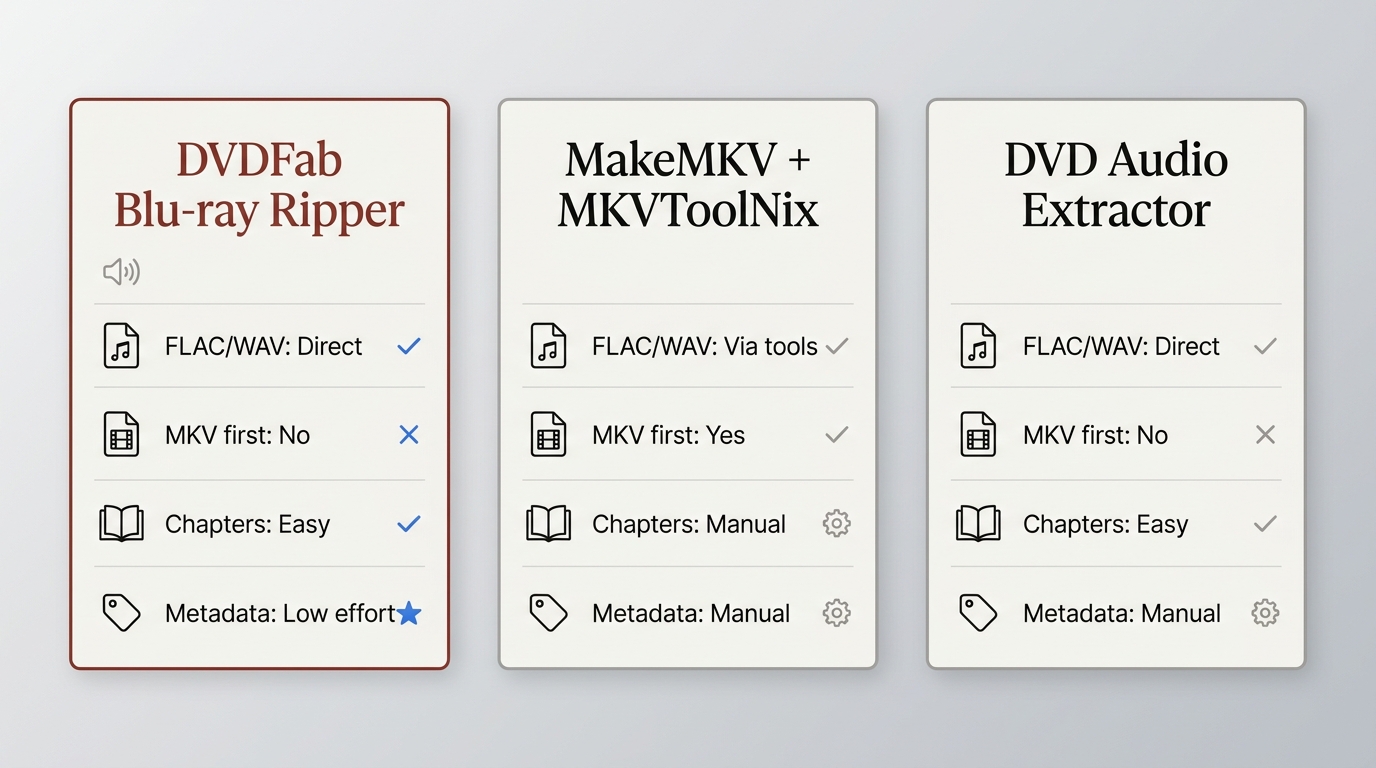
Before You Start: Choose the Right Blu-ray Audio Extractor
Before you rip Blu-ray audio, check what source you have and what output you need. This will help you choose the shortest method.
| Your Source | Recommended Tool | Use It For | Output You Can Expect |
| Protected Blu-ray disc, ISO image, or Blu-ray folder | DVDFab Blu-ray Ripper | Direct audio export from a Blu-ray source | FLAC, WAV, MP3, AAC, M4A, OGG, and other supported profiles |
| Homemade Blu-ray disc you want to save as MKV first | MakeMKV + MKVToolNix | Keeping original audio streams, chapters, and language information before extraction | MKV first, then extracted or converted audio |
| Blu-ray Audio disc, concert Blu-ray, or DVD-Audio disc | DVD Audio Extractor | Audio-first extraction with chapter selection | FLAC, WAV, MP3, OGG, or demuxed PCM, AC3, DTS, MLP, MPA streams |
Choose an Output Format and Check the Track
Keep a native TrueHD, DTS-HD, or LPCM stream when a compatible home-theater player can decode it. Choose multichannel FLAC when you want lossless surround sound in a smaller, tag-friendly music-library file, WAV when an editor needs uncompressed PCM, and MP3 or AAC when smaller portable files matter more than preserving the original stream.
- Before extraction: check the source codec, intended language, 2.0, 5.1, or 7.1 channel layout, chapter structure, and target player or editor.
- After extraction: confirm the codec, channel count, sample rate, duration, and audio sync with a media-information tool and a short playback check.
I have found that the highest-spec stream is not automatically the right choice when the playback device or editing app cannot decode it. FLAC is a balanced choice for many music libraries, WAV suits editing, native streams suit compatible home-theater playback, and MP3 or AAC prioritize portability.
How to Extract Blu-ray Audio with DVDFab Blu-ray Ripper?
DVDFab Blu-ray Ripper is a professional Blu-ray audio ripper that can extract audio from a Blu-ray disc, ISO image, or Blu-ray folder without first converting the whole movie to another video file. You can choose Hi-Fi Audio profiles for FLAC or WAV when you want to retain the lossless Dolby TrueHD or DTS-HD Master Audio quality, or switch to common audio formats such as MP3, AAC, M4A, and OGG when you need smaller files for everyday playback.
In my use, its main advantage is that the audio export settings are available before the ripping process starts, so I can choose the title, chapter range, and audio stream based on the disc content. This is especially helpful for concert discs and movie soundtracks, where I may only want one performance, one language mix, or separate files split by chapter instead of one long audio file. It also supports to load protected Blu-ray disc, so I can easily extract my favorite movie soundtracks and add them to my music library.
Step 1: Open DVDFab and Load Your Blu-ray Disc, ISO, or Folder
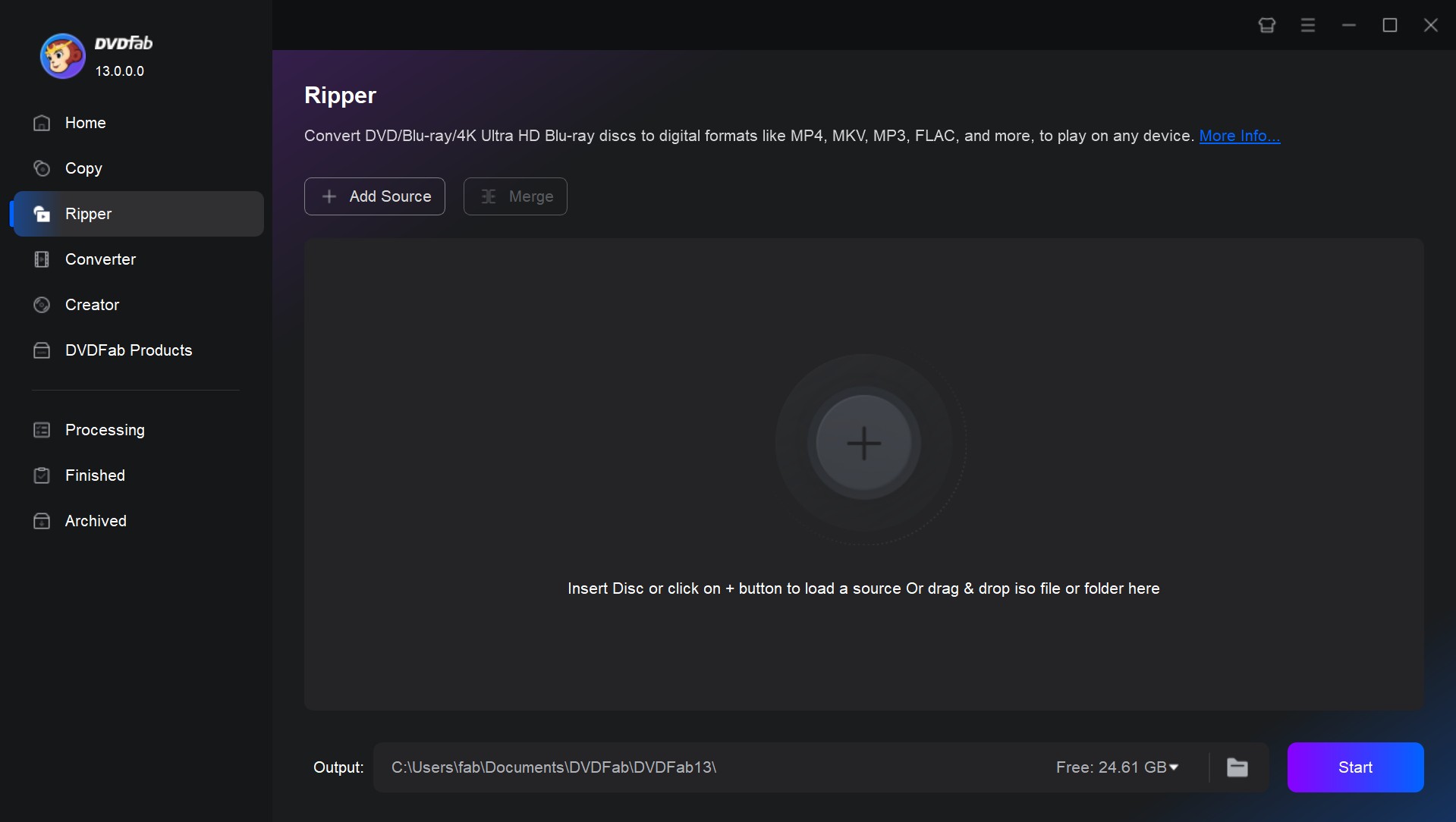
Download and install DVDFab 13. After that, run DVDFab and select Ripper from the menu.
Free Download Windows 11/10/8.1/8/7
Free Download macOS 12 and newer
Insert your Blu-ray into the optical drive, and DVDFab 13 will automatically load and decrypt the disc. If you're working with a Blu-ray ISO file or folder, click + or the +Add Source button to import them, or drag and drop the source anywhere in the main window.
Step 2: Choose a Hi-Fi Audio Profile
To choose the hi-fi output format, click Choose Other Profile > Format > Hi-Fi Audio.
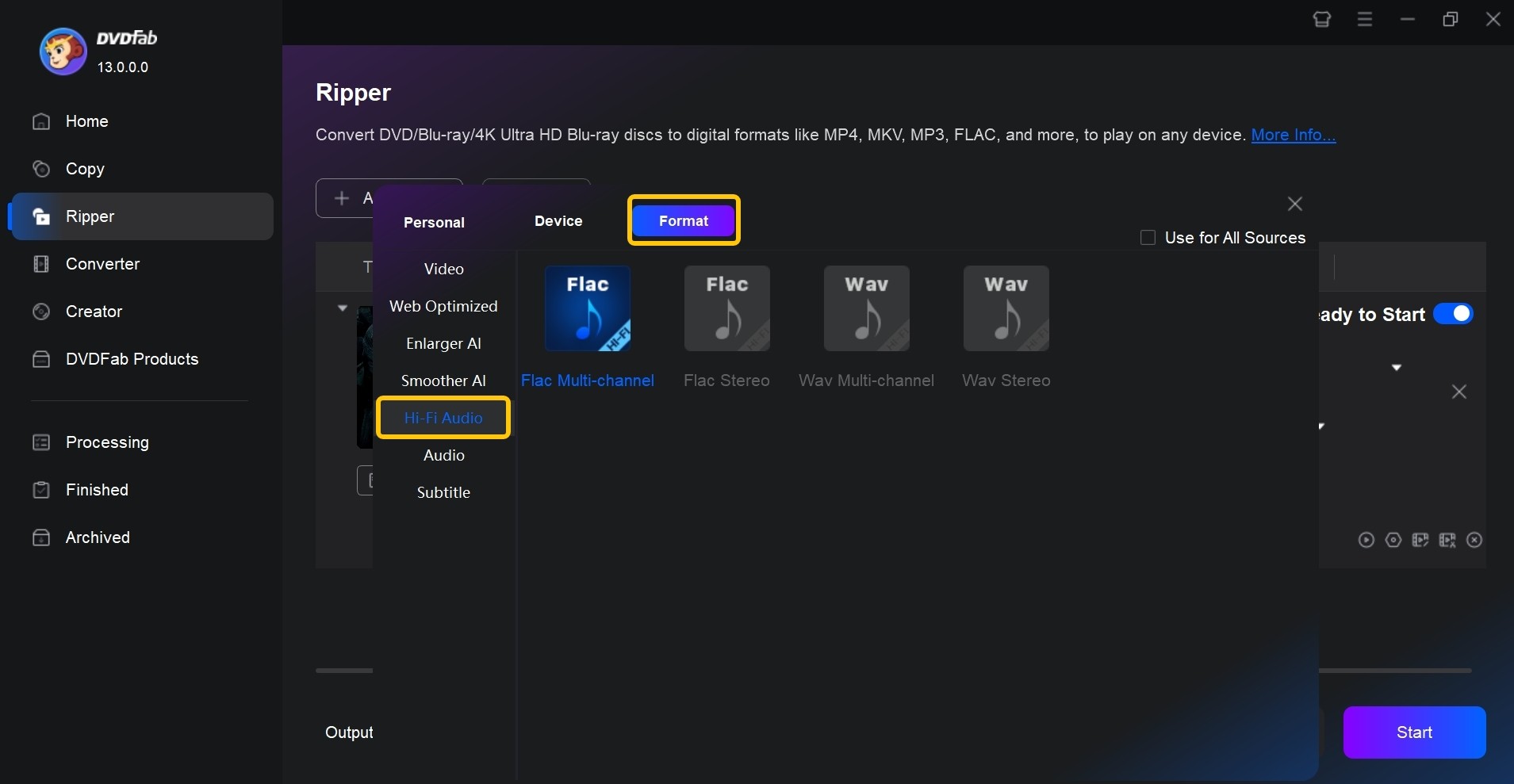
Here are four distinct conversion profiles: Flac Multi-channel, Flac Stereo, Wav Multi-channel, and Wav Stereo. To achieve the best possible quality, select the profile that best matches your sound system. If your system supports surround sound, you'll probably want to go with one of the multi-channel options.
- If you want a space-saving two-channel music library, choose FLAC Stereo.
- If you want true surround (5.1/7.1) while keeping file sizes smaller than WAV for home theater playback, choose FLAC Multi-channel.
- If you want maximum compatibility with pro tools or uncompressed PCM for editing in stereo, choose WAV Stereo.
- If you want uncompressed multichannel PCM for archival use and storage isn't a concern, choose WAV Multi-channel.
- If high-resolution audio isn't necessary, click Format > Audio. There are 16 audio options available, including MP3 and AAC. If you want to know which output format is most suitable, read Q2 in the FAQs of this article.
Step 3: Select the Title, Chapter Range, and Audio Stream
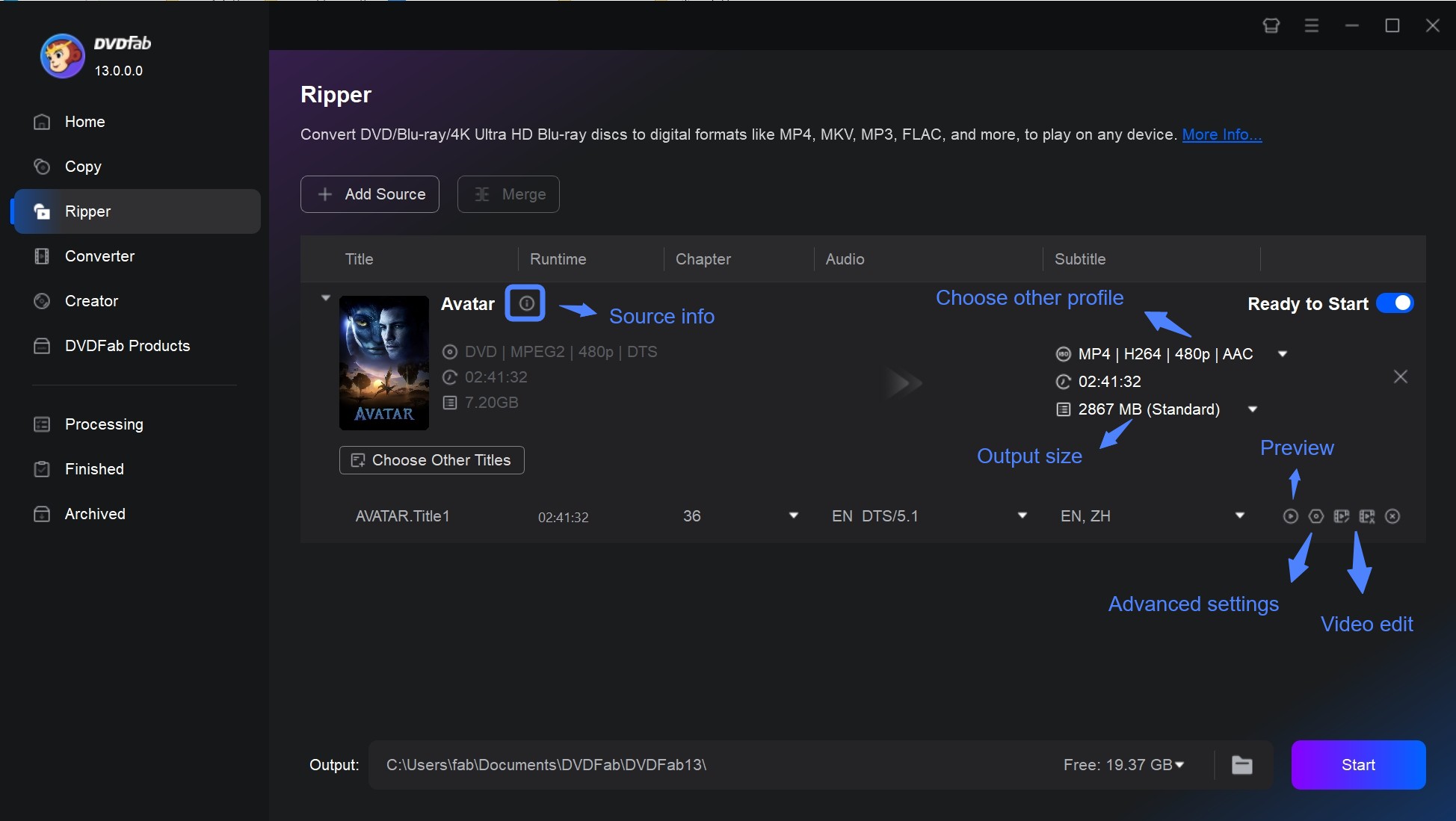
In the main interface, select the titles, chapters, audio tracks, and subtitles to keep in the output file. Check the title duration, intended language, and 2.0, 5.1, or 7.1 channel layout before exporting. For a concert or album, chapter selection often determines whether the result is separate tracks or one continuous file.
Step 4: Adjust Audio Settings
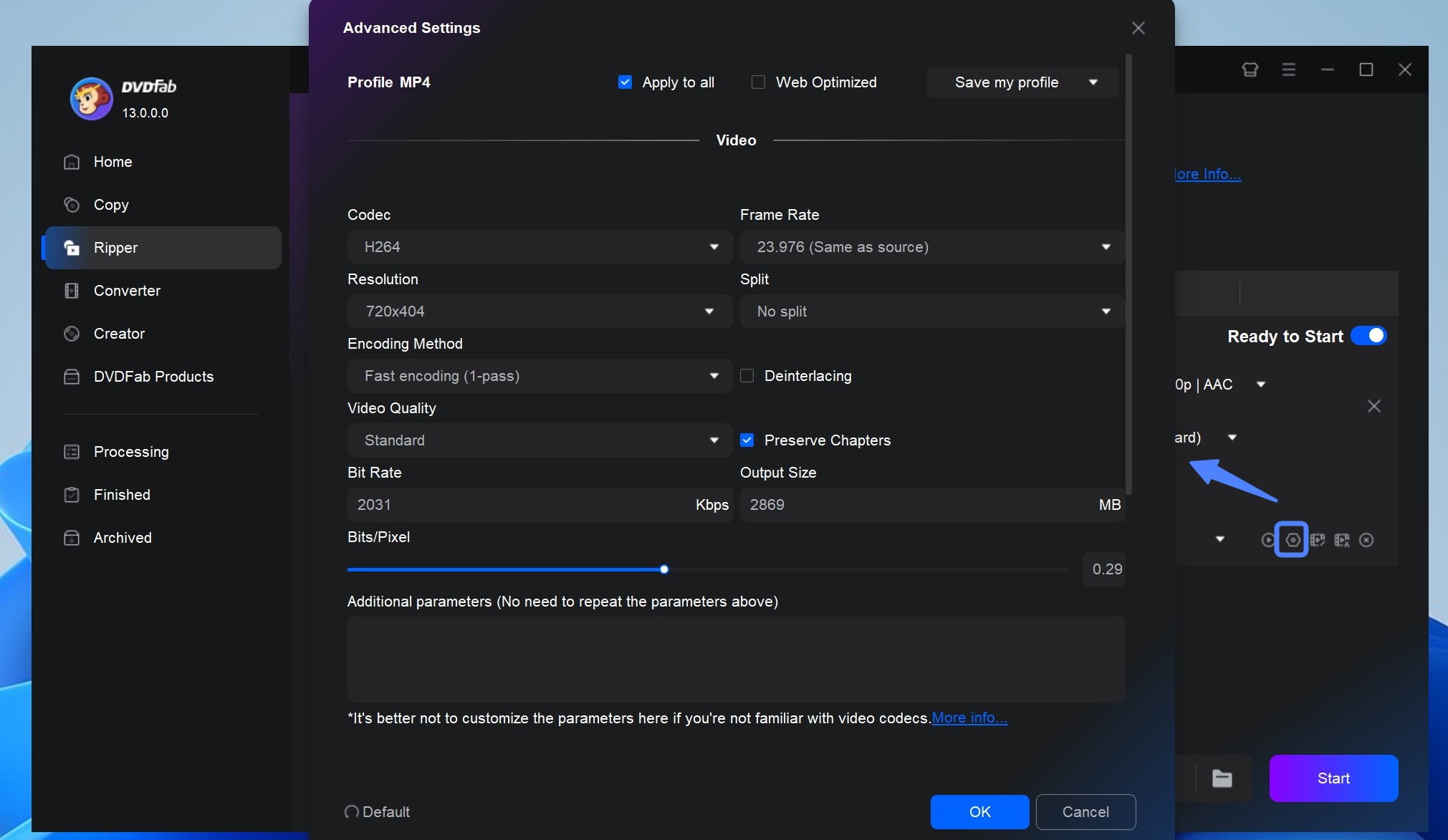
To customize the output audio, click Advanced Settings and adjust the sample-rate (up to 192 kHz High-Definition Output), channel, and volume controls. Some settings, including codec, bit rate, or bit depth, are tied to the selected profile and cannot be changed independently.
To split the Blu-ray by chapters, turn on the Split. If you leave the "No Split" option on, DVDFab Hi-Fi Audio Extractor exports the selected content as one album-length audio file.
Step 5: Start to Rip Blu-ray Audio with DVDFab Blu-ray Ripper
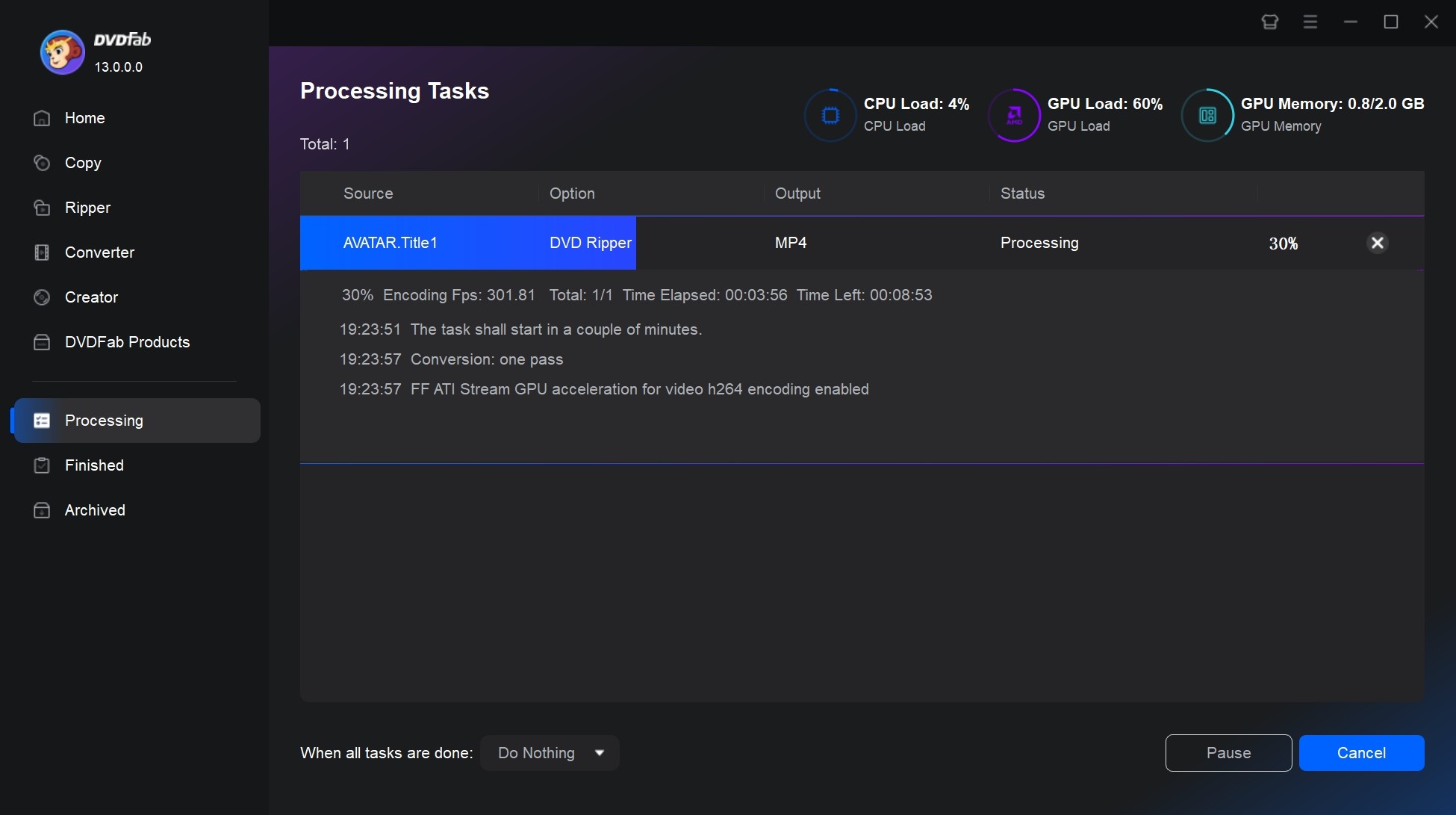
In the output box, choose a destination for your hi-fi audio files. After that, click the "Start" button to initiate the audio extraction from Blu-ray.
How to Extract Blu-ray Audio with MakeMKV and MKVToolNix
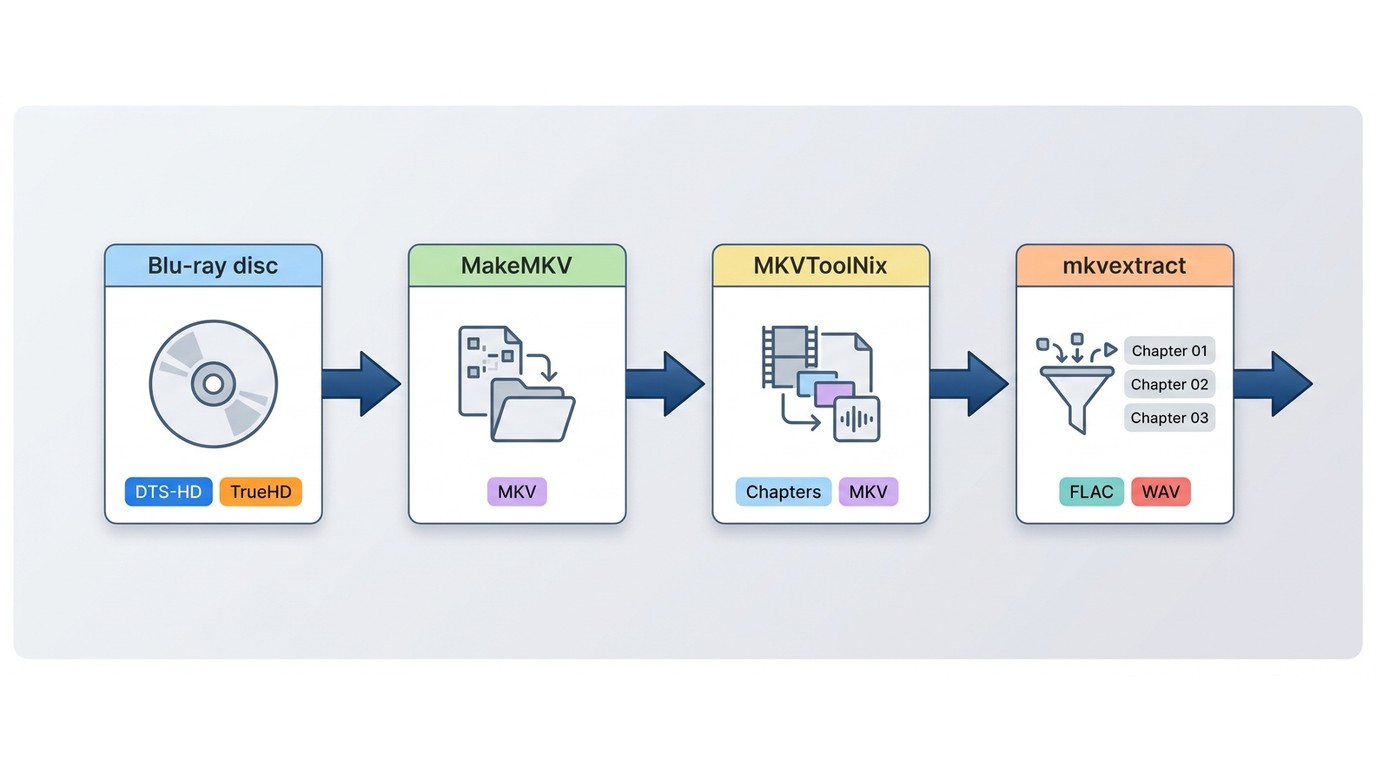
MakeMKV is useful when you want to create an MKV backup first and keep the selected Blu-ray audio stream, chapters, and available metadata together. It does not create a finished FLAC or WAV music file by itself, so extracting or converting the selected stream requires another application.
After you create a blu ray to MKV backup with MakeMKV, use MKVToolNix, mkvextract, DVD Audio Extractor, or FFmpeg to inspect, extract, or convert the selected DTS-HD Master Audio, Dolby TrueHD, AC3, DTS, or PCM stream. For a Blu-ray you are authorized to access, this process offers more control and lower software cost, but manual stream selection, conversion, and tagging add time. Also, you cannot process advanced protected Blu-ray discs with this method.
Step 1: Rip Blu-ray to MKV with MakeMKV
- Open MakeMKV and load the Blu-ray disc.
- Select the title that contains the movie, concert, or album program.
- Keep the audio stream you need. For surround sound, choose the HD audio stream when it is available.
- Save the selected title as an MKV file.
Step 2: Open the MKV in MKVToolNix
- Open MKVToolNix GUI and add the MKV file. As of August 2026, MKVToolNix 101.0 is actively maintained, while its macOS package and support conditions changed during 2026. macOS users should use the currently available official macOS package.
- Review the file items. You may see video, audio, subtitles, chapters, and attachments depending on the source.
- If you only want audio, keep the audio stream and chapter data, then remove items you do not need.
- Use chapter splitting if you want one file per song or chapter.
Step 3: Extract Blu-ray Audio from the MKV
MKVToolNix includes mkvextract, which can extract streams from Matroska files. Split by chapters when each chapter represents a song. Convert the extracted stream to FLAC or WAV only when the target player or editor needs a different codec, and use a tagger to add track titles, album data, track numbers, and cover art when disc metadata is incomplete. Metadata cleanup is often the hidden time cost of this lower-cost multi-tool process.
How to Rip Blu-ray Audio with DVD Audio Extractor
DVD Audio Extractor is mainly for extracting audio from discs, not converting a full Blu-ray movie. It can read Blu-ray, DVD-Audio, and DVD-Video sources, then export the audio as FLAC, WAV, MP3, OGG, or demuxed streams such as PCM, AC3, or DTS.
You can use this tool for a concert disc or Blu-ray Audio disc when the program can open the source and you want an audio file rather than a movie file. It suits supported systems and audio-first disc work, but it is not the right choice when the source cannot be opened or when you also need a full video backup.
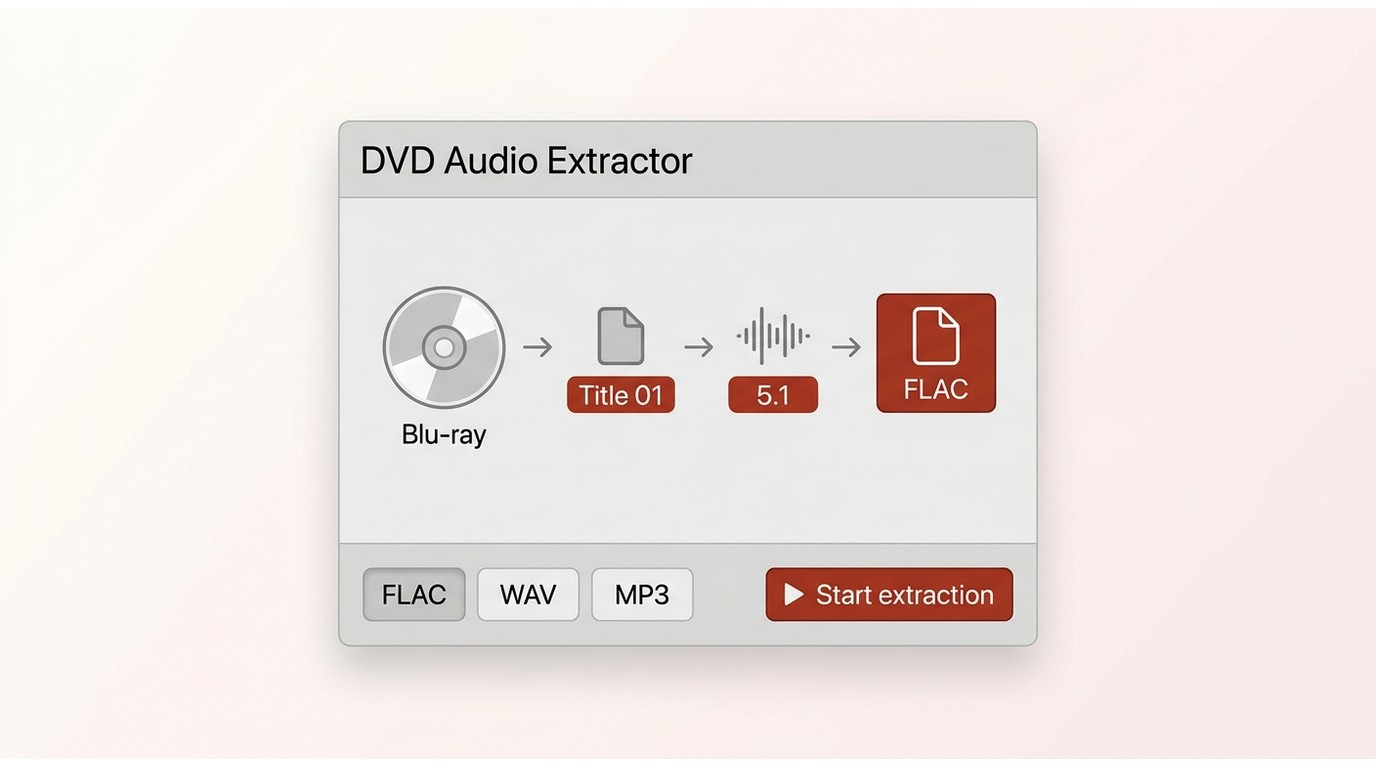
Here are the Steps to Extract Blu-ray Audio with DVD Audio Extractor:

- Install DVD Audio Extractor and open the program.
- Insert the Blu-ray disc, or load a Blu-ray folder if the program can read your source.
- Select the title that contains the music, concert, or movie audio you want.
- Choose the audio stream. For a movie disc, check the language and channel layout before exporting.
- Choose an output format. Use FLAC for a lossless music library, WAV for editing, MP3 or OGG for smaller files, or demux if you want to keep streams such as AC3 or DTS.
- Choose the output folder, then start the extraction.
Fix Common Blu-ray Audio Extraction Problems
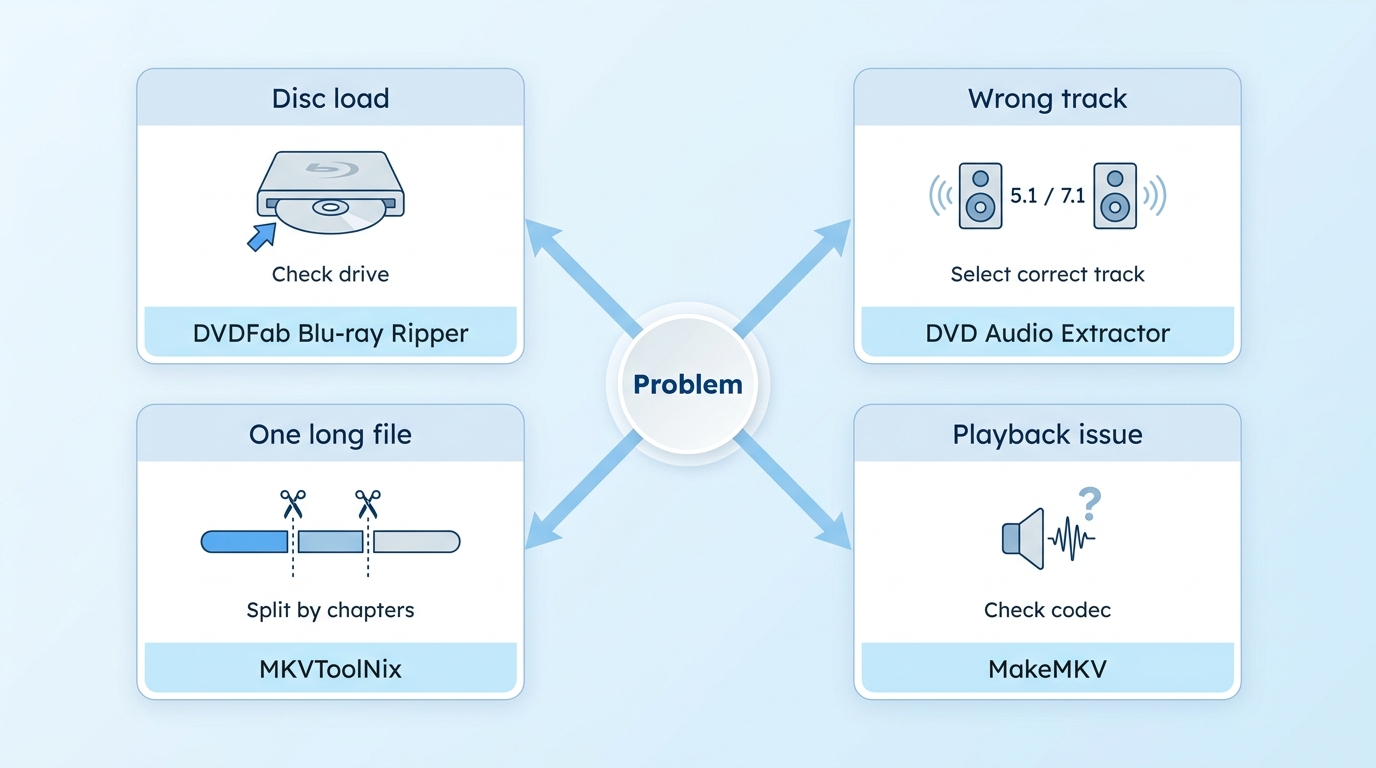
The disc or title will not load
Start with the drive and source rather than the output profile. Confirm that the disc loads in the drive, rescan the source, and compare title durations with the disc menu. If several similar titles appear, preview the opening and ending of the likely feature or concert program before exporting.
The wrong track or channel was exported
Check the language label, codec, and channel layout before starting again. A stereo commentary track can be selected by mistake when it sits next to the main 5.1 or 7.1 mix. The first check is the audio-stream list, followed by a short playback test of the exported file.
The album is one file or lacks tags
A single long file usually means chapter splitting was not enabled or the source has no usable chapter markers. Turn on chapter splitting when chapters match songs, then use a tagger to add track titles, album information, track numbers, and cover art when the disc metadata is incomplete.
Playback is silent or out of sync
Silent playback often points to an unsupported codec or channel layout. Try a player with the required decoder, use passthrough only with compatible home-theater equipment, or convert a copy for the destination device. If audio drifts out of sync, compare the exported duration with the source and test a different title or playlist before changing audio settings.
FAQs
Is ripping Blu-ray audio legal for personal use?
Use only Blu-ray discs you own or content you are authorized to access, keep the result for personal, noncommercial use, and follow the laws that apply where you live. Rules concerning copyright and disc-protection measures vary, so this is not a universal legal determination.
Can I rip just the audio from a DVD?
Yes. You can use a DVD audio extractor such as DVDFab DVD Ripper. The process is similar to ripping Blu-ray audio: load the DVD, select the title or chapter range, choose the audio track, and export it to an audio format. You can also read this guide on how to extract audio from DVDs.
What audio format should I choose when ripping Blu-ray audio?
There is no single right format for every Blu-ray audio rip. The better choice depends on whether you want a music library, an editing file, a smaller mobile copy, or the original home theater audio stream.
| Type | Format | Features | Use Cases |
| Lossy Compression | MP3 | Small file size and broad player support, but not lossless | Phones, car stereos, older players, and casual listening |
| AAC | Good quality at common bitrates and wide mobile device support | iPhone, iPad, Android devices, media apps, and portable playback | |
| WMA | Microsoft audio format mainly used in Windows environments | Windows Media Player and older Windows-based devices | |
| OGG | Open audio format with smaller files than WAV or FLAC | Players and apps that support OGG playback | |
| AC3 | Supports surround sound and is common on DVD and Blu-ray sources | AV receivers, home theater players, DVD, Blu-ray, and digital TV audio | |
| DTS | Surround sound format often used on Blu-ray and home theater discs | AV receivers and players that support DTS decoding | |
| Lossless Compression | FLAC | Lossless compression, metadata support, and smaller files than WAV | Music libraries, Blu-ray Audio discs, and players that support FLAC |
| Lossless Uncompressed | WAV | Uncompressed PCM audio with large file sizes | Audio editing, PCM playback, and software that works better with WAV |
Can I keep 5.1 or 7.1 sound when I extract audio from Blu-ray?
Yes, if the source contains 5.1 or 7.1 audio and you choose a multi-channel output profile. In DVDFab, use FLAC Multi-channel or WAV Multi-channel. After exporting, check the file with a player or media information tool to confirm the channel count.
What do I need to play Blu-ray audio?
To play Blu-ray audio from a disc, you need a Blu-ray player, an HDMI connection, and an audio device that supports the disc's audio format. For extracted audio files, the required setup depends on the format you choose.
- Blu-ray Player: Needed when playing the original Blu-ray disc. Many players can read Dolby TrueHD, DTS-HD Master Audio, and LPCM.
- Audio/Video Receiver (AVR): Needed if you want to decode and play surround formats such as Dolby TrueHD, DTS-HD Master Audio, AC3, or DTS through speakers.
- Speakers: Use stereo speakers for 2-channel audio, or a 5.1 / 7.1 speaker setup for multi-channel playback.
- HDMI Cable: Needed when sending Blu-ray video and audio from a player to an AVR or TV.
- Media Player: Needed when playing extracted FLAC, WAV, MP3, AAC, AC3, or DTS files on a computer, phone, media server, or home theater device.
If you do not want to use a Blu-ray player each time, you can extract audio from Blu-ray discs with DVDFab Blu-ray Ripper and play the exported files on supported devices.
Final Thoughts
Extracting audio from Blu-ray discs lets you keep concert performances, movie soundtracks, and album programs as separate files for the devices you actually use. Choose the direct exporter, DVDFab Blu-ray Ripper, when you want profile and chapter controls in one interface, or use the MakeMKV route when manual track work and metadata cleanup are acceptable. For discs you own or are authorized to access, keep the resulting files for personal, noncommercial use where permitted by applicable law.

 How to Rip Blu-ray to MKV on Windows & Mac: 4 Tested ConvertersBy Diana Smith - Sep 28, 2026
 How to Convert 3D Blu-ray to 2D Video: DVDFab 3D Converter GuideBy Diana Smith - Sep 16, 2026
 How to Convert BDMV to MKV/MP4 on Windows or macOS: 6 Tested ToolsBy Diana Smith - Aug 31, 2026
 How to Rip 3D Blu-ray to MVC, SBS or TAB for Quest 3, Projectors & PCBy Wenny Yan - Aug 26, 2026